
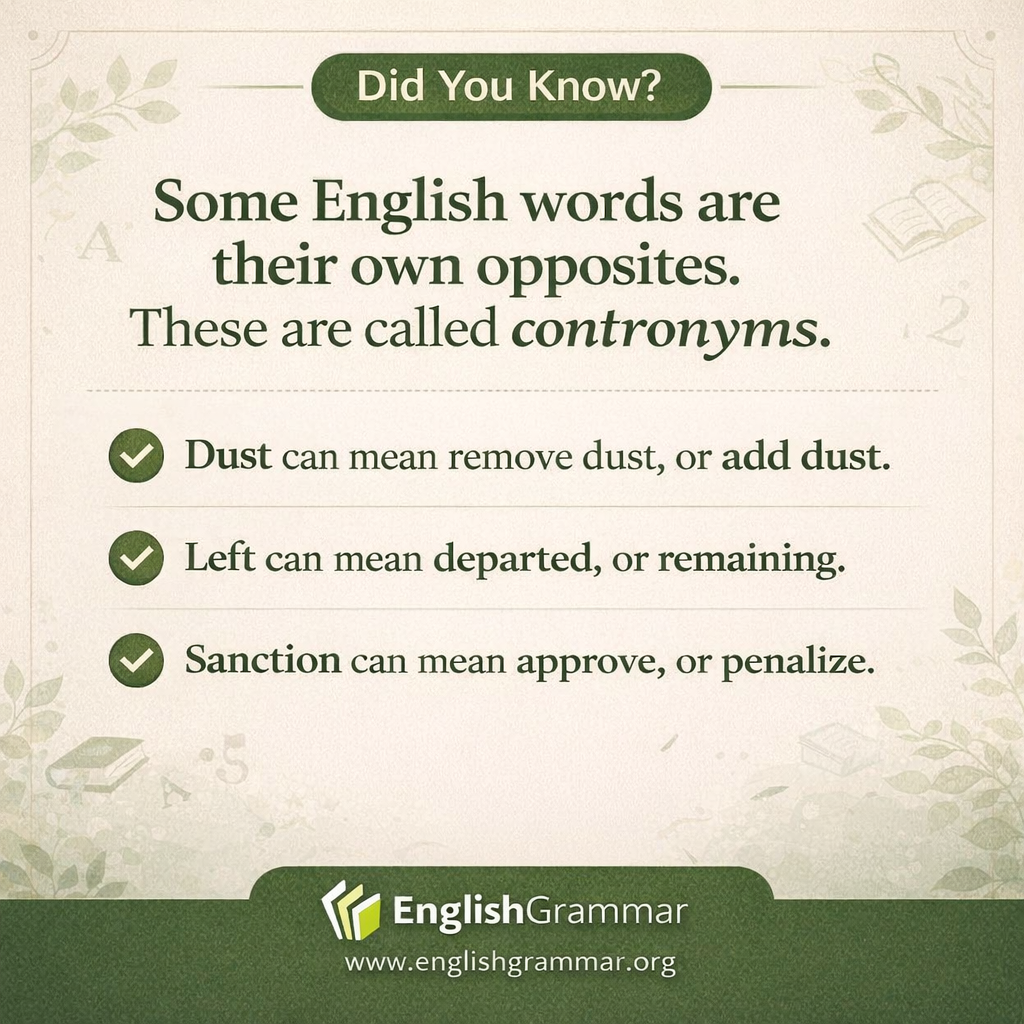
Some English words can mean one thing and also its opposite. These words are often called contronyms, or auto antonyms. The meaning depends on context, so the surrounding words tell you which sense is intended.
For example, dust can mean to remove fine powder, as in dust the shelves. But it can also mean to add a fine layer, as in dust the cake with sugar.
Left is another example. In She left early, it means departed. In Only two cookies are left, it means remaining.
Sanction can also point in opposite directions. It may mean official approval, as in The committee sanctioned the plan. It can also mean a penalty, as in The country faced trade sanctions.
- Contronyms are real and common in English.
- They are not random, context makes the meaning clear.
- Short example sentences are the best way to learn them.
When a word seems to contradict itself, check the sentence around it. In many cases, the grammar and topic will show which meaning is correct.
