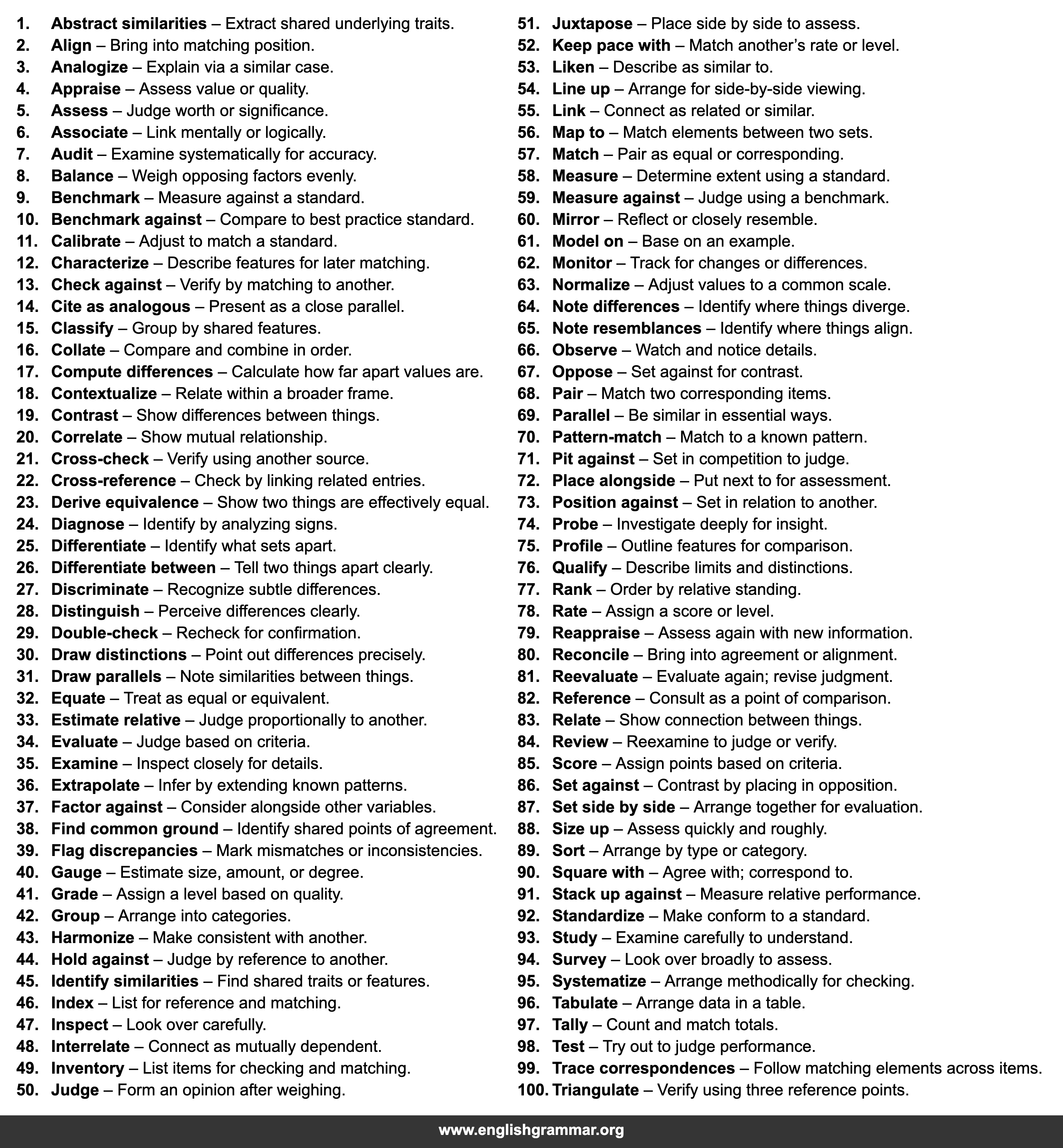
| No. | Term | Definition |
|---|---|---|
| 1. | Abstract similarities | Extract shared underlying traits. |
| 2. | Align | Bring into matching position. |
| 3. | Analogize | Explain via a similar case. |
| 4. | Appraise | Assess value or quality. |
| 5. | Assess | Judge worth or significance. |
| 6. | Associate | Link mentally or logically. |
| 7. | Audit | Examine systematically for accuracy. |
| 8. | Balance | Weigh opposing factors evenly. |
| 9. | Benchmark | Measure against a standard. |
| 10. | Benchmark against | Compare to best practice standard. |
| 11. | Calibrate | Adjust to match a standard. |
| 12. | Characterize | Describe features for later matching. |
| 13. | Check against | Verify by matching to another. |
| 14. | Cite as analogous | Present as a close parallel. |
| 15. | Classify | Group by shared features. |
| 16. | Collate | Compare and combine in order. |
| 17. | Compute differences | Calculate how far apart values are. |
| 18. | Contextualize | Relate within a broader frame. |
| 19. | Contrast | Show differences between things. |
| 20. | Correlate | Show mutual relationship. |
| 21. | Cross-check | Verify using another source. |
| 22. | Cross-reference | Check by linking related entries. |
| 23. | Derive equivalence | Show two things are effectively equal. |
| 24. | Diagnose | Identify by analyzing signs. |
| 25. | Differentiate | Identify what sets apart. |
| 26. | Differentiate between | Tell two things apart clearly. |
| 27. | Discriminate | Recognize subtle differences. |
| 28. | Distinguish | Perceive differences clearly. |
| 29. | Double-check | Recheck for confirmation. |
| 30. | Draw distinctions | Point out differences precisely. |
| 31. | Draw parallels | Note similarities between things. |
| 32. | Equate | Treat as equal or equivalent. |
| 33. | Estimate relative | Judge proportionally to another. |
| 34. | Evaluate | Judge based on criteria. |
| 35. | Examine | Inspect closely for details. |
| 36. | Extrapolate | Infer by extending known patterns. |
| 37. | Factor against | Consider alongside other variables. |
| 38. | Find common ground | Identify shared points of agreement. |
| 39. | Flag discrepancies | Mark mismatches or inconsistencies. |
| 40. | Gauge | Estimate size, amount, or degree. |
| 41. | Grade | Assign a level based on quality. |
| 42. | Group | Arrange into categories. |
| 43. | Harmonize | Make consistent with another. |
| 44. | Hold against | Judge by reference to another. |
| 45. | Identify similarities | Find shared traits or features. |
| 46. | Index | List for reference and matching. |
| 47. | Inspect | Look over carefully. |
| 48. | Interrelate | Connect as mutually dependent. |
| 49. | Inventory | List items for checking and matching. |
| 50. | Judge | Form an opinion after weighing. |
| 51. | Juxtapose | Place side by side to assess. |
| 52. | Keep pace with | Match another’s rate or level. |
| 53. | Liken | Describe as similar to. |
| 54. | Line up | Arrange for side-by-side viewing. |
| 55. | Link | Connect as related or similar. |
| 56. | Map to | Match elements between two sets. |
| 57. | Match | Pair as equal or corresponding. |
| 58. | Measure | Determine extent using a standard. |
| 59. | Measure against | Judge using a benchmark. |
| 60. | Mirror | Reflect or closely resemble. |
| 61. | Model on | Base on an example. |
| 62. | Monitor | Track for changes or differences. |
| 63. | Normalize | Adjust values to a common scale. |
| 64. | Note differences | Identify where things diverge. |
| 65. | Note resemblances | Identify where things align. |
| 66. | Observe | Watch and notice details. |
| 67. | Oppose | Set against for contrast. |
| 68. | Pair | Match two corresponding items. |
| 69. | Parallel | Be similar in essential ways. |
| 70. | Pattern-match | Match to a known pattern. |
| 71. | Pit against | Set in competition to judge. |
| 72. | Place alongside | Put next to for assessment. |
| 73. | Position against | Set in relation to another. |
| 74. | Probe | Investigate deeply for insight. |
| 75. | Profile | Outline features for comparison. |
| 76. | Qualify | Describe limits and distinctions. |
| 77. | Rank | Order by relative standing. |
| 78. | Rate | Assign a score or level. |
| 79. | Reappraise | Assess again with new information. |
| 80. | Reconcile | Bring into agreement or alignment. |
| 81. | Reevaluate | Evaluate again; revise judgment. |
| 82. | Reference | Consult as a point of comparison. |
| 83. | Relate | Show connection between things. |
| 84. | Review | Reexamine to judge or verify. |
| 85. | Score | Assign points based on criteria. |
| 86. | Set against | Contrast by placing in opposition. |
| 87. | Set side by side | Arrange together for evaluation. |
| 88. | Size up | Assess quickly and roughly. |
| 89. | Sort | Arrange by type or category. |
| 90. | Square with | Agree with; correspond to. |
| 91. | Stack up against | Measure relative performance. |
| 92. | Standardize | Make conform to a standard. |
| 93. | Study | Examine carefully to understand. |
| 94. | Survey | Look over broadly to assess. |
| 95. | Systematize | Arrange methodically for checking. |
| 96. | Tabulate | Arrange data in a table. |
| 97. | Tally | Count and match totals. |
| 98. | Test | Try out to judge performance. |
| 99. | Trace correspondences | Follow matching elements across items. |
| 100. | Triangulate | Verify using three reference points. |
