
• Skip to primary navigation
  • Skip to main content
  • Skip to primary sidebar
Home of English Grammar
  • Home
  • Course
  • Exercises
  • Grammar Rules
  • Matches
  • Posts
  • Tools
    • Grammar Checker
    • Very Replacer
    • Word Counter
  • Vocabulary Lists
  • Archives
    • Social Media Posts
    • Writing Guides
  • Join free

Pal vs. buddy vs. mate vs. friend vs. companion vs. confidant(e)

October 18, 2026

Pal vs. Buddy vs. Mate vs. Friend vs. Companion vs. Confidant(e)

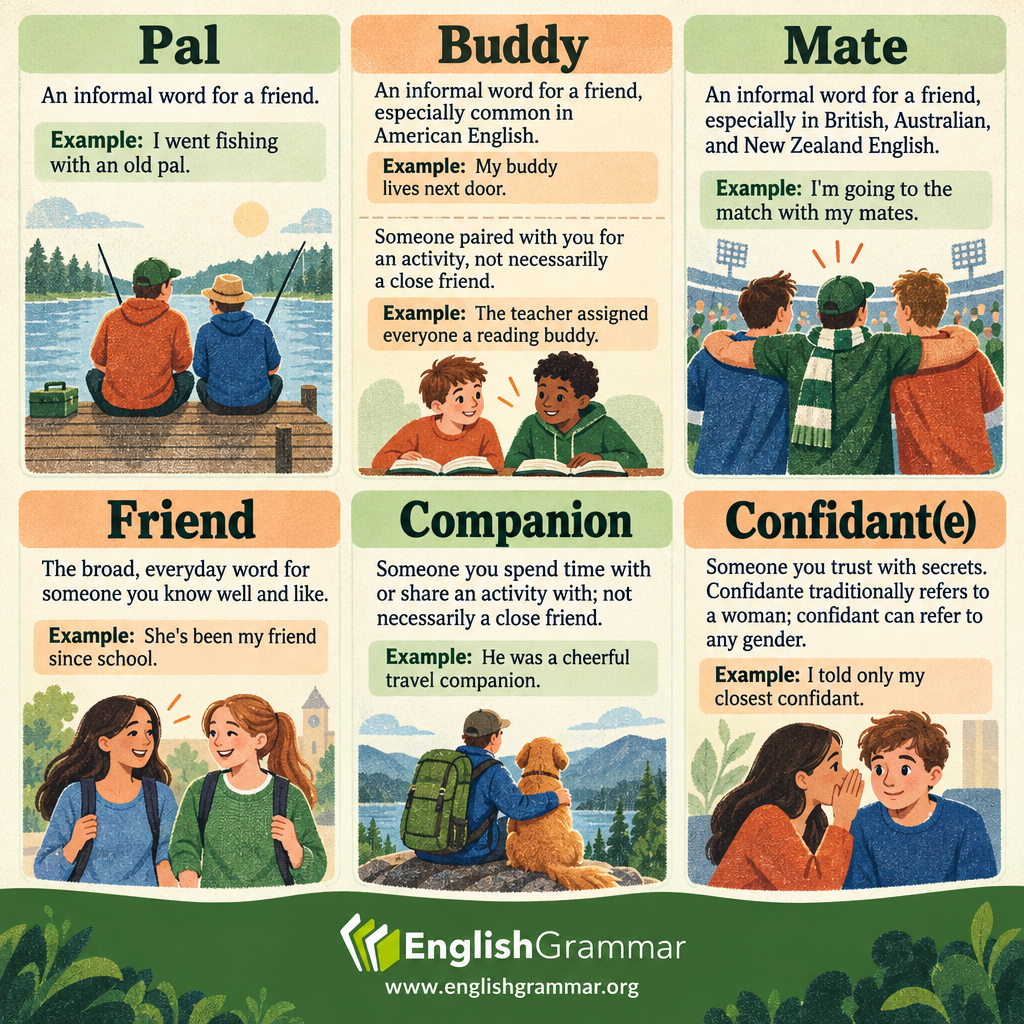
These six words describe relationships, but they are not always interchangeable. Choose according to tone, region, and what you want to emphasize.

  • Friend is the broad, everyday choice for someone you know well and like. It works in both casual and more formal contexts: Leah is a friend from university. It does not automatically mean someone knows your secrets.
  • Pal is an informal word for a friend: I had lunch with an old pal. It sounds familiar rather than formal.
  • Buddy is also informal and is especially common in American English: My buddy helped me move. It can also describe someone paired with you for an activity: Each swimmer needs a buddy. That person need not be a close friend.
  • Mate, meaning a friend, is informal and especially common in British, Australian, and New Zealand English: I’m meeting my mates after work. This use is less typical in American English.
  • Companion emphasizes spending time together or sharing an activity, rather than emotional closeness: Ravi was my companion on the walking tour. A companion may also be a friend.
  • Confidant emphasizes trust with private thoughts or secrets: Her sister became her closest confidant. Confidante is a spelling traditionally used for a woman; confidant can refer to any gender.

The same person can fit several descriptions. A casual friendship, shared company, and deep trust simply highlight different things about a relationship.

Improve your English grammar, vocabulary and writing

We take you step by step from beginner to advanced, even if you struggled with English at school or have always had trouble remembering the rules.

  • 10 modules, 105 lessons and 688 questions
  • Just log in and learn anytime and anywhere
  • Your progress is saved in your account
  • Download the 2026 Grammar Guide (PDF)
Join free

Already have an account? Sign in

See what’s in the course

Primary Sidebar

2.4M761.4K165.8K

Free 2026 Grammar Guide

  • Download Grammar Guide (PDF)
  • Online grammar course, A1 to C2
  • Weekly exercises and vocabulary
  • Join over 3 million English learners

We respect your privacy. Unsubscribe anytime.

Already have an account? Sign in

Grammar Checker - Try Now

Latest Posts

  • Pal vs. buddy vs. mate vs. friend vs. companion vs. confidant(e) October 18, 2026
  • 100 Best Synonyms for “Powerless” October 18, 2026
  • Research Translation Language Exercise October 18, 2026
  • Delusion vs. illusion: How to choose the right word October 18, 2026
  • 100 Best Synonyms for “Unresponsive” October 18, 2026
  • 100 Best Synonyms for “Rooted” October 18, 2026
  • The origin of “not a sausage” October 18, 2026
  • 100 Best Synonyms for “Consideration” October 18, 2026
  • 100 Best Synonyms for “Potency” October 18, 2026
  • 100 Best Synonyms for “Romantic” October 17, 2026
Home of English Grammar

Free English grammar exercises, rules and vocabulary lists, with new exercises every week. Join the leading English grammar site with over 3 million followers.

Join free

Learn

  • Exercises
  • Matches
  • Grammar rules
  • Vocabulary lists
  • Writing guides
  • Online tools

More

  • Top social media posts
  • Various posts
  • Contact

Account

  • Join free
  • Grammar Course
  • Free grammar guide (PDF)

Copyright © 2026 EnglishGrammar.org

  • Disclaimer
  • Privacy policy
  • Terms
  • Sitemap