
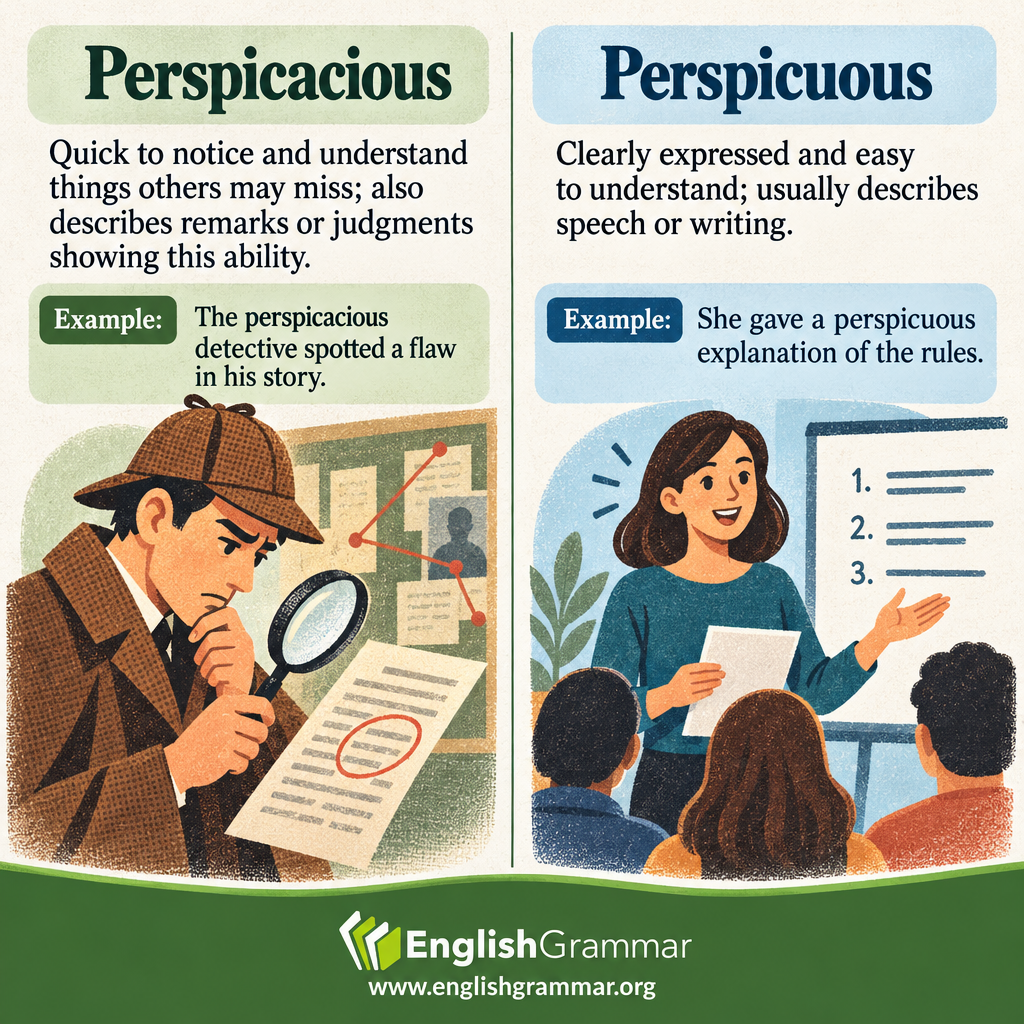
Perspicacious and perspicuous look similar, but they praise different qualities: sharp understanding and clear expression. Both are formal adjectives, so you are more likely to encounter them in reviews, essays, or professional writing than in everyday conversation.
Perspicacious means good at noticing and understanding things that others might miss. It often describes a person, but it can also describe a remark, observation, or judgment that shows this ability.
- The perspicacious interviewer noticed that the candidate had avoided the question.
- Her perspicacious comments revealed a weakness in our plan.
Choose this word when the important quality is insight: someone sees what matters or understands a situation especially well. In everyday English, perceptive is often a more familiar alternative.
Perspicuous means clearly expressed and easy to understand. It usually describes communication, such as an explanation, argument, or piece of writing.
- The report gives a perspicuous account of how the system works.
- His perspicuous explanation helped the class understand the problem.
Choose this word when the important quality is clarity: the audience can easily follow what is being said. In everyday English, clear is usually more natural.
The qualities can occur together, but neither guarantees the other. A reviewer might make a perspicacious observation yet express it confusingly. A perspicuous summary might be easy to follow without offering any new insight. Ask whether you are praising the understanding behind the message or the way the message is expressed.