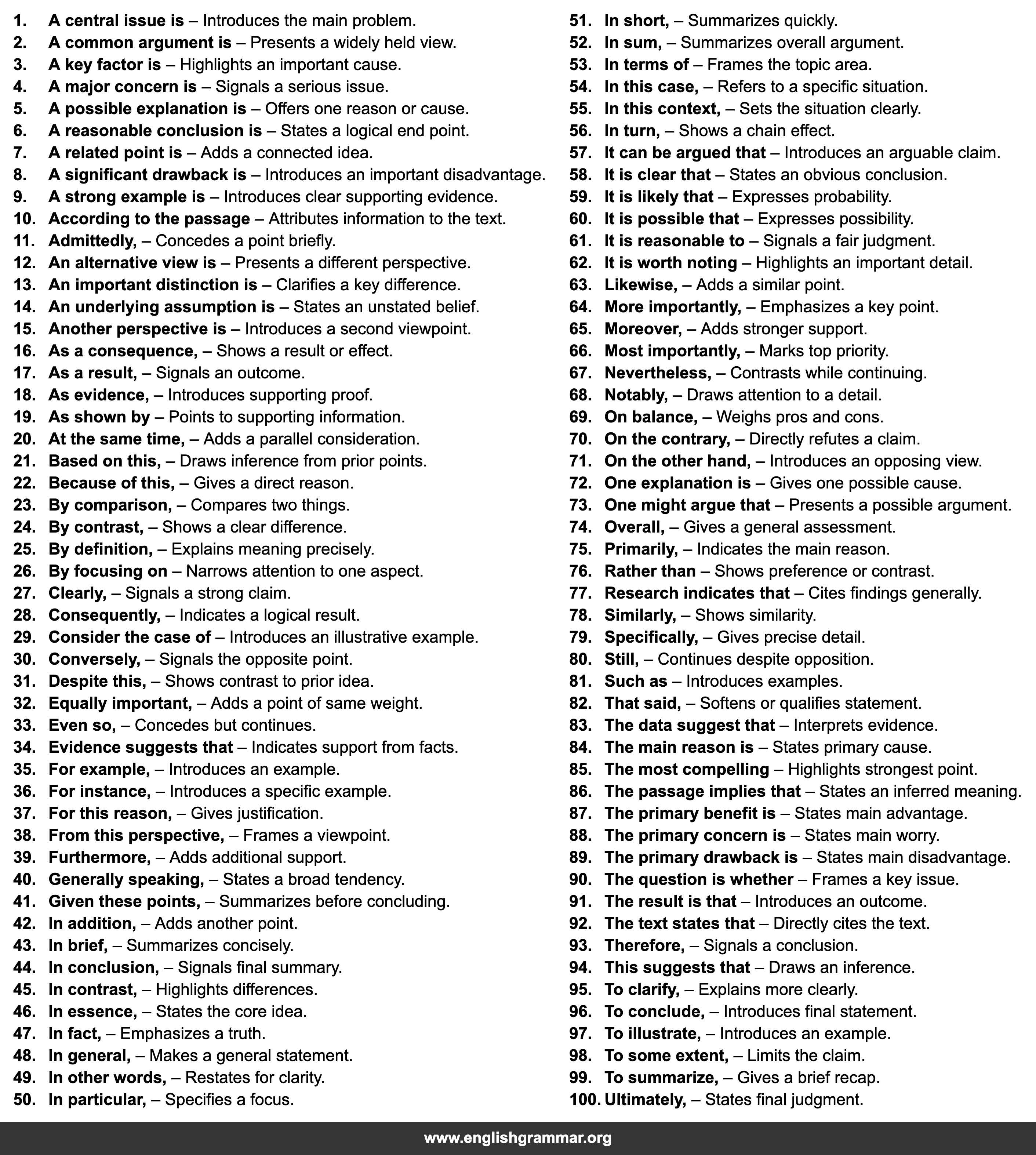
| No. | Term | Definition |
|---|---|---|
| 1. | A central issue is | Introduces the main problem. |
| 2. | A common argument is | Presents a widely held view. |
| 3. | A key factor is | Highlights an important cause. |
| 4. | A major concern is | Signals a serious issue. |
| 5. | A possible explanation is | Offers one reason or cause. |
| 6. | A reasonable conclusion is | States a logical end point. |
| 7. | A related point is | Adds a connected idea. |
| 8. | A significant drawback is | Introduces an important disadvantage. |
| 9. | A strong example is | Introduces clear supporting evidence. |
| 10. | According to the passage | Attributes information to the text. |
| 11. | Admittedly, | Concedes a point briefly. |
| 12. | An alternative view is | Presents a different perspective. |
| 13. | An important distinction is | Clarifies a key difference. |
| 14. | An underlying assumption is | States an unstated belief. |
| 15. | Another perspective is | Introduces a second viewpoint. |
| 16. | As a consequence, | Shows a result or effect. |
| 17. | As a result, | Signals an outcome. |
| 18. | As evidence, | Introduces supporting proof. |
| 19. | As shown by | Points to supporting information. |
| 20. | At the same time, | Adds a parallel consideration. |
| 21. | Based on this, | Draws inference from prior points. |
| 22. | Because of this, | Gives a direct reason. |
| 23. | By comparison, | Compares two things. |
| 24. | By contrast, | Shows a clear difference. |
| 25. | By definition, | Explains meaning precisely. |
| 26. | By focusing on | Narrows attention to one aspect. |
| 27. | Clearly, | Signals a strong claim. |
| 28. | Consequently, | Indicates a logical result. |
| 29. | Consider the case of | Introduces an illustrative example. |
| 30. | Conversely, | Signals the opposite point. |
| 31. | Despite this, | Shows contrast to prior idea. |
| 32. | Equally important, | Adds a point of same weight. |
| 33. | Even so, | Concedes but continues. |
| 34. | Evidence suggests that | Indicates support from facts. |
| 35. | For example, | Introduces an example. |
| 36. | For instance, | Introduces a specific example. |
| 37. | For this reason, | Gives justification. |
| 38. | From this perspective, | Frames a viewpoint. |
| 39. | Furthermore, | Adds additional support. |
| 40. | Generally speaking, | States a broad tendency. |
| 41. | Given these points, | Summarizes before concluding. |
| 42. | In addition, | Adds another point. |
| 43. | In brief, | Summarizes concisely. |
| 44. | In conclusion, | Signals final summary. |
| 45. | In contrast, | Highlights differences. |
| 46. | In essence, | States the core idea. |
| 47. | In fact, | Emphasizes a truth. |
| 48. | In general, | Makes a general statement. |
| 49. | In other words, | Restates for clarity. |
| 50. | In particular, | Specifies a focus. |
| 51. | In short, | Summarizes quickly. |
| 52. | In sum, | Summarizes overall argument. |
| 53. | In terms of | Frames the topic area. |
| 54. | In this case, | Refers to a specific situation. |
| 55. | In this context, | Sets the situation clearly. |
| 56. | In turn, | Shows a chain effect. |
| 57. | It can be argued that | Introduces an arguable claim. |
| 58. | It is clear that | States an obvious conclusion. |
| 59. | It is likely that | Expresses probability. |
| 60. | It is possible that | Expresses possibility. |
| 61. | It is reasonable to | Signals a fair judgment. |
| 62. | It is worth noting | Highlights an important detail. |
| 63. | Likewise, | Adds a similar point. |
| 64. | More importantly, | Emphasizes a key point. |
| 65. | Moreover, | Adds stronger support. |
| 66. | Most importantly, | Marks top priority. |
| 67. | Nevertheless, | Contrasts while continuing. |
| 68. | Notably, | Draws attention to a detail. |
| 69. | On balance, | Weighs pros and cons. |
| 70. | On the contrary, | Directly refutes a claim. |
| 71. | On the other hand, | Introduces an opposing view. |
| 72. | One explanation is | Gives one possible cause. |
| 73. | One might argue that | Presents a possible argument. |
| 74. | Overall, | Gives a general assessment. |
| 75. | Primarily, | Indicates the main reason. |
| 76. | Rather than | Shows preference or contrast. |
| 77. | Research indicates that | Cites findings generally. |
| 78. | Similarly, | Shows similarity. |
| 79. | Specifically, | Gives precise detail. |
| 80. | Still, | Continues despite opposition. |
| 81. | Such as | Introduces examples. |
| 82. | That said, | Softens or qualifies statement. |
| 83. | The data suggest that | Interprets evidence. |
| 84. | The main reason is | States primary cause. |
| 85. | The most compelling | Highlights strongest point. |
| 86. | The passage implies that | States an inferred meaning. |
| 87. | The primary benefit is | States main advantage. |
| 88. | The primary concern is | States main worry. |
| 89. | The primary drawback is | States main disadvantage. |
| 90. | The question is whether | Frames a key issue. |
| 91. | The result is that | Introduces an outcome. |
| 92. | The text states that | Directly cites the text. |
| 93. | Therefore, | Signals a conclusion. |
| 94. | This suggests that | Draws an inference. |
| 95. | To clarify, | Explains more clearly. |
| 96. | To conclude, | Introduces final statement. |
| 97. | To illustrate, | Introduces an example. |
| 98. | To some extent, | Limits the claim. |
| 99. | To summarize, | Gives a brief recap. |
| 100. | Ultimately, | States final judgment. |
