
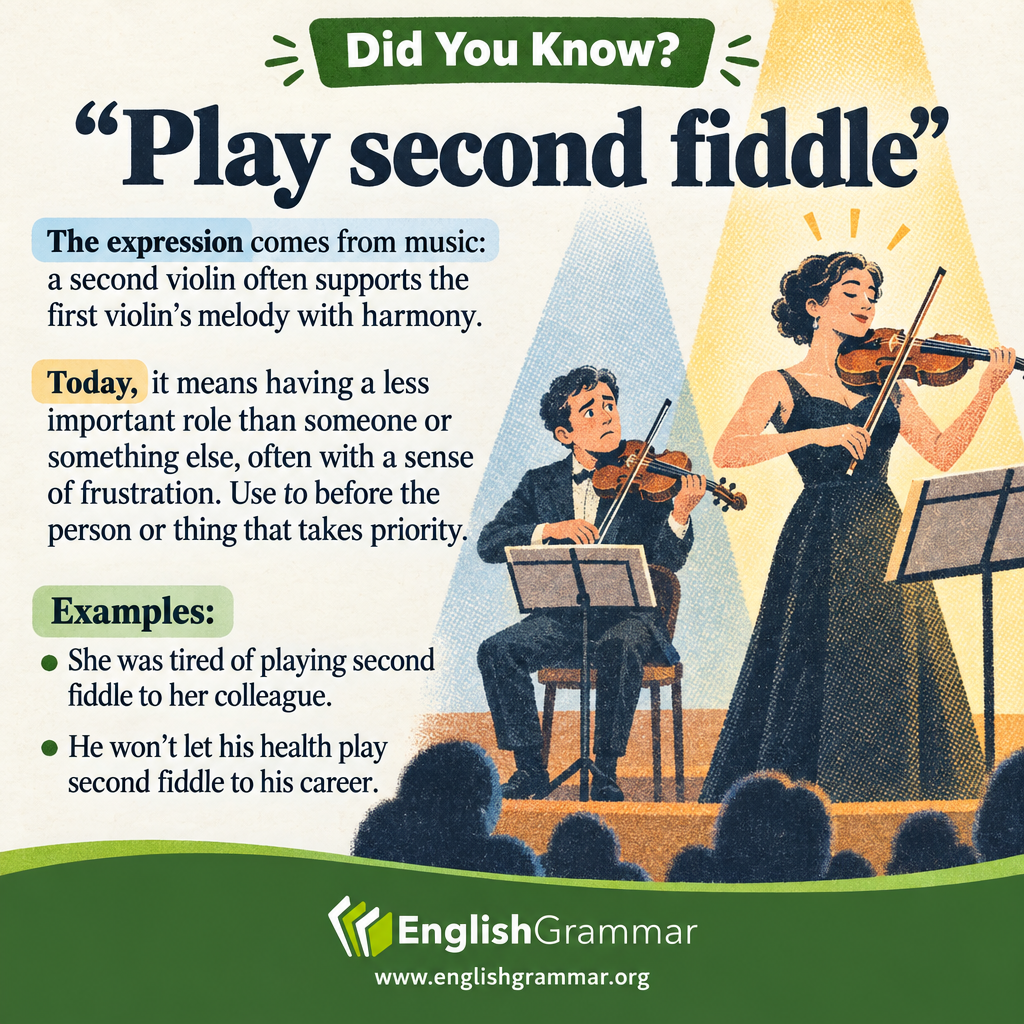
The expression comes from music. A fiddle is a violin, and in music written for first and second violins, the first violin often carries the main melody while the second provides harmony or support. Both parts matter, but their different roles gave English a way to describe someone taking a less prominent position.
Today, the idiom means to have a less important or less powerful role than someone or something else. It can describe work, relationships, sport, or competing priorities. It often suggests frustration: the person would prefer more attention, influence, or recognition.
- After years of playing second fiddle to her business partner, Lena started her own company. Lena felt that her partner had the more important role.
- Our local team has played second fiddle to its city rivals for several seasons. The rival team has been more successful or prominent.
- He refuses to let family time play second fiddle to work. He does not want work to receive more attention than his family.
The usual pattern is play second fiddle to someone or something. The word to introduces the person or thing with the leading role or higher priority.
The musical background also helps explain a useful distinction: a supporting role is not necessarily a bad or unskilled one. In everyday speech, however, the idiom often carries dissatisfaction with being treated as less important.