
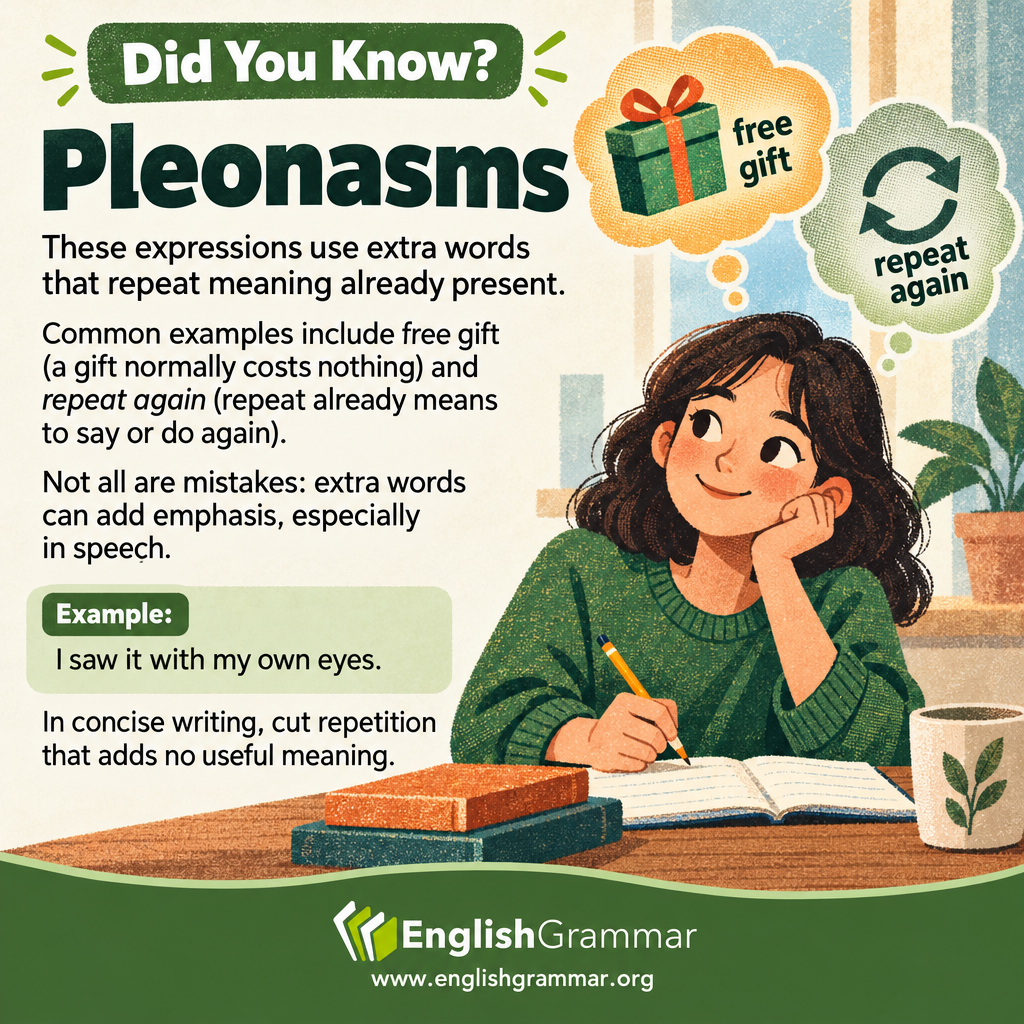
A pleonasm is an expression that uses more words than are needed to convey its basic meaning. Some words repeat information that other words already provide. This can make writing unnecessarily long, but it is not automatically a mistake.
Consider these familiar expressions:
- Free gift: a gift normally costs the receiver nothing, so free often repeats part of its meaning.
- Repeat again: repeat already means to say or do something again. However, again can be useful if the speaker means another repetition after an earlier one.
For example, “Please repeat the question” is usually enough when you want to hear a question a second time. If someone has already repeated it, “Please repeat it again” can make the request for another repetition clearer.
Extra words can also add emphasis. In “I heard it with my own ears,” the final phrase stresses that the speaker heard something directly, rather than learning about it from someone else. Removing those words keeps the basic statement but loses some of its force.
In instructions, reports, and other concise writing, look for repetition that does not help the reader. In conversation, dialogue, or storytelling, some repetition can sound natural and expressive.
The useful editing question is not simply “Can I delete this word?” Ask whether deleting it would remove helpful emphasis, clarity, or a meaningful distinction.