
• Skip to primary navigation
  • Skip to main content
  • Skip to primary sidebar
Home of English Grammar
  • Home
  • Course
  • Exercises
  • Grammar Rules
  • Matches
  • Posts
  • Tools
    • Grammar Checker
    • Very Replacer
    • Word Counter
  • Vocabulary Lists
  • Archives
    • Social Media Posts
    • Writing Guides
  • Join free

Possible, feasible, viable, plausible, probable and inevitable: What’s the difference?

October 21, 2026

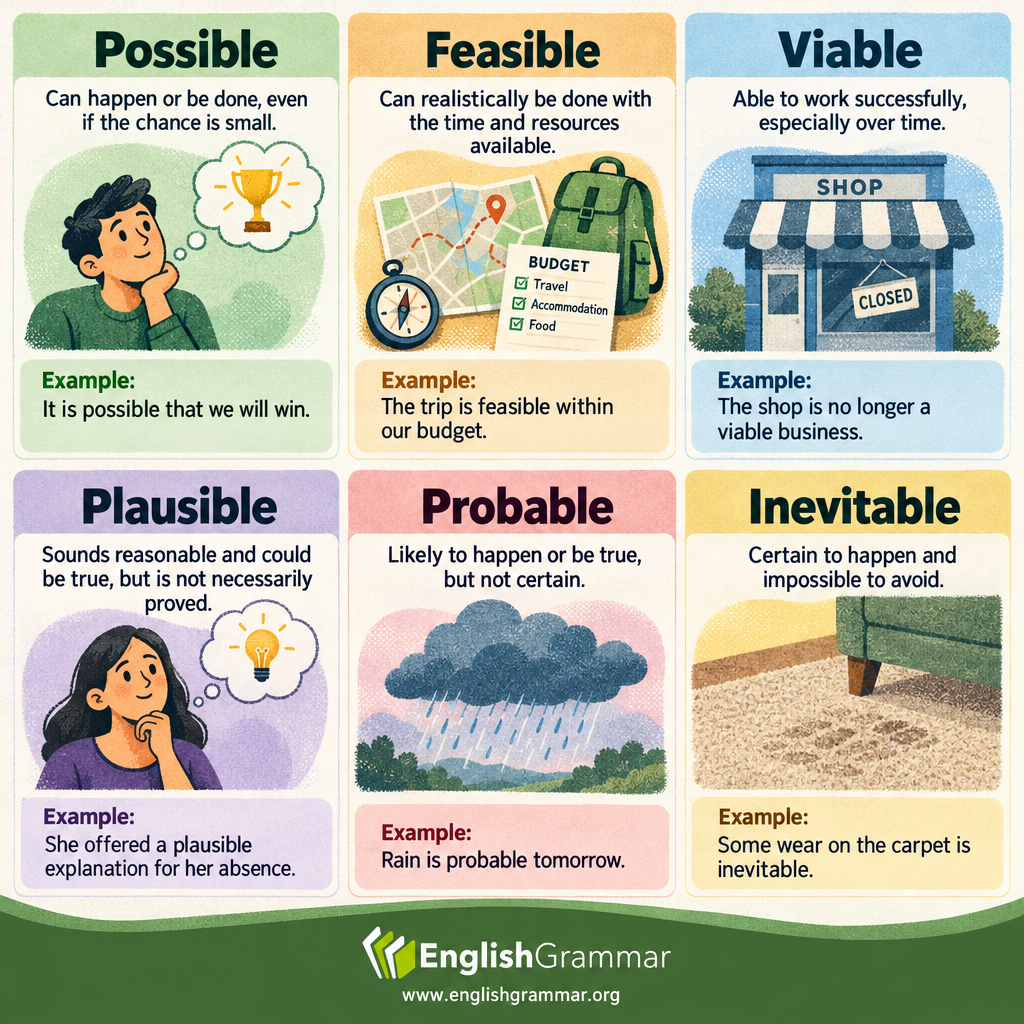
Possible vs. Feasible vs. Viable vs. Plausible vs. Probable vs. Inevitable

These six adjectives answer different questions. Some describe whether something can happen; others describe practical plans, believable explanations or expected results. They do not form one simple scale from uncertain to certain.

  • Possible means something can happen or be done. It does not tell you that the chance is high. It is possible that we will see snow tonight.
  • Feasible means something can realistically be done with the time, money, skills or equipment available. Finishing the repairs today is feasible if both mechanics help.
  • Viable means something can work successfully, especially over time. It often describes businesses, plans and solutions. The café needs more regular customers to remain viable.
  • Plausible means an explanation, claim or idea sounds reasonable and could be true. It does not mean it has been proved. A flat battery is a plausible explanation for the problem.
  • Probable means something is likely to happen or be true, but is not certain. A delay is probable because of the storm.
  • Inevitable means something is certain to happen and cannot be avoided. Without urgent repairs, further damage is inevitable.

A project may be feasible to launch but not viable as a lasting business. Similarly, a story can sound plausible without being the most probable explanation. Choose the adjective that matches your question: practical limits, lasting success, believability or likelihood.

Improve your English grammar, vocabulary and writing

We take you step by step from beginner to advanced, even if you struggled with English at school or have always had trouble remembering the rules.

  • 10 modules, 105 lessons and 688 questions
  • Just log in and learn anytime and anywhere
  • Your progress is saved in your account
  • Download the 2027 Grammar Guide (PDF)
Join free

Already have an account? Sign in

See what’s in the course

Primary Sidebar

2.4M761.4K165.8K

Free 2027 Grammar Guide

  • Download Grammar Guide (PDF)
  • Online grammar course, A1 to C2
  • Weekly exercises and vocabulary
  • Join over 3 million English learners

We respect your privacy. Unsubscribe anytime.

Already have an account? Sign in

Grammar Checker - Try Now

Latest Posts

  • Possible, feasible, viable, plausible, probable and inevitable: What’s the difference? October 21, 2026
  • Asking for Help Exercise October 21, 2026
  • 100 Best Synonyms for “Preposterous” October 21, 2026
  • 100 Best Synonyms for “Sneaky” October 21, 2026
  • 100 Best Synonyms for “Destroyed” October 21, 2026
  • 100 Best Synonyms for “Bothered” October 21, 2026
  • 100 Best Synonyms for “Pointed Out” October 21, 2026
  • Modals of Deduction Exercise October 21, 2026
  • 100 Best Synonyms for “Proceeded” October 21, 2026
  • 100 Best Synonyms for “Smooth” October 21, 2026
Home of English Grammar

Free English grammar exercises, rules and vocabulary lists, with new exercises every week. Join the leading English grammar site with over 3 million followers.

Join free

Learn

  • Exercises
  • Matches
  • Grammar rules
  • Vocabulary lists
  • Writing guides
  • Online tools

More

  • Top social media posts
  • Various posts
  • Contact

Account

  • Join free
  • Grammar Course
  • Free grammar guide (PDF)

Copyright © 2026 EnglishGrammar.org

  • Disclaimer
  • Privacy policy
  • Terms
  • Sitemap