
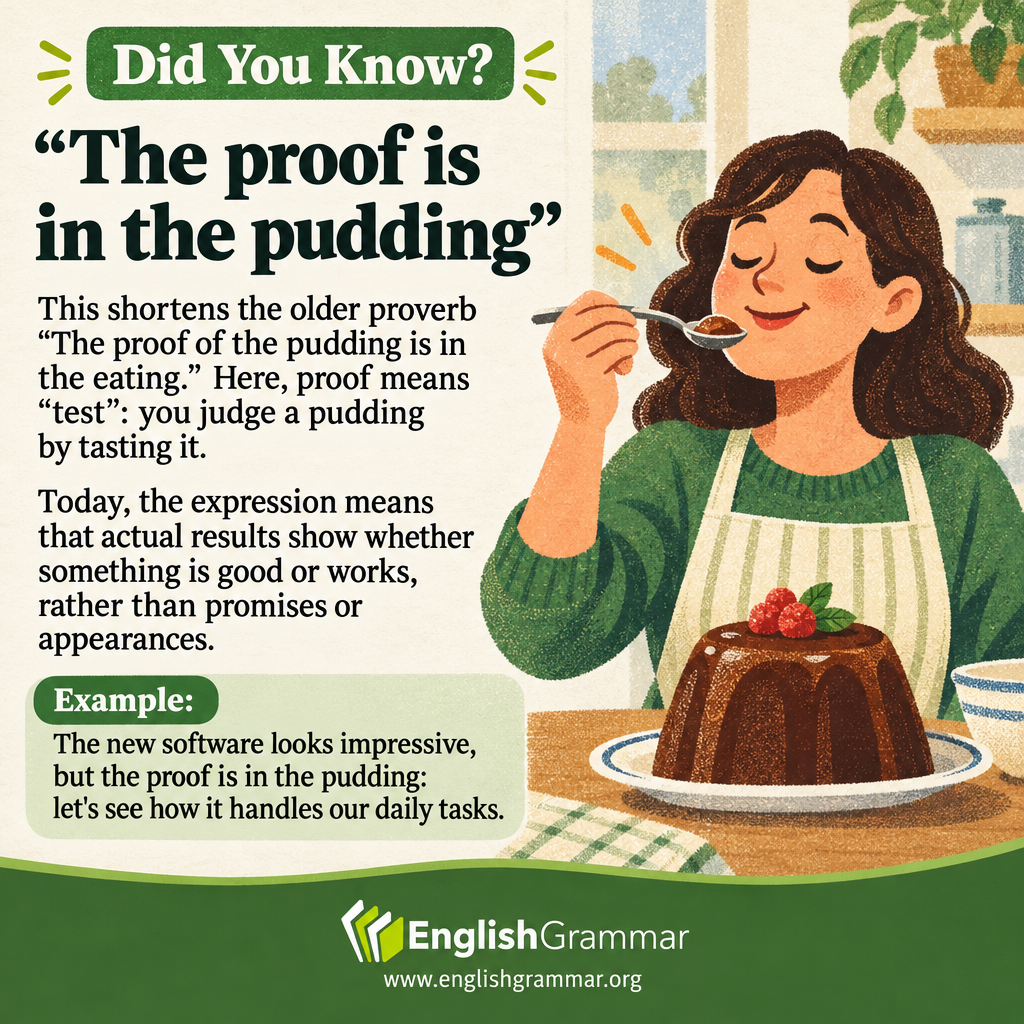
The familiar expression comes from the older proverb “The proof of the pudding is in the eating.” Its message is practical: you find out whether something is good by trying it, not simply by hearing claims about it.
Here, proof means test. This older meaning makes the connection clearer: eating a pudding is the test of its quality. A dish might look impressive, but you cannot judge its taste without taking a bite.
Also, pudding did not always mean a sweet dessert. In older English, it could refer to a savoury dish, including a sausage-like mixture. The saying does not depend on a particular recipe; the important link is between testing food and judging its quality.
Today, people use the shortened expression when they want actual performance or results to support a claim. It can apply to a product, a plan, a skill, or a promised improvement—not just food.
- “The new app looks easy to use, but the proof is in the pudding: let’s try booking a ticket.”
- “They promised faster deliveries, but the proof will be in the pudding when our next order arrives.”
The expression often introduces a note of caution rather than a negative judgment. The speaker is not necessarily saying that something will fail; they are waiting to see how it works in practice.