
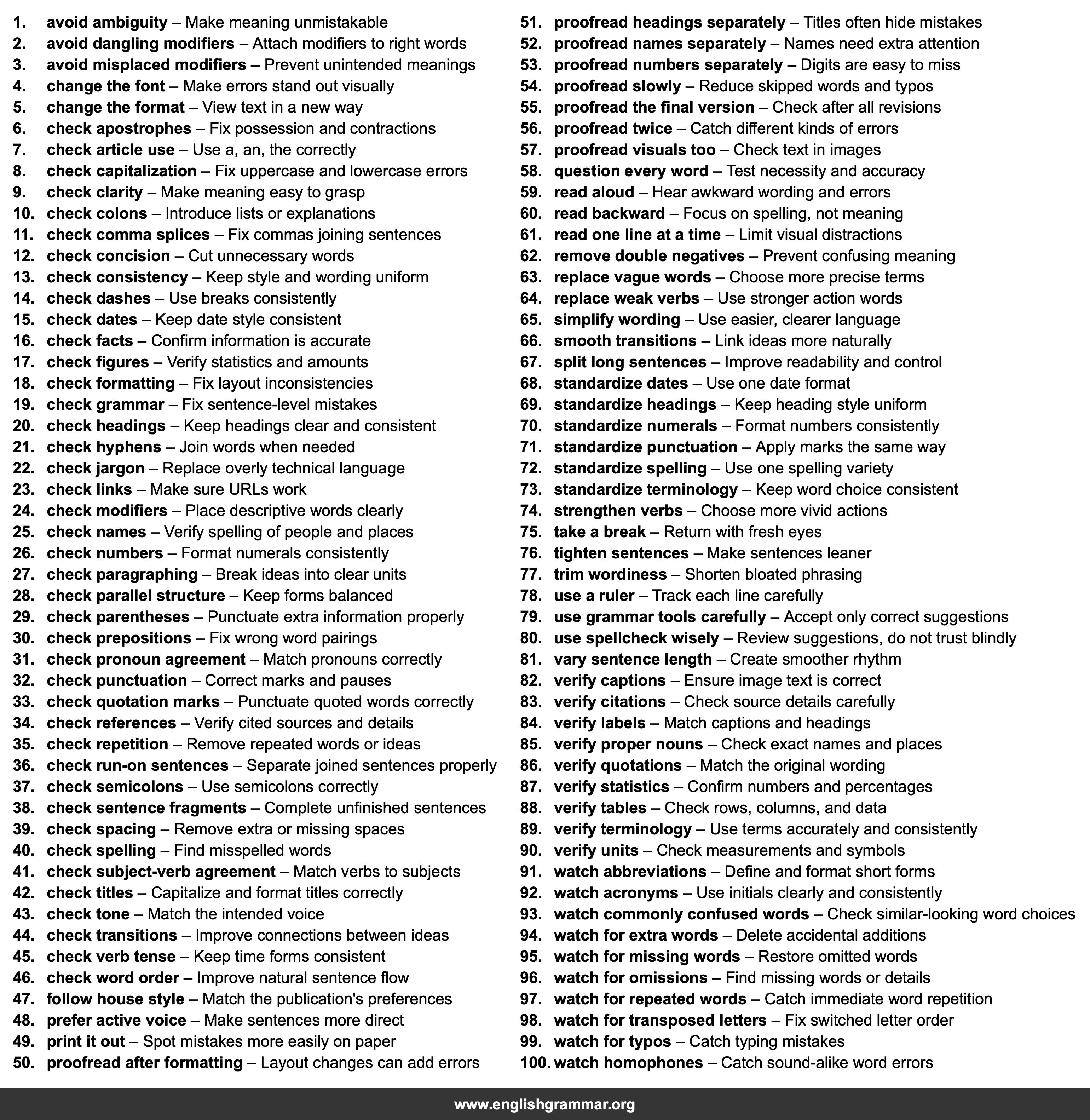
| No. | Item | Definition |
|---|---|---|
| 1. | avoid ambiguity | Make meaning unmistakable |
| 2. | avoid dangling modifiers | Attach modifiers to right words |
| 3. | avoid misplaced modifiers | Prevent unintended meanings |
| 4. | change the font | Make errors stand out visually |
| 5. | change the format | View text in a new way |
| 6. | check apostrophes | Fix possession and contractions |
| 7. | check article use | Use a, an, the correctly |
| 8. | check capitalization | Fix uppercase and lowercase errors |
| 9. | check clarity | Make meaning easy to grasp |
| 10. | check colons | Introduce lists or explanations |
| 11. | check comma splices | Fix commas joining sentences |
| 12. | check concision | Cut unnecessary words |
| 13. | check consistency | Keep style and wording uniform |
| 14. | check dashes | Use breaks consistently |
| 15. | check dates | Keep date style consistent |
| 16. | check facts | Confirm information is accurate |
| 17. | check figures | Verify statistics and amounts |
| 18. | check formatting | Fix layout inconsistencies |
| 19. | check grammar | Fix sentence-level mistakes |
| 20. | check headings | Keep headings clear and consistent |
| 21. | check hyphens | Join words when needed |
| 22. | check jargon | Replace overly technical language |
| 23. | check links | Make sure URLs work |
| 24. | check modifiers | Place descriptive words clearly |
| 25. | check names | Verify spelling of people and places |
| 26. | check numbers | Format numerals consistently |
| 27. | check paragraphing | Break ideas into clear units |
| 28. | check parallel structure | Keep forms balanced |
| 29. | check parentheses | Punctuate extra information properly |
| 30. | check prepositions | Fix wrong word pairings |
| 31. | check pronoun agreement | Match pronouns correctly |
| 32. | check punctuation | Correct marks and pauses |
| 33. | check quotation marks | Punctuate quoted words correctly |
| 34. | check references | Verify cited sources and details |
| 35. | check repetition | Remove repeated words or ideas |
| 36. | check run-on sentences | Separate joined sentences properly |
| 37. | check semicolons | Use semicolons correctly |
| 38. | check sentence fragments | Complete unfinished sentences |
| 39. | check spacing | Remove extra or missing spaces |
| 40. | check spelling | Find misspelled words |
| 41. | check subject-verb agreement | Match verbs to subjects |
| 42. | check titles | Capitalize and format titles correctly |
| 43. | check tone | Match the intended voice |
| 44. | check transitions | Improve connections between ideas |
| 45. | check verb tense | Keep time forms consistent |
| 46. | check word order | Improve natural sentence flow |
| 47. | follow house style | Match the publication’s preferences |
| 48. | prefer active voice | Make sentences more direct |
| 49. | print it out | Spot mistakes more easily on paper |
| 50. | proofread after formatting | Layout changes can add errors |
| 51. | proofread headings separately | Titles often hide mistakes |
| 52. | proofread names separately | Names need extra attention |
| 53. | proofread numbers separately | Digits are easy to miss |
| 54. | proofread slowly | Reduce skipped words and typos |
| 55. | proofread the final version | Check after all revisions |
| 56. | proofread twice | Catch different kinds of errors |
| 57. | proofread visuals too | Check text in images |
| 58. | question every word | Test necessity and accuracy |
| 59. | read aloud | Hear awkward wording and errors |
| 60. | read backward | Focus on spelling, not meaning |
| 61. | read one line at a time | Limit visual distractions |
| 62. | remove double negatives | Prevent confusing meaning |
| 63. | replace vague words | Choose more precise terms |
| 64. | replace weak verbs | Use stronger action words |
| 65. | simplify wording | Use easier, clearer language |
| 66. | smooth transitions | Link ideas more naturally |
| 67. | split long sentences | Improve readability and control |
| 68. | standardize dates | Use one date format |
| 69. | standardize headings | Keep heading style uniform |
| 70. | standardize numerals | Format numbers consistently |
| 71. | standardize punctuation | Apply marks the same way |
| 72. | standardize spelling | Use one spelling variety |
| 73. | standardize terminology | Keep word choice consistent |
| 74. | strengthen verbs | Choose more vivid actions |
| 75. | take a break | Return with fresh eyes |
| 76. | tighten sentences | Make sentences leaner |
| 77. | trim wordiness | Shorten bloated phrasing |
| 78. | use a ruler | Track each line carefully |
| 79. | use grammar tools carefully | Accept only correct suggestions |
| 80. | use spellcheck wisely | Review suggestions, do not trust blindly |
| 81. | vary sentence length | Create smoother rhythm |
| 82. | verify captions | Ensure image text is correct |
| 83. | verify citations | Check source details carefully |
| 84. | verify labels | Match captions and headings |
| 85. | verify proper nouns | Check exact names and places |
| 86. | verify quotations | Match the original wording |
| 87. | verify statistics | Confirm numbers and percentages |
| 88. | verify tables | Check rows, columns, and data |
| 89. | verify terminology | Use terms accurately and consistently |
| 90. | verify units | Check measurements and symbols |
| 91. | watch abbreviations | Define and format short forms |
| 92. | watch acronyms | Use initials clearly and consistently |
| 93. | watch commonly confused words | Check similar-looking word choices |
| 94. | watch for extra words | Delete accidental additions |
| 95. | watch for missing words | Restore omitted words |
| 96. | watch for omissions | Find missing words or details |
| 97. | watch for repeated words | Catch immediate word repetition |
| 98. | watch for transposed letters | Fix switched letter order |
| 99. | watch for typos | Catch typing mistakes |
| 100. | watch homophones | Catch sound-alike word errors |