Home of English Grammar

Grammar Guide
  • Home
  • Exercises
  • Matches
  • Rules
  • Tools
    • Grammar Checker
    • Very Replacer
    • Word Counter
  • Top Social Media Posts
  • Various Posts
  • Vocabulary
  • Writing Guides
  • Contact

How punctuation controls pace in writing

April 28, 2026 - pdf

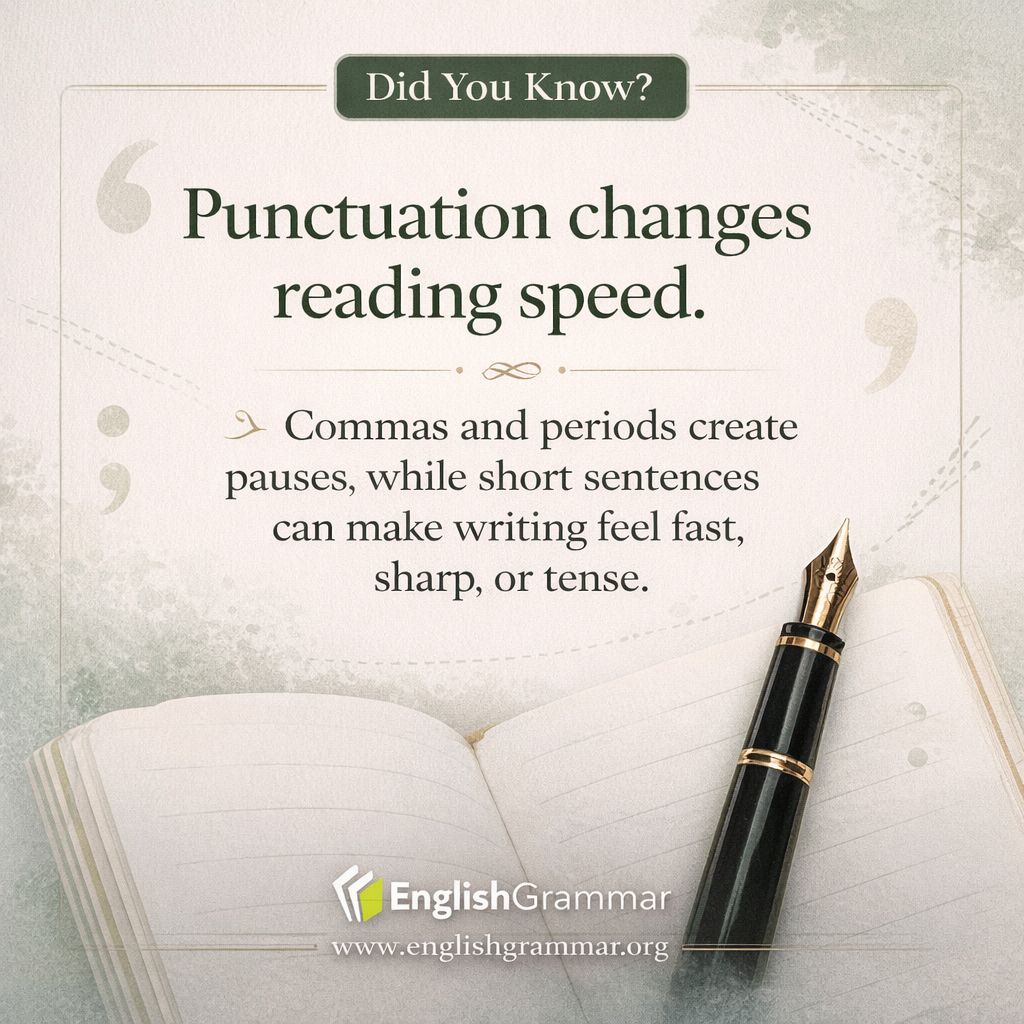
Punctuation controls pace.

Punctuation does more than mark grammar rules. It also helps control pace, which is the speed and rhythm a reader feels while moving through a sentence.

Commas often create a small pause. Periods create a full stop. When a writer uses several short sentences, the result can feel quick, tense, or dramatic. Longer sentences with commas often feel slower, calmer, or more reflective.

Compare these examples:

  • Fast pace: He opened the door. Nothing moved. Then he heard breathing.
  • Slower pace: He opened the door, stepped inside, and waited in the silence until he heard breathing.

Both versions describe a similar moment, but the punctuation changes the experience. The first feels sharp and urgent. The second feels more gradual and suspenseful.

This is why punctuation matters even when the basic meaning stays the same. It guides the reader through the sentence, shaping emphasis, timing, and mood. Good writers use punctuation not only to be correct, but also to control how the writing sounds in the reader’s mind.

  • Share
  • Post
  • Post
  • Email
NEW: Try Matches, our daily vocabulary challenge. Pick a topic and level and match words with definitions to boost your vocabulary.
2,485,429 
761,532 
Improve Your Grammar
  • Download 2026 Grammar Guide (PDF)
  • Free Weekly Exercises & Vocabulary
  • Join over 3 Million English Learners
We respect your privacy. Unsubscribe anytime.

Grammar Checker

GrammarCheck.net - Try online
Hint → Bookmark GrammarCheck for future use.

Latest Posts

  • Why “sinister” and “dexter” started as left and right April 29, 2026
  • 100 Grammar Fixes for Cleaner Sentences April 29, 2026
  • 100 Ways to Change the Subject Smoothly April 29, 2026
  • 100 Words to Describe Lectures April 29, 2026
  • Where “fat cat” comes from, and what it means April 29, 2026
  • Future Continuous Exercise April 29, 2026
  • 100 Idioms Book Lovers Will Love April 29, 2026

Copyright © 2026 · EnglishGrammar.org
Disclaimer · Privacy Policy · Sitemap · Terms

Improve Your Grammar
  • Download 2026 Grammar Guide (PDF)
  • Free Weekly Exercises & Vocabulary
  • Join over 3 Million English Learners
We respect your privacy. Unsubscribe anytime.