
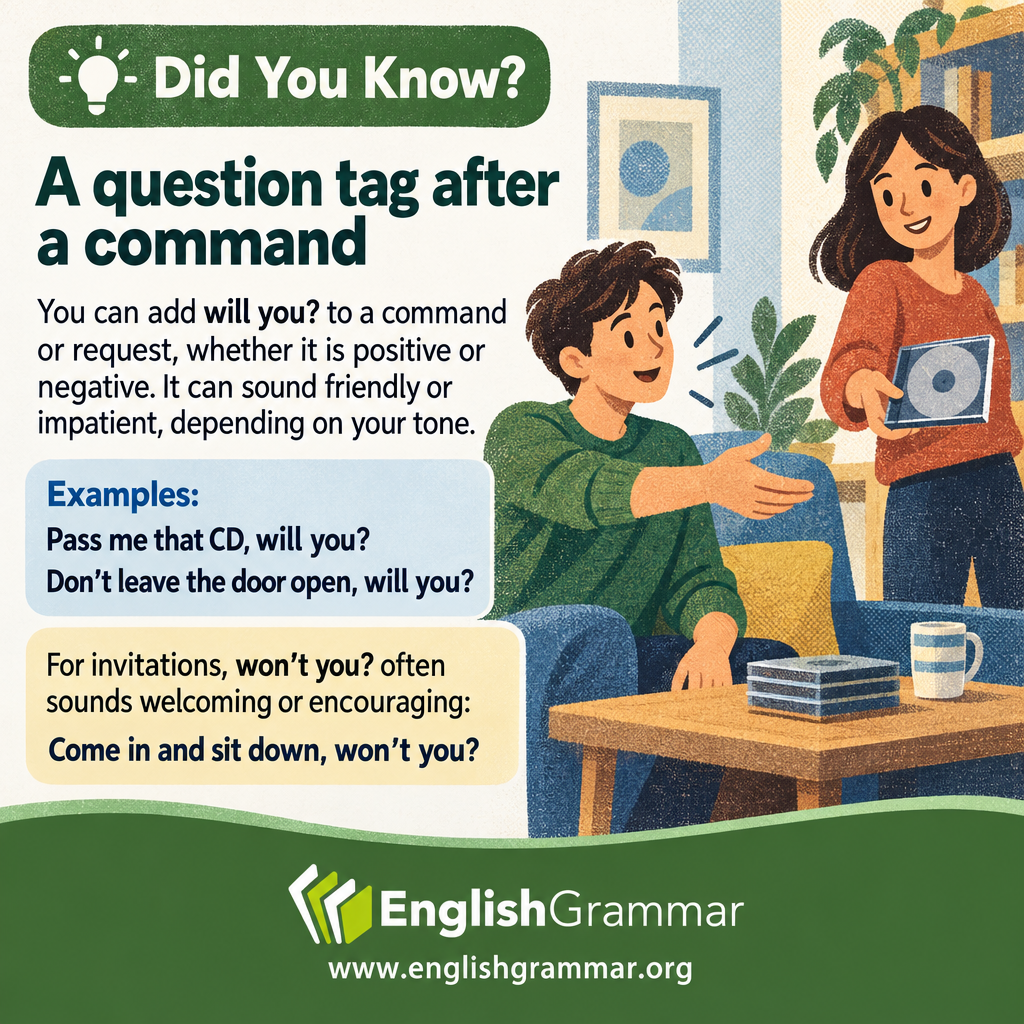
A question tag is a short question added to the end of a sentence. It can follow a command or request, not just a statement: “Pass me that CD, will you?” Here, the speaker is asking someone to do something, rather than checking whether a statement is true.
Use “will you?” after positive or negative commands. With statement tags, learners often practise changing from positive to negative: “You like music, don’t you?” Commands do not follow that same pattern.
- “Close the window, will you?” asks someone to close it.
- “Don’t leave the door open, will you?” asks someone not to leave it open.
Tone matters. Adding a tag does not automatically make a command polite. Said gently, “Help me with this, will you?” can sound friendly. Said sharply, the same words can sound impatient or demanding. Consider your voice, the situation, and your relationship with the listener.
Other tags are possible too. “Hold this for a moment, could you?” often sounds less direct. “Won’t you?” often adds a welcoming or encouraging tone to an invitation: “Come in and sit down, won’t you?”
In writing, put a comma before the tag and a question mark at the end. The tag turns the whole command into a question-like request, even though the main part still uses the command form.