
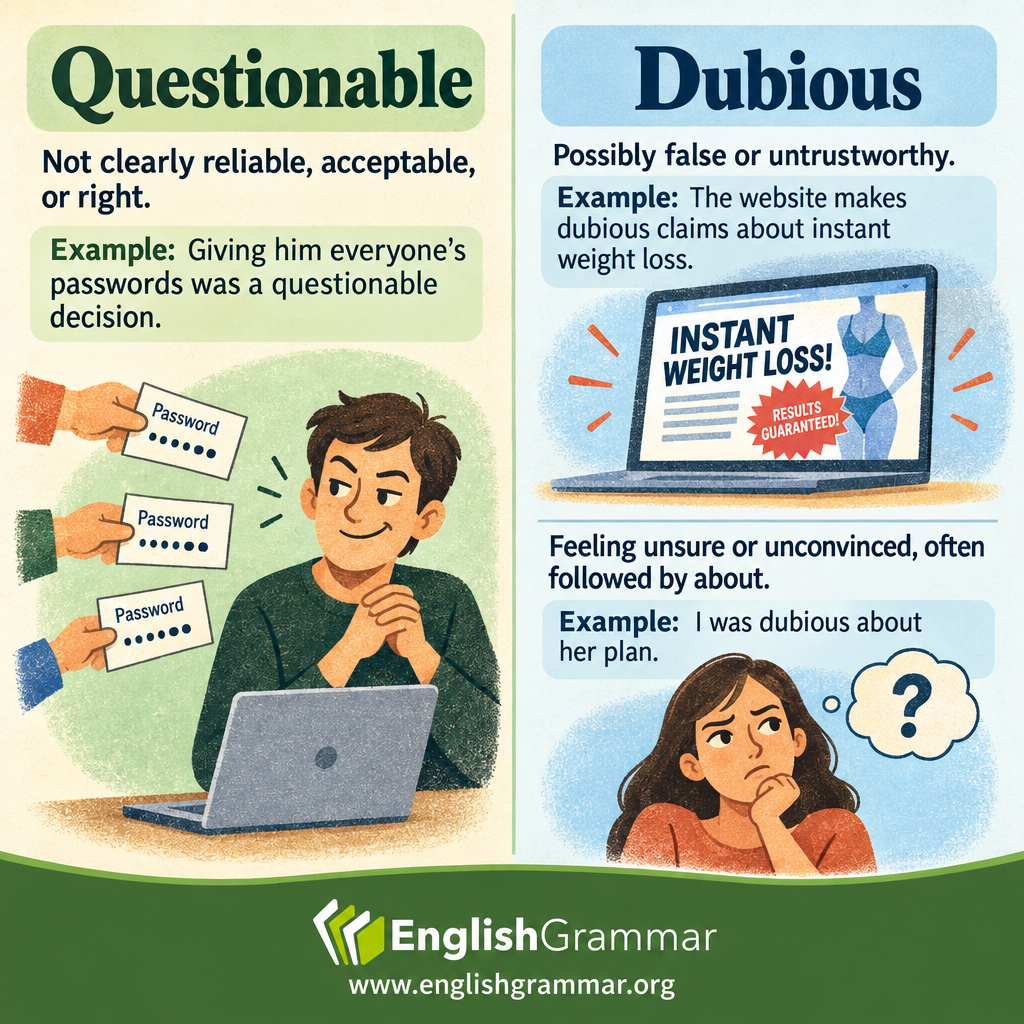
Questionable and dubious both express doubt. They often overlap, so the difference is usually a matter of emphasis, not a strict rule.
Questionable describes something whose quality, reliability, or acceptability is open to doubt. It is useful when you want to suggest that something deserves examination or criticism.
- The report relies on questionable data. The data may not be reliable.
- Leaving a young child alone was a questionable choice. The choice may not have been sensible or acceptable.
Dubious can describe something that seems unreliable, suspicious, or possibly false. It often suggests stronger suspicion than a neutral expression of uncertainty, though context matters.
- He offered a dubious explanation for the missing money. The explanation does not seem trustworthy.
Both words can describe claims, evidence, business practices, or decisions. A questionable claim invites doubt or scrutiny; a dubious claim often suggests that the speaker suspects it is false. Neither word proves that the claim is wrong.
Dubious also describes a person who feels unsure or unconvinced, often with about: I’m dubious about buying a car without a test drive. Here, the speaker has doubts.
Do not replace it with I’m questionable about buying a car. That is not the usual way to express personal uncertainty. Describing a person as questionable would instead cast doubt on that person’s character, suitability, or reliability.