
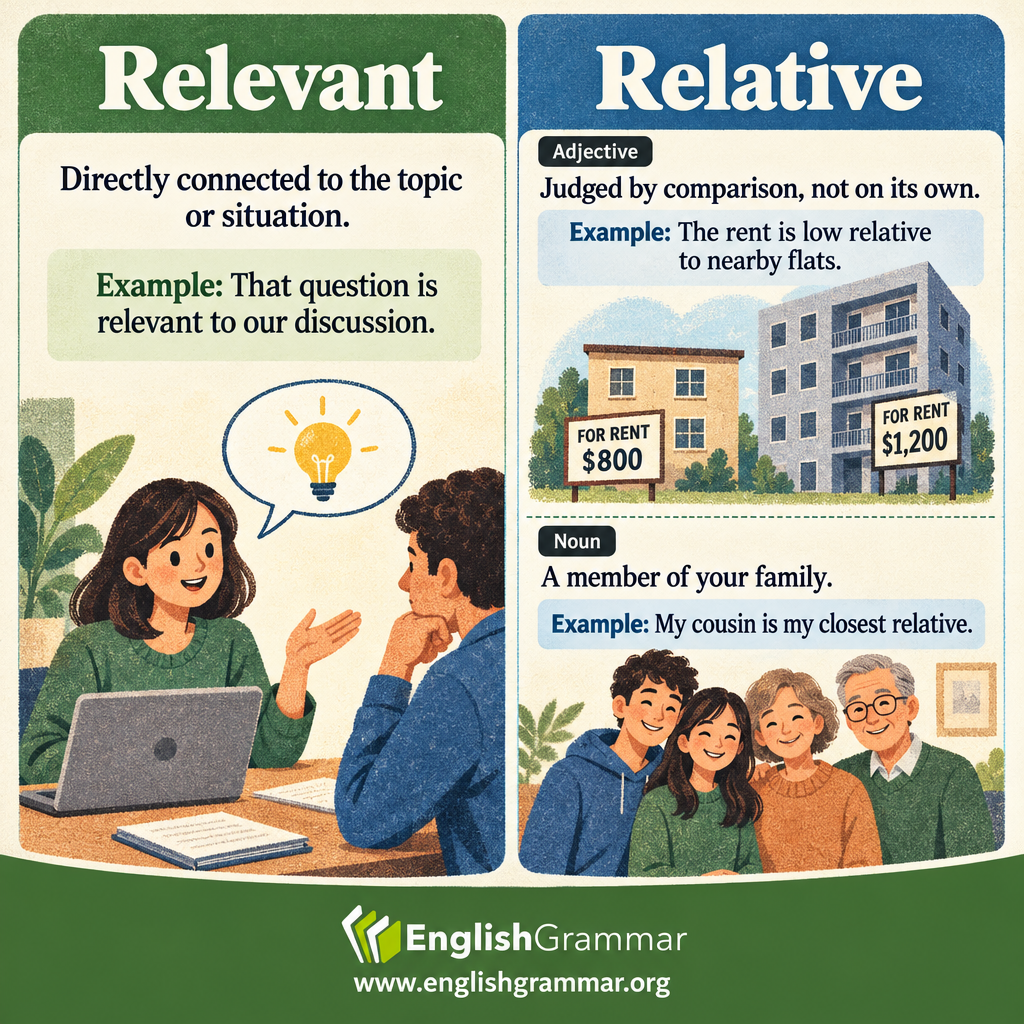
Relevant and relative look similar, but they answer different questions. Are you talking about something connected to a topic, something judged by comparison, or a person in your family?
Relevant is an adjective. It describes something directly connected to the subject or situation being discussed. Use it for information, experience, questions, or details that matter in that context.
- Your teaching experience is relevant to this job.
- Please include only relevant details in your report.
Experience can be valuable without being relevant to a particular job. The word focuses on the connection, not simply on whether something is good or important.
Relative can also be an adjective. It describes something judged in comparison with something else, rather than on its own. The comparison may be stated directly or understood from the situation.
- This room is small relative to the other bedrooms.
- After the busy station, we enjoyed the relative quiet of the park.
In the second example, the park is quieter than the station; it does not have to be completely silent.
Relative is also a noun meaning a family member, such as a cousin or aunt.
- A relative is staying with us this weekend.
Both adjectives can appear before to, so that small word alone cannot tell you which one to choose. Look at whether the sentence expresses a connection or a comparison.