
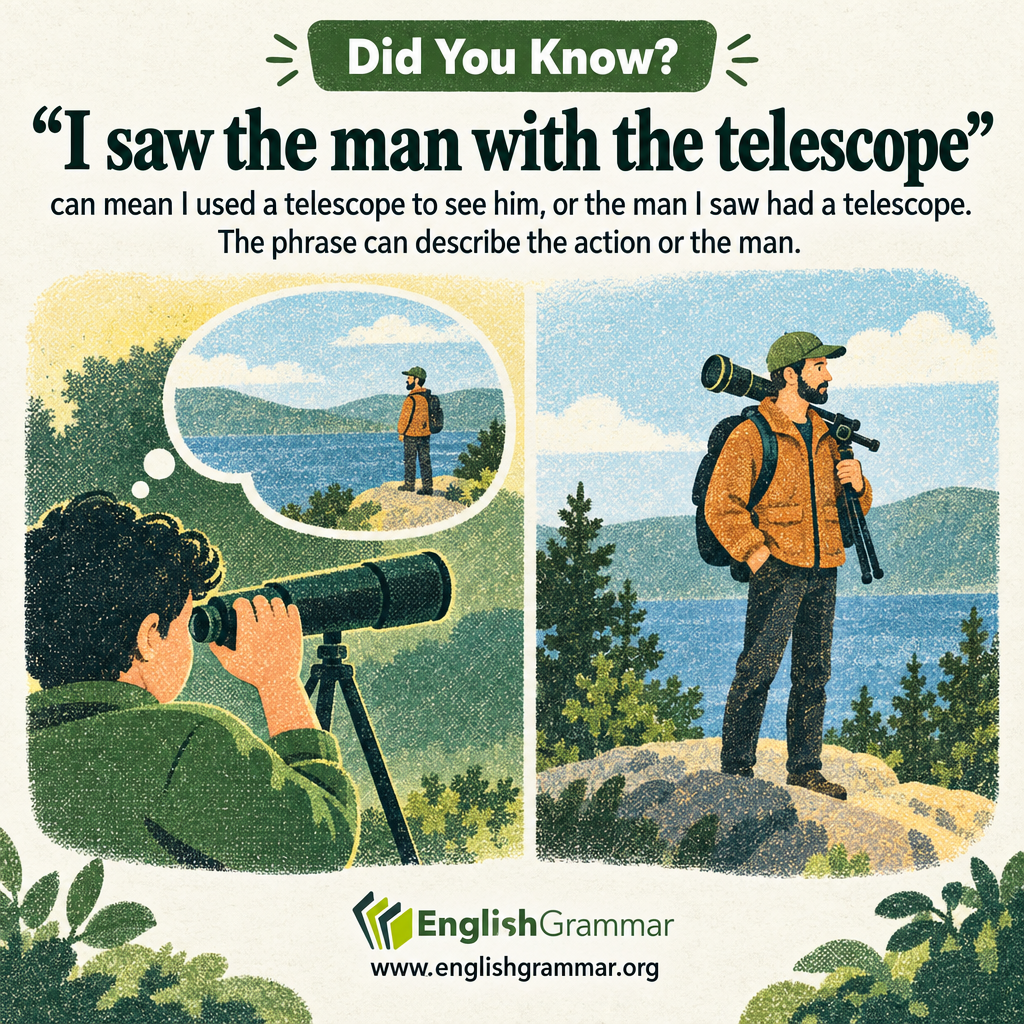
One sentence can leave us unsure who has the telescope. Consider “I saw the man with the telescope.” The words are familiar, but they allow two different readings.
- I used the telescope. The phrase “with the telescope” explains how I saw the man. Perhaps he was far away, so I needed help to see him.
- The man had the telescope. The same phrase describes the man I saw. Perhaps several people were nearby, and he was the one carrying a telescope.
This happens because the phrase can connect to different parts of the sentence. It can connect to the action, “saw,” or to the person, “the man.” Grammarians call this structural ambiguity: a sentence has more than one possible meaning because its words can be grouped in different ways.
In conversation, the situation often makes the intended meaning clear. If you are discussing a distant hillside, the telescope is probably your viewing tool. If you are identifying someone in a crowd, it may belong to the man.
When the situation does not help, rewrite the sentence. To make the first meaning clear, say, “I used a telescope to see the man.” For the second, say, “I saw the man who was carrying a telescope.” These versions give the reader a clearer picture without relying on a guess.