
• Skip to primary navigation
  • Skip to main content
  • Skip to primary sidebar
Home of English Grammar
  • Home
  • Course
  • Exercises
  • Grammar Rules
  • Matches
  • Posts
  • Tools
    • Grammar Checker
    • Very Replacer
    • Word Counter
  • Vocabulary Lists
  • Archives
    • Social Media Posts
    • Writing Guides
  • Join free

Why we say “bury your head in the sand”

September 2, 2026

The origin of "bury your head in the sand"

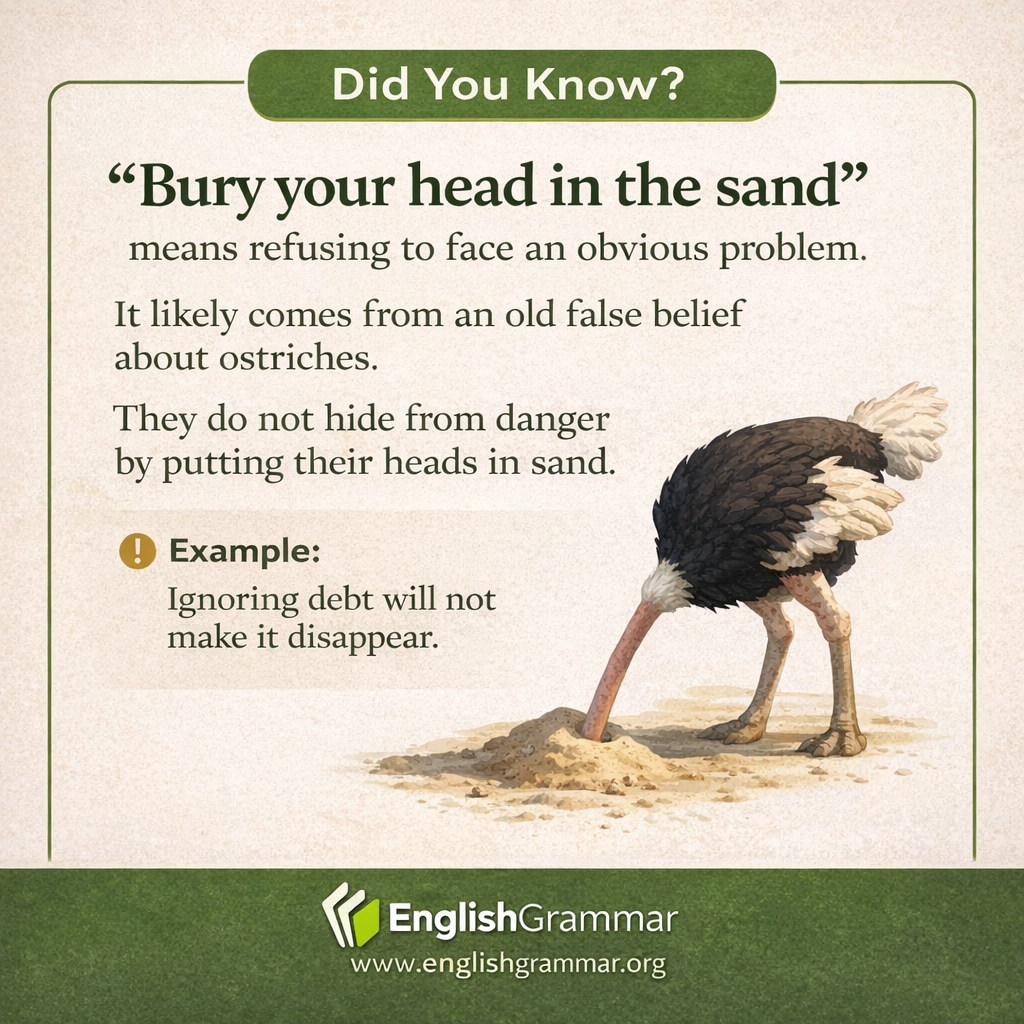
“Bury your head in the sand” means to avoid dealing with something uncomfortable, obvious, or threatening. When people use it, they usually mean that someone is pretending a problem is not there instead of facing it directly.

The expression is commonly linked to an old belief about ostriches. For a long time, people repeated the idea that an ostrich, when frightened, would hide by sticking its head in the sand. That picture is memorable, but it is not true. Ostriches do not protect themselves that way.

So why did the idea spread? One reason is that ostriches sometimes lower their heads to the ground, especially when tending nests or turning eggs. From a distance, that can make it look as if the head has disappeared.

  • Literal myth: people once believed ostriches hid this way.
  • Modern meaning: a person avoids reality or responsibility.
  • Example: If someone ignores unpaid bills for months, a friend might say they are burying their head in the sand.

The phrase survives because the image is vivid, even though the animal story behind it is mistaken.

Improve your English grammar, vocabulary and writing

We take you step by step from beginner to advanced, even if you struggled with English at school or have always had trouble remembering the rules.

  • 10 modules, 105 lessons and 688 questions
  • Just log in and learn anytime and anywhere
  • Your progress is saved in your account
  • Download the 2026 Grammar Guide (PDF)
Join free

Already have an account? Sign in

See what’s in the course

Primary Sidebar

2.4M761.4K165.8K

Free 2026 Grammar Guide

  • Download Grammar Guide (PDF)
  • Online grammar course, A1 to C2
  • Weekly exercises and vocabulary
  • Join over 3 million English learners

We respect your privacy. Unsubscribe anytime.

Already have an account? Sign in

Grammar Checker - Try Now

Latest Posts

  • “Impact” has been a verb for centuries October 18, 2026
  • 100 Best Synonyms for “Consistently” October 18, 2026
  • Pal vs. buddy vs. mate vs. friend vs. companion vs. confidant(e) October 18, 2026
  • 100 Best Synonyms for “Powerless” October 18, 2026
  • Research Translation Language Exercise October 18, 2026
  • Delusion vs. illusion: How to choose the right word October 18, 2026
  • 100 Best Synonyms for “Unresponsive” October 18, 2026
  • 100 Best Synonyms for “Rooted” October 18, 2026
  • The origin of “not a sausage” October 18, 2026
  • 100 Best Synonyms for “Consideration” October 18, 2026
Home of English Grammar

Free English grammar exercises, rules and vocabulary lists, with new exercises every week. Join the leading English grammar site with over 3 million followers.

Join free

Learn

  • Exercises
  • Matches
  • Grammar rules
  • Vocabulary lists
  • Writing guides
  • Online tools

More

  • Top social media posts
  • Various posts
  • Contact

Account

  • Join free
  • Grammar Course
  • Free grammar guide (PDF)

Copyright © 2026 EnglishGrammar.org

  • Disclaimer
  • Privacy policy
  • Terms
  • Sitemap