
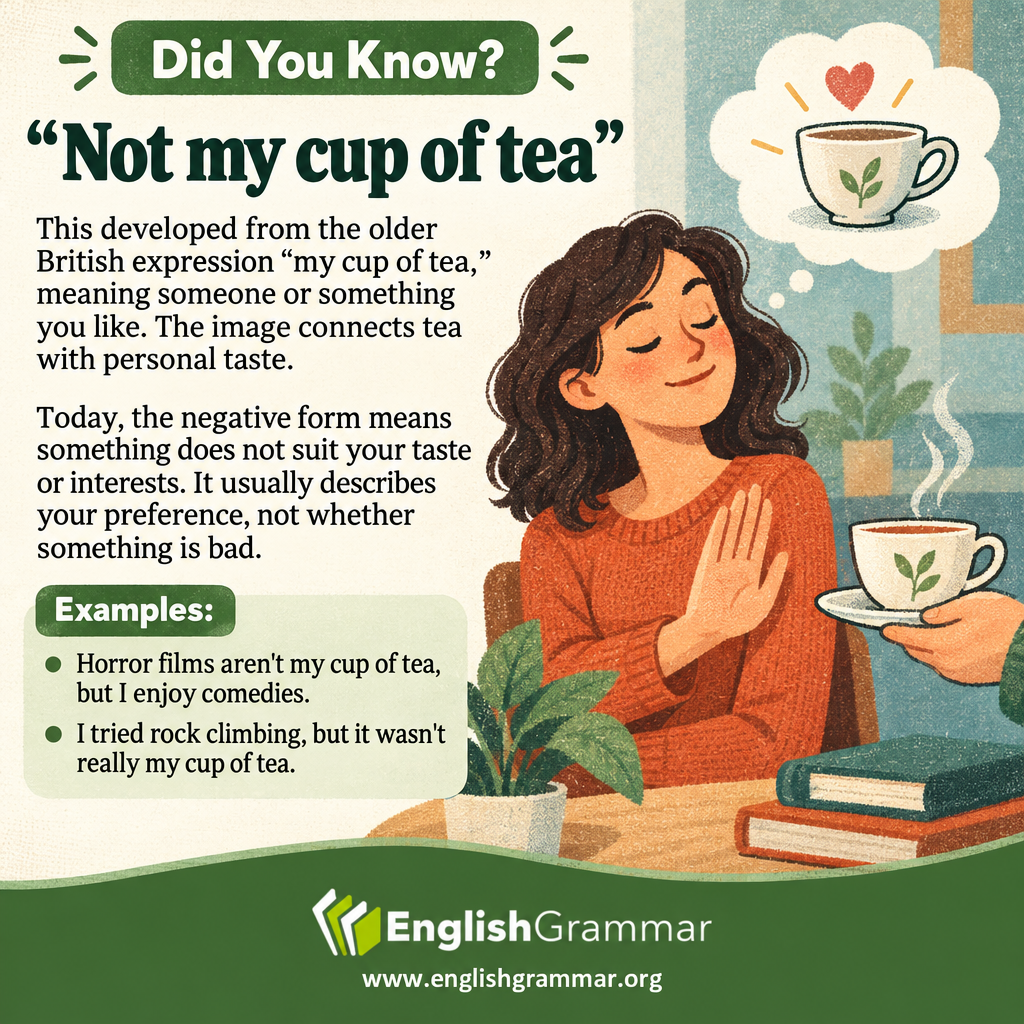
“Not my cup of tea” means that something does not suit your taste or interests. It usually expresses a personal preference rather than saying that something is bad.
The expression developed from the older, positive phrase “my cup of tea,” used in British English for someone or something a person liked. The positive form came first; the negative form became common later. Its familiar image connects a cup of tea with personal taste: a cup that one person enjoys may not appeal to another.
Today, the negative expression is especially familiar. You can use it when talking about music, food, films, hobbies, or other things you do not particularly enjoy.
- Horror films are not my cup of tea, but I enjoy comedies.
- I tried rock climbing, but it wasn’t really my cup of tea.
These speakers are describing their own preferences, not judging everyone else’s. That makes the expression useful for a fairly gentle refusal or disagreement. Adding “really” can soften it further.
The positive form is still possible, too: “A quiet weekend with a good book is just my cup of tea.” Here, “just” means that the activity suits the speaker very well.
Because the phrase is conversational, it fits naturally in everyday speech and informal writing. In a formal setting, you might choose “That doesn’t appeal to me” or “That isn’t my preference.”