
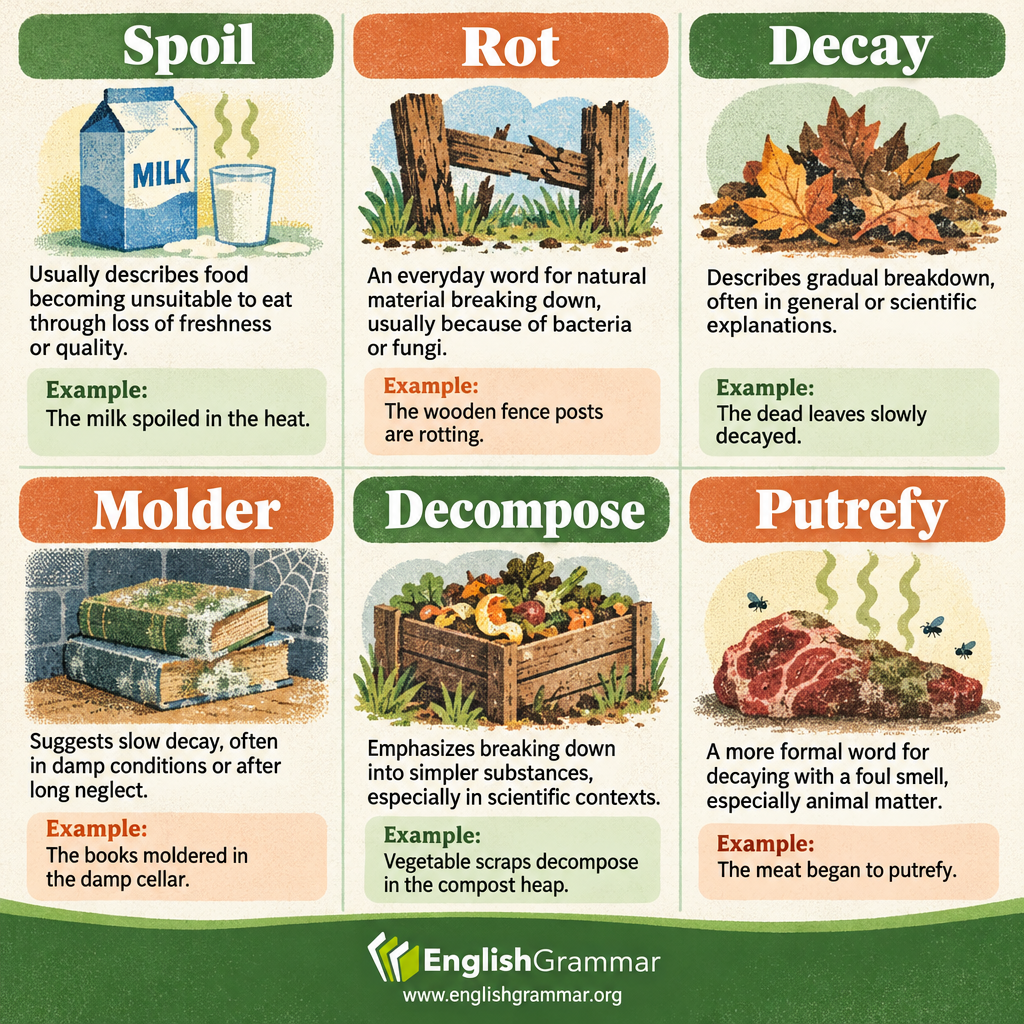
These six verbs describe things going bad or breaking down, but they highlight different parts of the process. They overlap, so more than one can fit the same situation.
- Spoil usually describes food becoming unsuitable to eat. It focuses on lost freshness or quality, not necessarily visible breakdown: The cream spoiled before we could use it.
- Rot is an everyday word for natural material breaking down, usually through the action of bacteria or fungi: The fallen apples rotted beneath the tree. It is common with food, wood, and plant material.
- Decay describes gradual breakdown and is common in general or scientific explanations: Fungi help dead trees decay. It also appears in discussions of damaged teeth.
- Molder suggests slow decay, often in damp conditions or after long neglect: The old curtains moldered in the empty house. British English usually spells it moulder.
- Decompose emphasizes the process of breaking down into simpler substances: Grass clippings decompose in the compost bin. It is neutral and common in science and environmental writing.
- Putrefy describes decay that produces a foul smell, especially in animal matter: The fish began to putrefy in the heat. It is more formal and less common in everyday conversation.
For ordinary food storage, spoil is often the natural choice. For a biological process, decompose may fit better. Choose according to what you want to emphasize, rather than treating these verbs as separate stages in a fixed sequence.