
• Skip to primary navigation
  • Skip to main content
  • Skip to primary sidebar
Home of English Grammar
  • Home
  • Course
  • Exercises
  • Grammar Rules
  • Matches
  • Posts
  • Tools
    • Grammar Checker
    • Very Replacer
    • Word Counter
  • Vocabulary Lists
  • Archives
    • Social Media Posts
    • Writing Guides
  • Join free

The origin of “the straw that broke the camel’s back”

October 27, 2026

The origin of "the straw that broke the camel’s back"

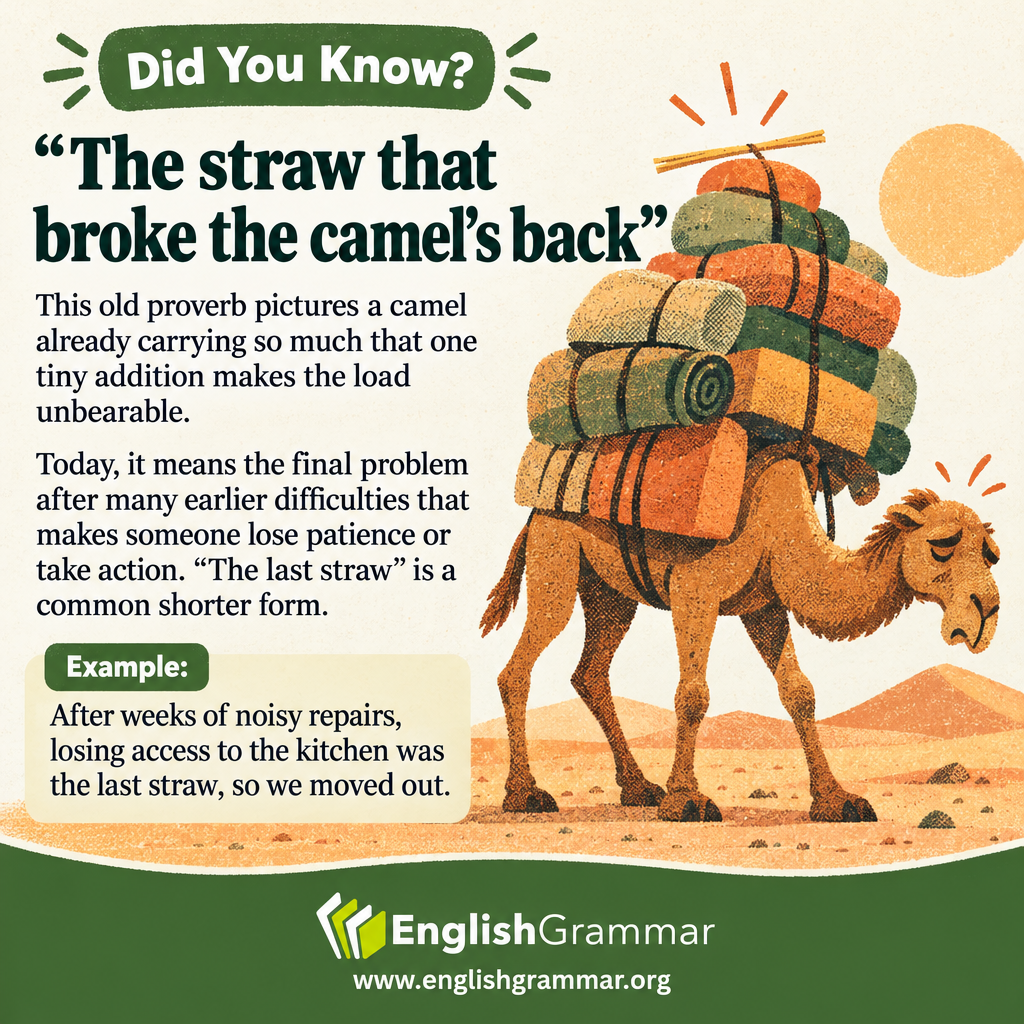
“The straw that broke the camel’s back” comes from a proverbial image: a camel is carrying such a heavy load that adding even one small piece of straw makes the load too much to bear. The straw matters not because it is heavy, but because the camel is already at its limit.

The expression belongs to a tradition of sayings about a tiny addition causing an overloaded animal to collapse. Older related sayings use a feather and a horse. It is best understood as a proverb, not as a report of one particular camel’s experience.

Today, we use the expression for the final problem in a series that makes someone lose patience, give up, or take action. That last problem may seem small on its own. The earlier difficulties explain why it causes such a strong reaction.

  • After months of unpaid overtime, being asked to work on her birthday was the straw that broke the camel’s back.
  • The hotel had lost our booking and given us a dirty room. The broken shower was the last straw.

“The last straw” is a common shorter form with the same meaning. Both forms connect a final incident to problems that came before it. For a single annoying event with no earlier buildup, a simpler description such as “That was frustrating” may fit better.

Improve your English grammar, vocabulary and writing

We take you step by step from beginner to advanced, even if you struggled with English at school or have always had trouble remembering the rules.

  • 10 modules, 112 lessons and 730 questions
  • Just log in and learn anytime and anywhere
  • Your progress is saved in your account
  • Download the 2027 Grammar Guide (PDF)
Join free

Already have an account? Sign in

See what’s in the course

Primary Sidebar

2.4M761.4K165.8K

Free 2027 Grammar Guide

  • Download Grammar Guide (PDF)
  • Online grammar course, A1 to C2
  • Weekly exercises and vocabulary
  • Join over 3 million English learners

We respect your privacy. Unsubscribe anytime.

Already have an account? Sign in

Grammar Checker - Try Now

Latest Posts

  • The origin of “the straw that broke the camel’s back” October 27, 2026
  • 100 Best Synonyms for “Ramifications” October 27, 2026
  • 100 Best Synonyms for “Follow” October 27, 2026
  • 100 Best Synonyms for “Susceptible” October 27, 2026
  • The origin and meaning of “on pins and needles” October 27, 2026
  • 100 Best Synonyms for “Musty” October 27, 2026
  • 100 Best Synonyms for “Crabby” October 27, 2026
  • Method vs. methodology: choosing the right word October 27, 2026
  • 100 Best Synonyms for “Fix” October 27, 2026
  • 100 Best Synonyms for “Rambunctious” October 27, 2026
Home of English Grammar

Free English grammar exercises, rules and vocabulary lists, with new exercises every week. Join the leading English grammar site with over 3 million followers.

Join free

Learn

  • Exercises
  • Matches
  • Grammar rules
  • Vocabulary lists
  • Writing guides
  • Online tools

More

  • Top social media posts
  • Various posts
  • Contact

Account

  • Join free
  • Grammar Course
  • Free grammar guide (PDF)

Copyright © 2026 EnglishGrammar.org

  • Disclaimer
  • Privacy policy
  • Terms
  • Sitemap