
Home of English Grammar

Grammar Guide
  • Home
  • Exercises
  • Matches
  • Rules
  • Tools
    • Grammar Checker
    • Very Replacer
    • Word Counter
  • Top Social Media Posts
  • Various Posts
  • Vocabulary
  • Writing Guides
  • Contact

What “it takes two to tango” means, and why people say it

August 21, 2026 - pdf

The origin of "it takes two to tango"

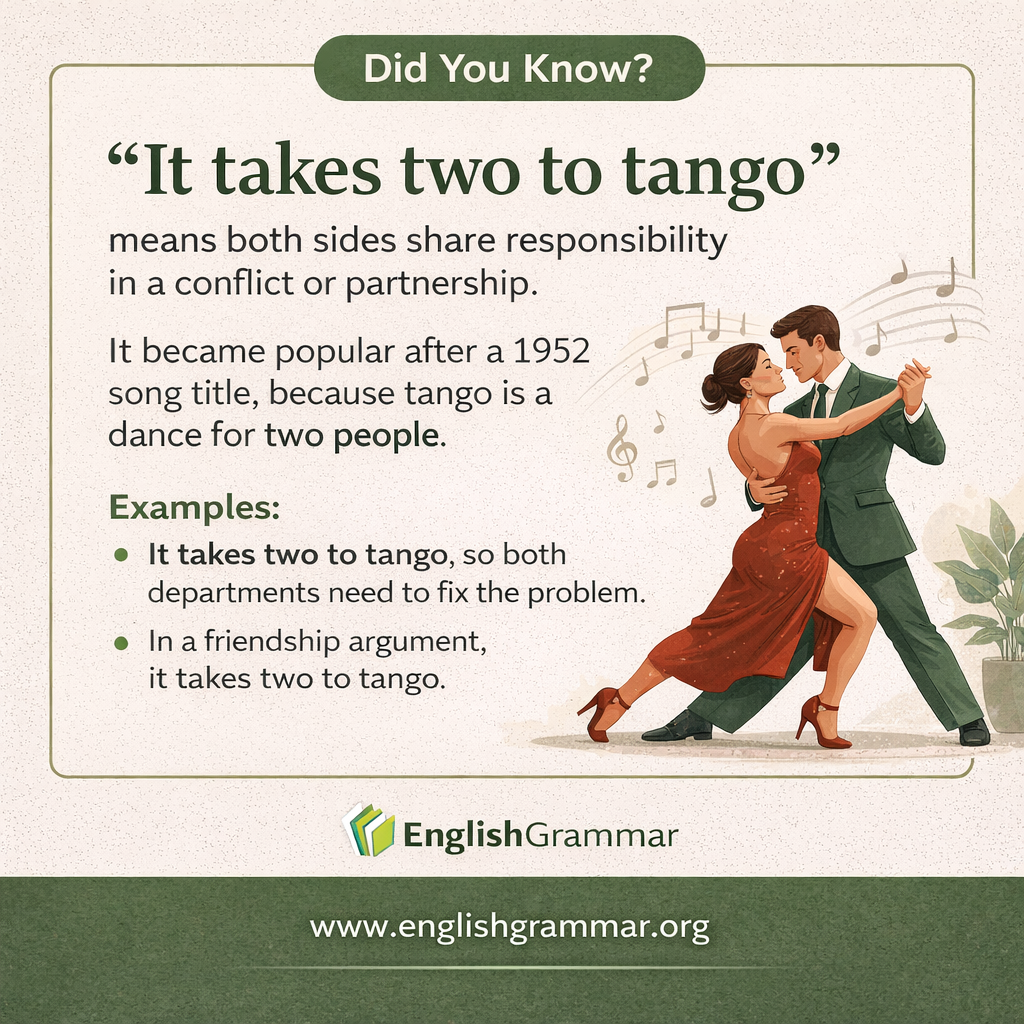
“It takes two to tango” means that two people or groups are involved, so both usually share some responsibility for what happens. People often use it when talking about arguments, cooperation, or relationships.

The image is easy to understand because the tango is a partner dance. One person cannot do the full dance alone. That is why the expression suggests that an outcome depends on more than one side.

The phrase became widely known from the 1952 song Takes Two to Tango. The song helped popularize an idea that already felt natural: some situations only happen when two sides participate.

Today, the expression is often used in conflict. If two coworkers keep blaming each other, someone might say, It takes two to tango, meaning both may have contributed to the problem. It can also be used more neutrally about cooperation. For example, a successful negotiation needs effort from both sides.

  • Conflict: “It takes two to tango, so both neighbors should try to solve the dispute.”
  • Cooperation: “A good partnership works because it takes two to tango.”

In short, the phrase reminds us that many results, good or bad, depend on both sides, not just one.

  • Share
  • Post
  • Post
  • Reddit
  • Email
  • WhatsApp
NEW: Try Matches, our daily vocabulary challenge. Pick a topic and level and match words with definitions to boost your vocabulary.
2,485,429 
761,532 
Improve Your Grammar
  • Download 2026 Grammar Guide (PDF)
  • Free Weekly Exercises & Vocabulary
  • Join over 3 Million English Learners
We respect your privacy. Unsubscribe anytime.

Grammar Checker

GrammarCheck.net - Try online
Hint → Bookmark GrammarCheck for future use.

Latest Posts

  • 100 Email Subject Lines for Introducing Yourself to a New Team September 8, 2026
  • 100 Best Synonyms for “Encouraged” September 8, 2026
  • Discern vs. distinguish: what is the difference? September 8, 2026
  • 100 Best Synonyms for “Destruction” September 8, 2026
  • Present Perfect Continuous Exercise September 8, 2026
  • 100 Best Synonyms for “Discrepancy” September 8, 2026
  • What “kith and kin” means, and where it comes from September 8, 2026

Copyright © 2026 · EnglishGrammar.org
Disclaimer · Pro · Privacy Policy · Refund Policy · Sitemap · Terms

Improve Your Grammar
  • Download 2026 Grammar Guide (PDF)
  • Free Weekly Exercises & Vocabulary
  • Join over 3 Million English Learners
We respect your privacy. Unsubscribe anytime.