
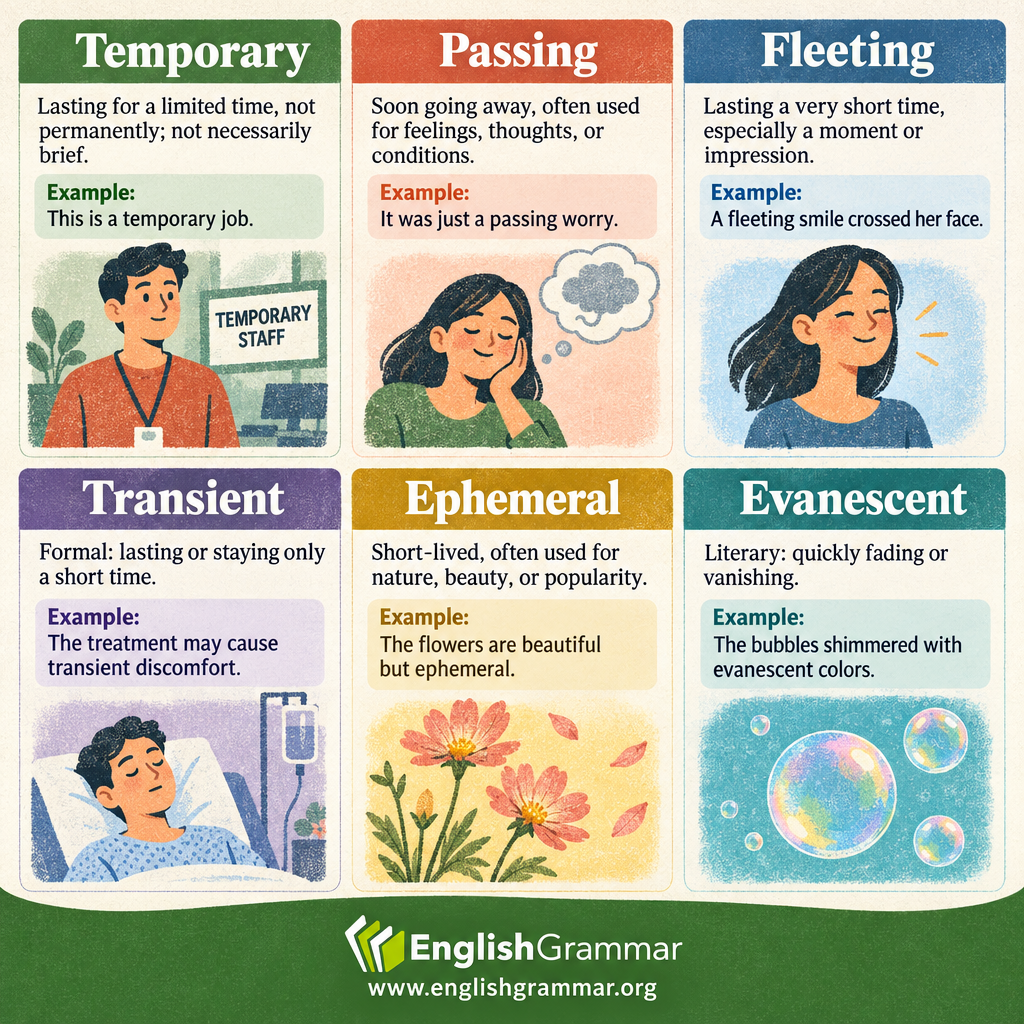
These six adjectives describe things that do not last, but they are not interchangeable in every sentence. Choose according to what is short-lived and what you want to emphasize.
- Temporary is the broad, everyday choice for something that lasts for a limited time rather than permanently. It does not necessarily mean very brief. They moved into temporary accommodation while their house was repaired.
- Passing often describes a feeling, thought, or condition that soon goes away. Her disappointment was only a passing mood. It can suggest that something is not lasting or deeply established.
- Fleeting emphasizes extreme brevity, especially with moments, impressions, or opportunities. I caught a fleeting glimpse of a fox. The emphasis is on how little time the experience lasts.
- Transient is more formal and often describes short-lived conditions or people staying somewhere briefly. The town has a large transient population. Here, the residents do not usually settle permanently.
- Ephemeral means short-lived, often with attention to how quickly something disappears or loses its relevance. Online fame can be ephemeral. It is common in discussions of nature, art, and culture.
- Evanescent is literary and emphasizes fading or vanishing. The mist formed evanescent shapes above the lake. It draws attention to disappearance rather than simply a limited duration.
These are tendencies, not fixed time limits. A temporary arrangement can last months, while a fleeting impression may last only seconds.