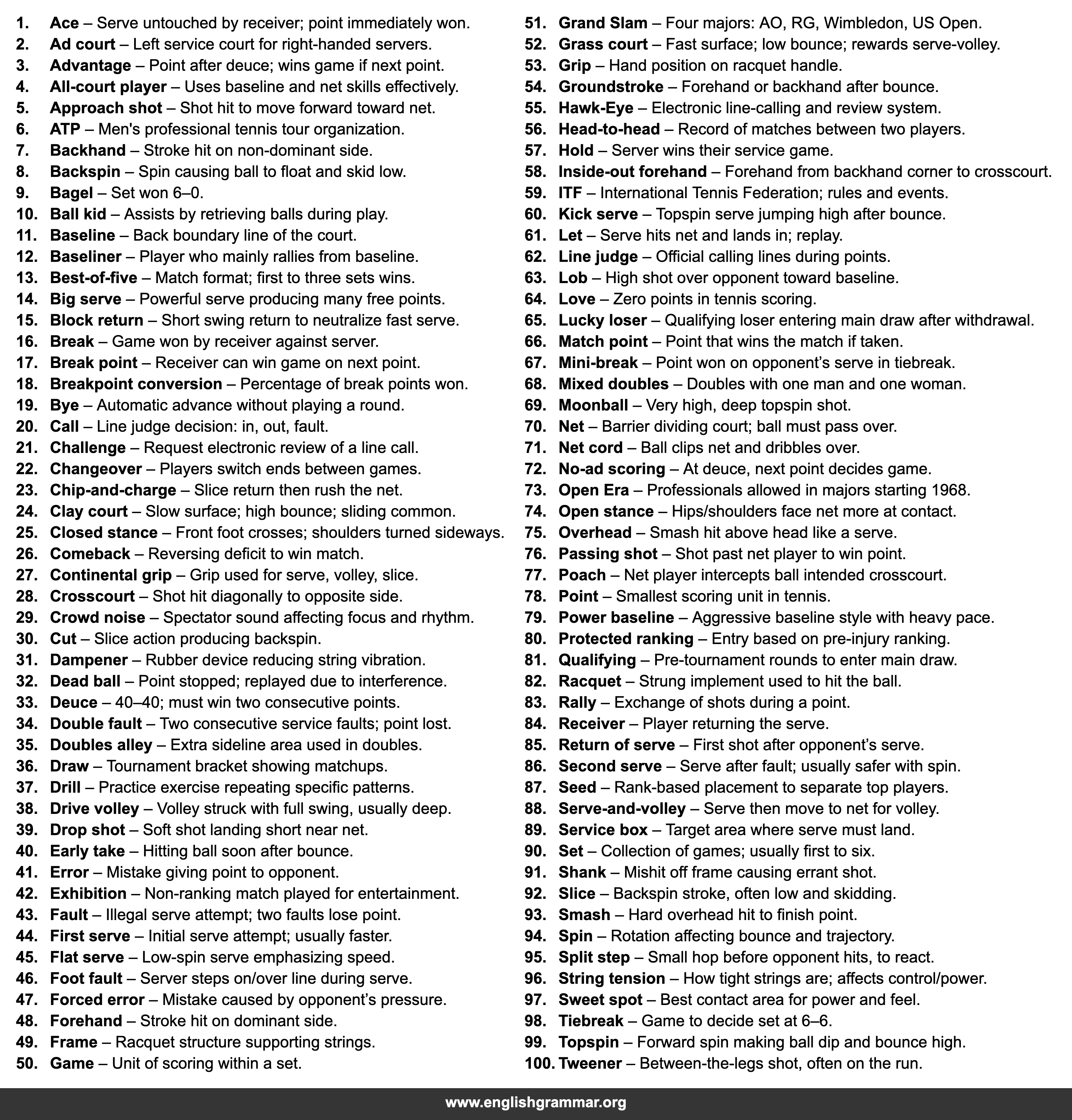
| No. | Term | Definition |
|---|---|---|
| 1. | Ace | Serve untouched by receiver; point immediately won. |
| 2. | Ad court | Left service court for right-handed servers. |
| 3. | Advantage | Point after deuce; wins game if next point. |
| 4. | All-court player | Uses baseline and net skills effectively. |
| 5. | Approach shot | Shot hit to move forward toward net. |
| 6. | ATP | Men’s professional tennis tour organization. |
| 7. | Backhand | Stroke hit on non-dominant side. |
| 8. | Backspin | Spin causing ball to float and skid low. |
| 9. | Bagel | Set won 6–0. |
| 10. | Ball kid | Assists by retrieving balls during play. |
| 11. | Baseline | Back boundary line of the court. |
| 12. | Baseliner | Player who mainly rallies from baseline. |
| 13. | Best-of-five | Match format; first to three sets wins. |
| 14. | Big serve | Powerful serve producing many free points. |
| 15. | Block return | Short swing return to neutralize fast serve. |
| 16. | Break | Game won by receiver against server. |
| 17. | Break point | Receiver can win game on next point. |
| 18. | Breakpoint conversion | Percentage of break points won. |
| 19. | Bye | Automatic advance without playing a round. |
| 20. | Call | Line judge decision: in, out, fault. |
| 21. | Challenge | Request electronic review of a line call. |
| 22. | Changeover | Players switch ends between games. |
| 23. | Chip-and-charge | Slice return then rush the net. |
| 24. | Clay court | Slow surface; high bounce; sliding common. |
| 25. | Closed stance | Front foot crosses; shoulders turned sideways. |
| 26. | Comeback | Reversing deficit to win match. |
| 27. | Continental grip | Grip used for serve, volley, slice. |
| 28. | Crosscourt | Shot hit diagonally to opposite side. |
| 29. | Crowd noise | Spectator sound affecting focus and rhythm. |
| 30. | Cut | Slice action producing backspin. |
| 31. | Dampener | Rubber device reducing string vibration. |
| 32. | Dead ball | Point stopped; replayed due to interference. |
| 33. | Deuce | 40–40; must win two consecutive points. |
| 34. | Double fault | Two consecutive service faults; point lost. |
| 35. | Doubles alley | Extra sideline area used in doubles. |
| 36. | Draw | Tournament bracket showing matchups. |
| 37. | Drill | Practice exercise repeating specific patterns. |
| 38. | Drive volley | Volley struck with full swing, usually deep. |
| 39. | Drop shot | Soft shot landing short near net. |
| 40. | Early take | Hitting ball soon after bounce. |
| 41. | Error | Mistake giving point to opponent. |
| 42. | Exhibition | Non-ranking match played for entertainment. |
| 43. | Fault | Illegal serve attempt; two faults lose point. |
| 44. | First serve | Initial serve attempt; usually faster. |
| 45. | Flat serve | Low-spin serve emphasizing speed. |
| 46. | Foot fault | Server steps on/over line during serve. |
| 47. | Forced error | Mistake caused by opponent’s pressure. |
| 48. | Forehand | Stroke hit on dominant side. |
| 49. | Frame | Racquet structure supporting strings. |
| 50. | Game | Unit of scoring within a set. |
| 51. | Grand Slam | Four majors: AO, RG, Wimbledon, US Open. |
| 52. | Grass court | Fast surface; low bounce; rewards serve-volley. |
| 53. | Grip | Hand position on racquet handle. |
| 54. | Groundstroke | Forehand or backhand after bounce. |
| 55. | Hawk-Eye | Electronic line-calling and review system. |
| 56. | Head-to-head | Record of matches between two players. |
| 57. | Hold | Server wins their service game. |
| 58. | Inside-out forehand | Forehand from backhand corner to crosscourt. |
| 59. | ITF | International Tennis Federation; rules and events. |
| 60. | Kick serve | Topspin serve jumping high after bounce. |
| 61. | Let | Serve hits net and lands in; replay. |
| 62. | Line judge | Official calling lines during points. |
| 63. | Lob | High shot over opponent toward baseline. |
| 64. | Love | Zero points in tennis scoring. |
| 65. | Lucky loser | Qualifying loser entering main draw after withdrawal. |
| 66. | Match point | Point that wins the match if taken. |
| 67. | Mini-break | Point won on opponent’s serve in tiebreak. |
| 68. | Mixed doubles | Doubles with one man and one woman. |
| 69. | Moonball | Very high, deep topspin shot. |
| 70. | Net | Barrier dividing court; ball must pass over. |
| 71. | Net cord | Ball clips net and dribbles over. |
| 72. | No-ad scoring | At deuce, next point decides game. |
| 73. | Open Era | Professionals allowed in majors starting 1968. |
| 74. | Open stance | Hips/shoulders face net more at contact. |
| 75. | Overhead | Smash hit above head like a serve. |
| 76. | Passing shot | Shot past net player to win point. |
| 77. | Poach | Net player intercepts ball intended crosscourt. |
| 78. | Point | Smallest scoring unit in tennis. |
| 79. | Power baseline | Aggressive baseline style with heavy pace. |
| 80. | Protected ranking | Entry based on pre-injury ranking. |
| 81. | Qualifying | Pre-tournament rounds to enter main draw. |
| 82. | Racquet | Strung implement used to hit the ball. |
| 83. | Rally | Exchange of shots during a point. |
| 84. | Receiver | Player returning the serve. |
| 85. | Return of serve | First shot after opponent’s serve. |
| 86. | Second serve | Serve after fault; usually safer with spin. |
| 87. | Seed | Rank-based placement to separate top players. |
| 88. | Serve-and-volley | Serve then move to net for volley. |
| 89. | Service box | Target area where serve must land. |
| 90. | Set | Collection of games; usually first to six. |
| 91. | Shank | Mishit off frame causing errant shot. |
| 92. | Slice | Backspin stroke, often low and skidding. |
| 93. | Smash | Hard overhead hit to finish point. |
| 94. | Spin | Rotation affecting bounce and trajectory. |
| 95. | Split step | Small hop before opponent hits, to react. |
| 96. | String tension | How tight strings are; affects control/power. |
| 97. | Sweet spot | Best contact area for power and feel. |
| 98. | Tiebreak | Game to decide set at 6–6. |
| 99. | Topspin | Forward spin making ball dip and bounce high. |
| 100. | Tweener | Between-the-legs shot, often on the run. |
