
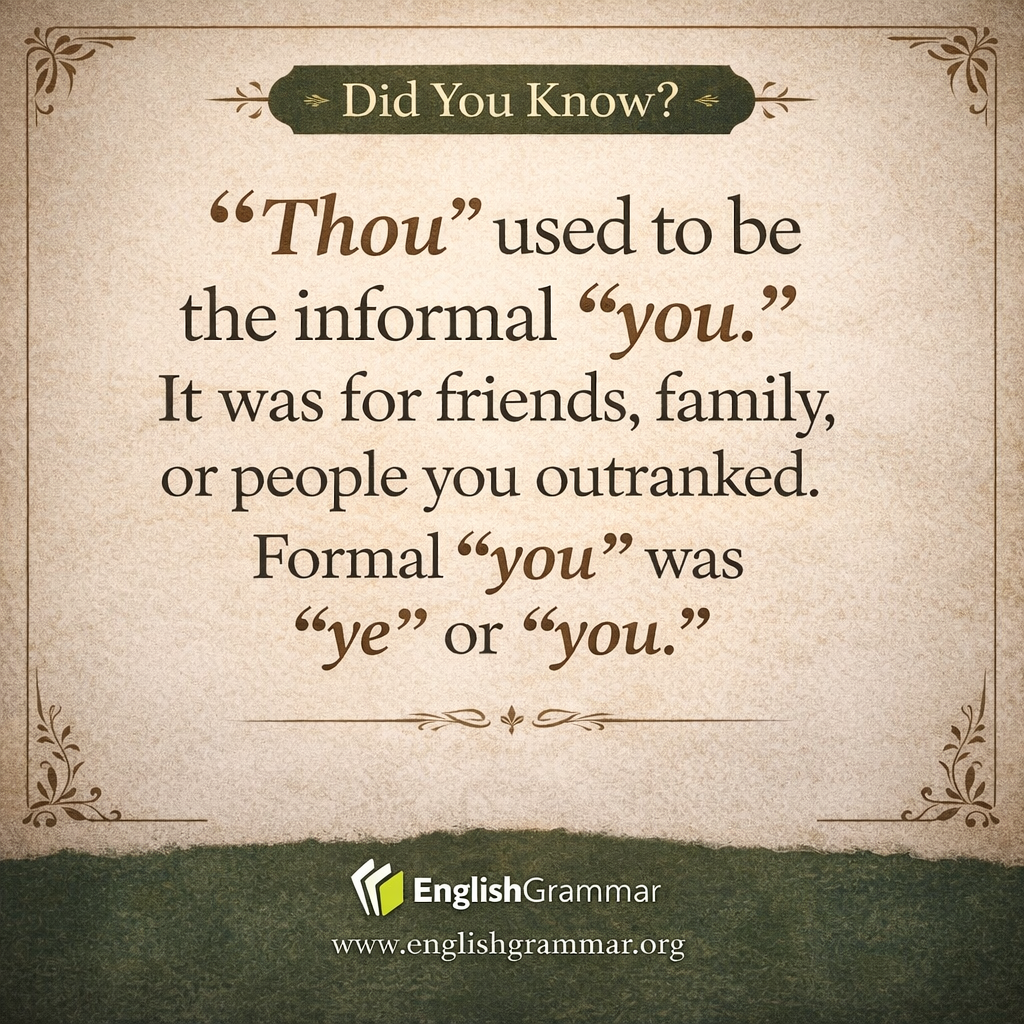
In earlier stages of English, speakers had a clearer choice between informal and formal second person pronouns. Thou was typically the familiar, singular form, used with friends, family, children, or people of lower status. By contrast, ye (subject) and you (object) were associated with more respectful or socially distant address, and were also used for plural “you.”
This system is similar to the difference between informal and formal “you” in languages like French (tu vs. vous) or Spanish (tú vs. usted), although the details vary by time and region.
Here is a simple contrast:
- Informal singular: “Thou art late.”
- More formal or plural: “You are late.”
Over time, English shifted toward using you more broadly, and thou became rare in everyday speech. It survived longer in some dialects and in certain styles of writing, including religious language and poetic or archaic settings. That is why “thou” can sound old fashioned today, even though it once signaled closeness rather than distance.
