
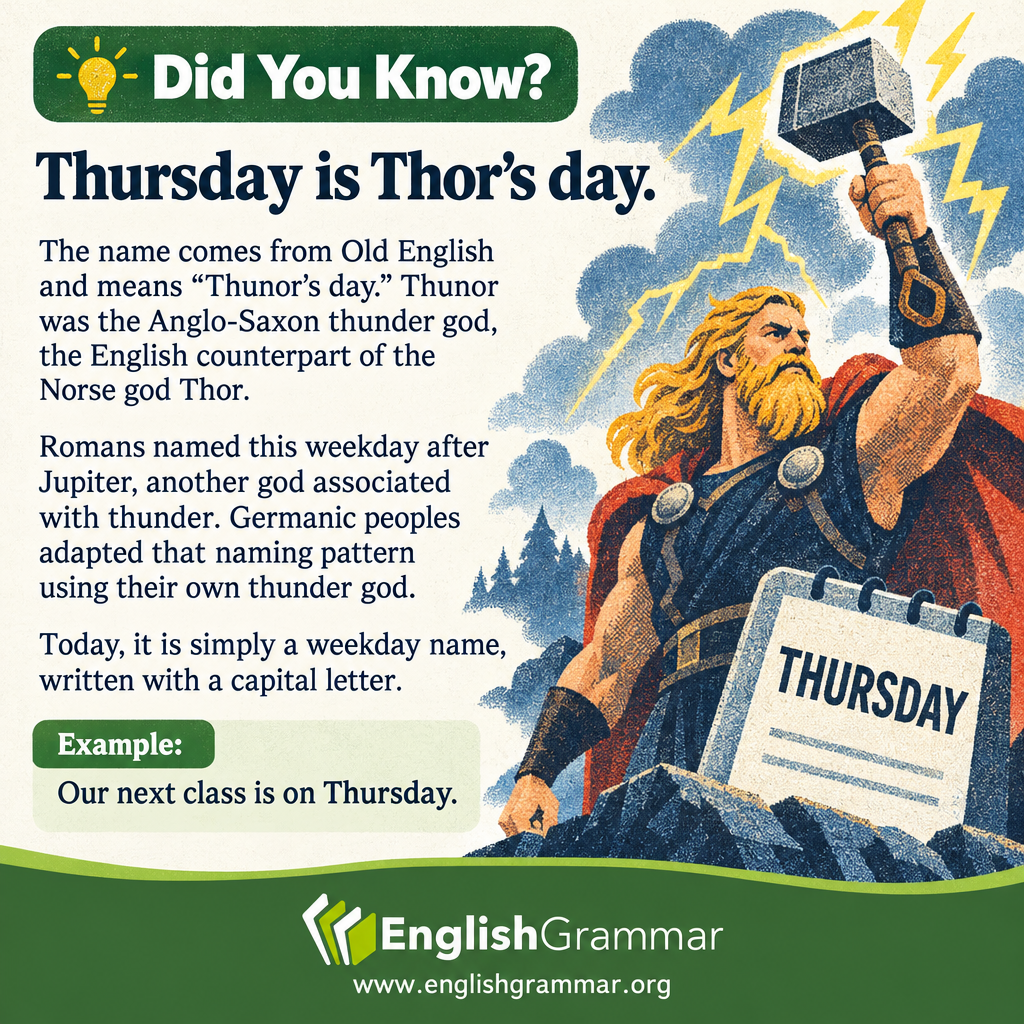
The name Thursday preserves an old connection between weekdays and gods. It comes from Old English and originally meant Thunor’s day. Thunor was the Anglo-Saxon thunder god, the English counterpart of the Norse god Thor.
So calling it “Thor’s day” is a helpful way to explain the connection. More precisely, though, the English name developed from Thunor’s name rather than directly from the Norse name Thor. These were closely related gods in different Germanic traditions.
Why was a thunder god linked to this weekday? In the Roman naming system, this day belonged to Jupiter, a god associated with the sky and thunder. When Germanic peoples adapted the Roman weekday names, they used the name of their own thunder god for the corresponding day.
The Roman connection is still visible in other languages. French jeudi and Spanish jueves, both meaning Thursday, developed from the Latin name referring to Jupiter.
In modern English, the word is simply a weekday name. Using it does not suggest a religious belief. Like all English weekday names, it begins with a capital letter.
- Our next class is on Thursday.
- The library stays open late on Thursdays.
The first example refers to a particular day. The second uses the plural form to describe something that happens regularly on that weekday.