
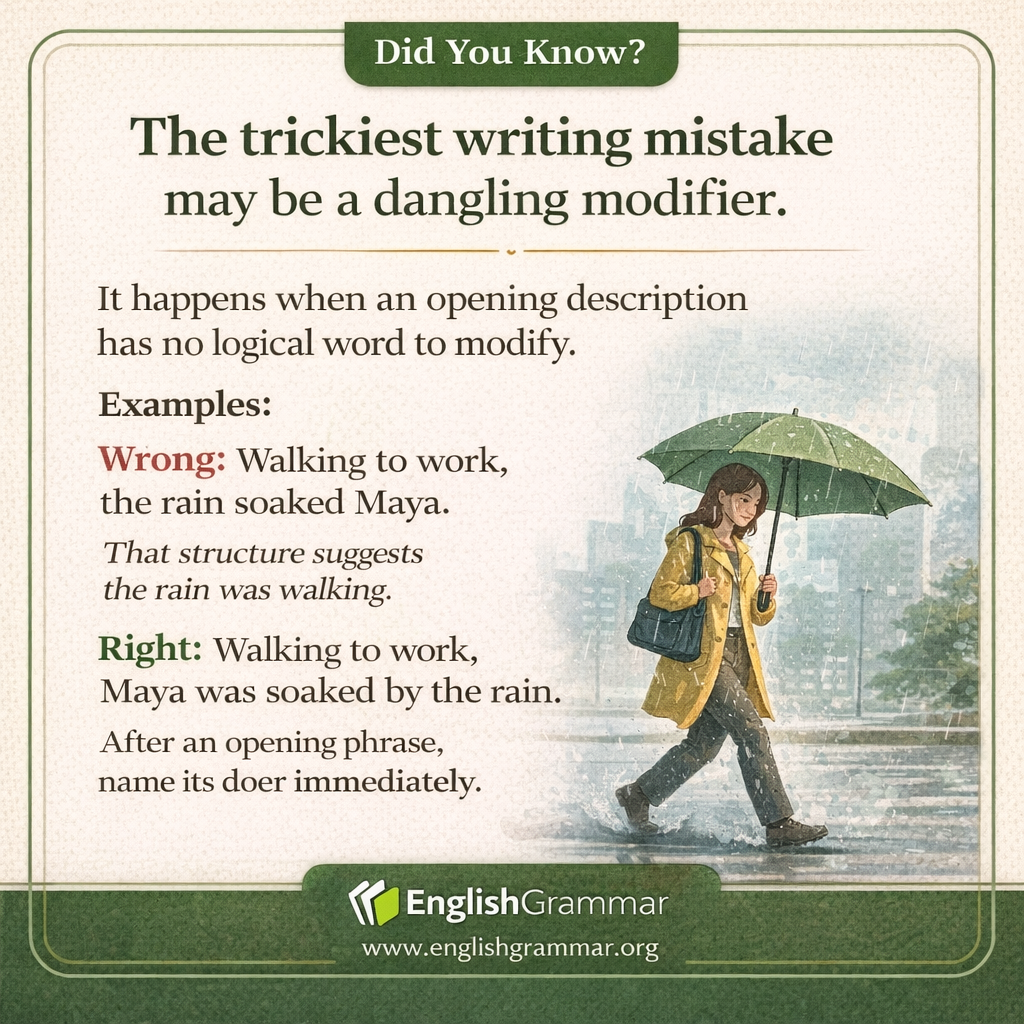
A dangling modifier is an introductory word group that does not logically describe the subject that follows it. Because readers naturally connect an opening modifier to the next noun, the sentence may assign an action or condition to the wrong thing.
Consider: Walking to work, the rain soaked Maya. Grammatically, the rain is the subject after the opening phrase, so the sentence suggests that the rain was walking. The intended doer, Maya, appears too late.
Revise it by placing the intended doer immediately after the modifier: Walking to work, Maya was soaked by the rain. You can also rewrite the thought as a complete clause: While Maya was walking to work, the rain soaked her.
Dangling modifiers often begin with participles, infinitives, or shortened clauses:
- Wrong: After reading the report, the conclusion seemed obvious. The conclusion did not read.
- Right: After reading the report, Lena found the conclusion obvious.
- Wrong: To improve the recipe, more salt was added. The salt had no intention to improve anything.
- Right: To improve the recipe, the chef added more salt.
A misplaced modifier is related but different. It has a word to modify, yet its position creates the wrong connection. In She almost edited every page, almost suggests she did not edit any page. If she edited most pages, write She edited almost every page.
When proofreading, underline each opening phrase and ask, “Who performs this action?” Put that person or thing directly after the comma. This quick test catches errors that spelling and grammar tools may miss.