
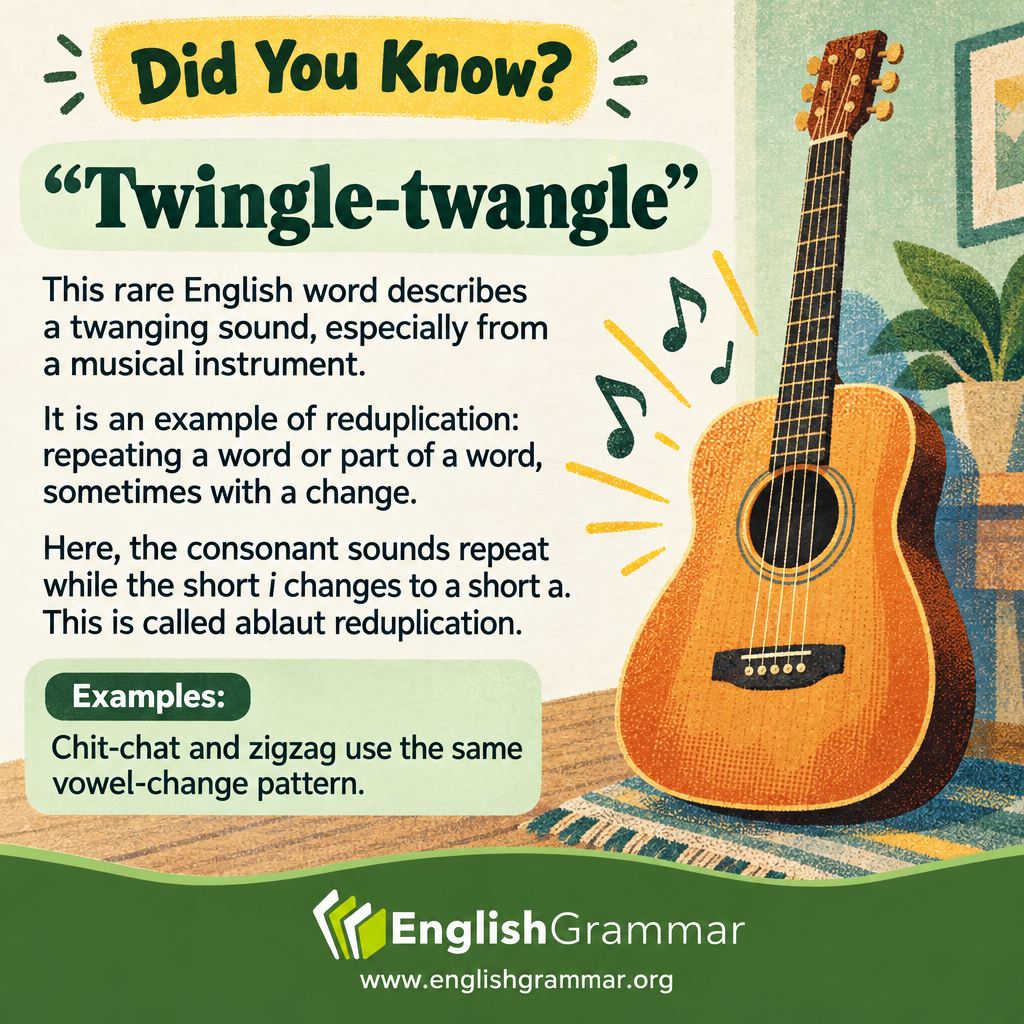
“Twingle-twangle” is a real, though rare, English word for a twanging sound, especially one made by a musical instrument. It is sound-imitating: its playful rhythm helps suggest the noise it describes. You are unlikely to need it in everyday conversation, but it offers a useful way to understand a broader word pattern.
Reduplication means repeating a word or part of a word to create a new form. The repetition does not have to be exact. Sometimes the consonant sounds stay the same while a vowel changes.
That is what happens here: the short i sound in the first part changes to the short a sound in the second. This pattern is called ablaut reduplication. The technical name simply describes repetition with a vowel change.
Two much more familiar examples show the same pattern:
- Chit-chat means informal conversation. Example: We had a little chit-chat before the meeting.
- Zigzag describes a line or movement with repeated sharp turns. Example: The path follows a zigzag route up the hill.
In these words, the short i comes before the short a. English has other vowel-changing pairs too, such as tick-tock, so not every example uses the same two vowels.
The useful distinction is between exact repetition and repetition with a change. Both can count as reduplication; the second part does not need to be an identical copy.