
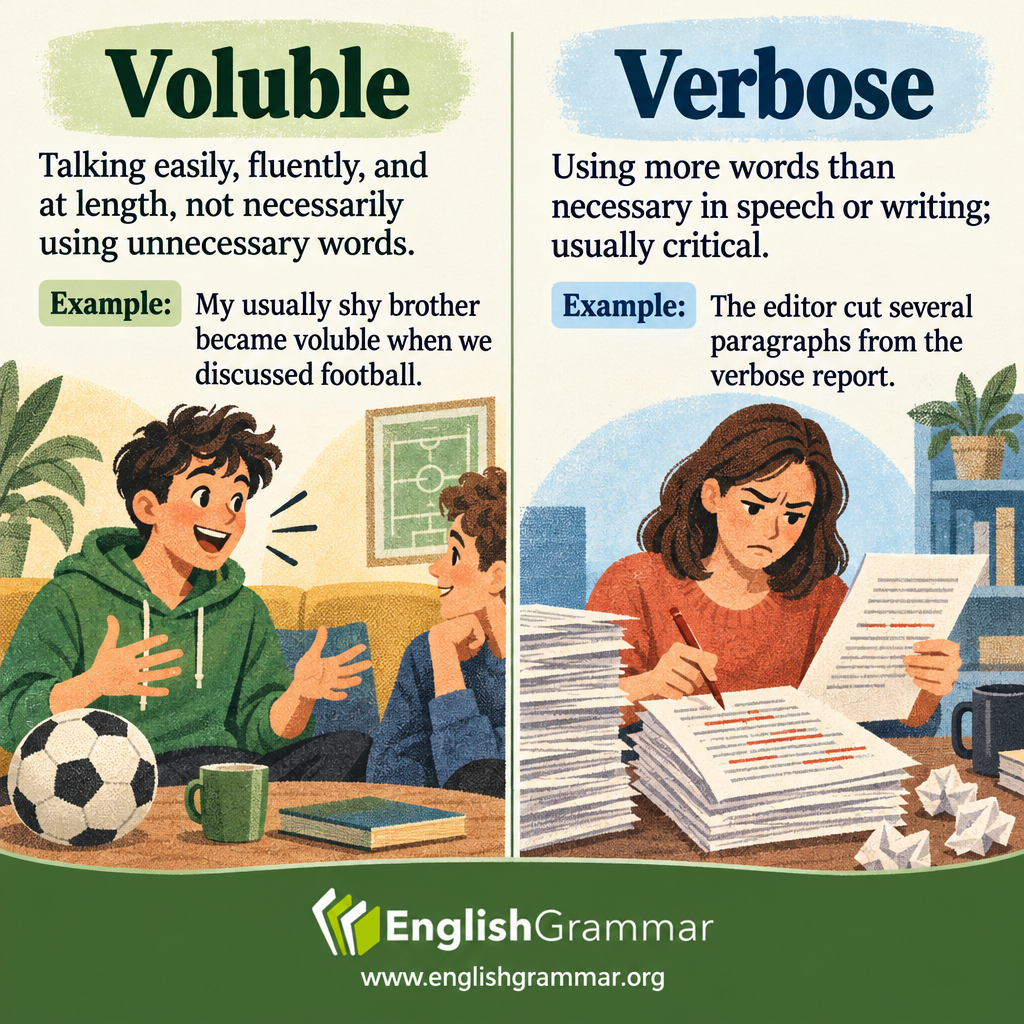
Voluble and verbose both suggest plenty of words, but they draw attention to different things. One describes how someone talks; the other judges how efficiently someone communicates.
Voluble usually describes a person who talks easily, fluently, and at length. It can also describe their speech. The word does not, by itself, mean that their words are unnecessary. Depending on the context, the speaker might seem lively, enthusiastic, or tiring.
- Our normally quiet neighbor became voluble when we asked about her garden.
- He gave a voluble account of his adventures abroad.
Verbose means using more words than necessary. It usually expresses criticism: the message could be shorter without losing its meaning. Use it for speech or writing, including explanations, reports, emails, and a person’s communication style.
- The instructions were so verbose that I struggled to find the first step.
- Her verbose answer turned a simple question into a ten-minute discussion.
These descriptions can overlap. A lively storyteller may speak fluently for a long time without wasting words. A short email, however, can still be verbose if it makes a simple point unnecessarily complicated.
Before choosing, ask what you want to emphasize. Are you describing someone’s easy flow of talk, or suggesting that the wording needs cutting? Neither word simply measures the length of a conversation or a document.