
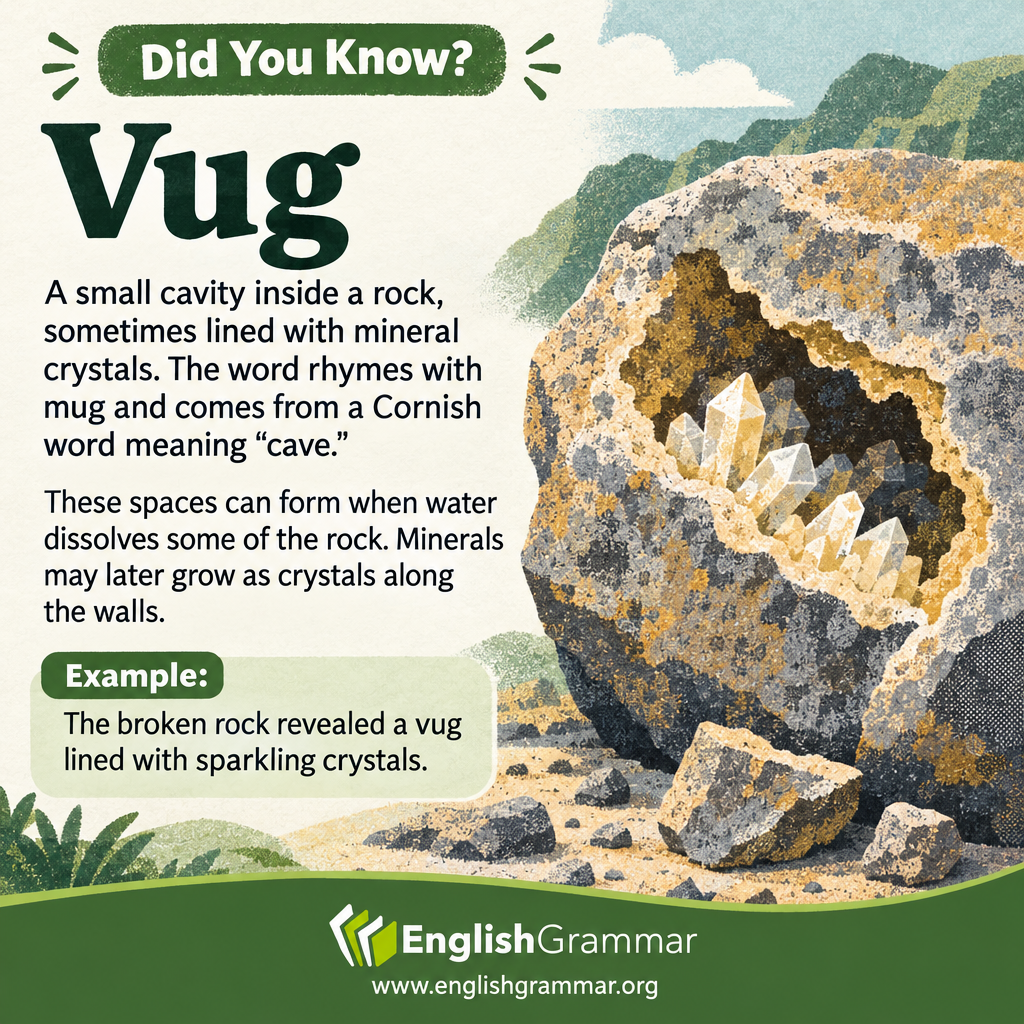
A rock can look solid on the outside but have small spaces inside. Geologists call a small cavity within rock a vug. The space may be empty, partly filled with minerals, or lined with crystals.
The word rhymes with mug and rug. It comes from a Cornish word meaning “cave,” which offers a useful connection: think of a tiny cave inside a rock, rather than a cave that a person could enter.
How does the space form? One way is through dissolving. Water moving through rock can dissolve some of its material, leaving a cavity behind. Minerals carried by water may later form crystals along the cavity’s walls. Not every cavity has an impressive crystal display, however.
Examples in sentences:
- The geologist found a vug lined with quartz crystals.
- Several small vugs became visible when the rock was cut open.
The plural is simply vugs. You are most likely to meet the word in geology, mining, or descriptions of mineral specimens. In everyday conversation, a small cavity in the rock explains the same basic idea without specialist vocabulary.
Do not use the word for every mark on a stone. A surface scratch or a narrow crack is not necessarily a cavity. The important feature is a small hollow space within the rock, which may become visible when the rock breaks or is cut.