
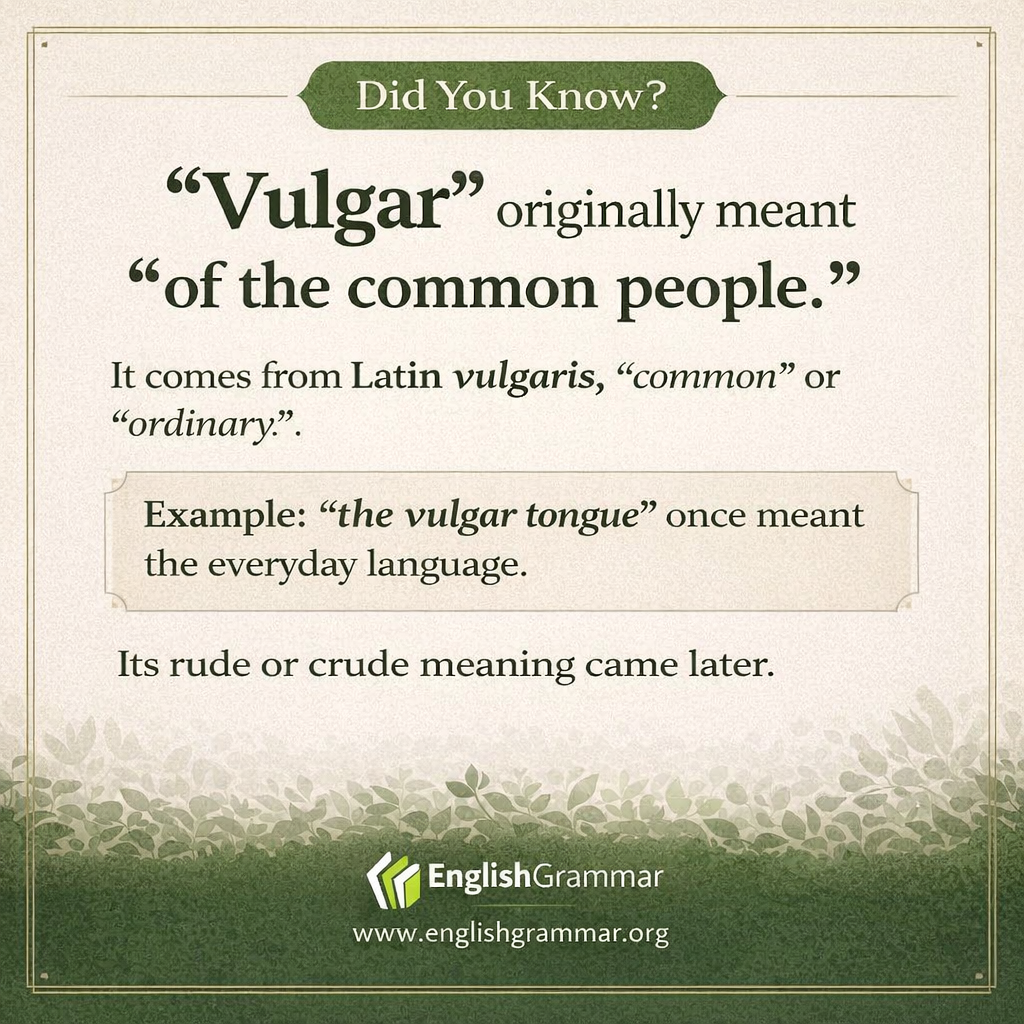
Vulgar did not originally mean rude, crude, or offensive. In earlier English, it meant common, ordinary, or of the common people. The word comes from Latin vulgaris, which carried the idea of what belongs to the general public rather than to an elite group.
One place this older meaning appears is in language. The phrase the vulgar tongue once meant the everyday language people actually spoke, not a refined or scholarly language like Latin. In that sense, vulgar was descriptive, not insulting.
Over time, the word took on a negative tone. Because it referred to what was associated with ordinary people, it gradually shifted toward meanings like coarse, uncultured, or offensively crude. That later sense is now the main one in modern English.
- Older sense: vulgar speech could mean common, everyday speech.
- Modern sense: a vulgar joke means a crude or offensive joke.
This kind of change is common in language history. A neutral word can become negative over time as social attitudes change.