
• Skip to primary navigation
  • Skip to main content
  • Skip to primary sidebar
Home of English Grammar
  • Home
  • Course
  • Exercises
  • Grammar Rules
  • Matches
  • Posts
  • Tools
    • Grammar Checker
    • Very Replacer
    • Word Counter
  • Vocabulary Lists
    • My Word Lists
  • For Teachers
  • Archives
    • Social Media Posts
    • Writing Guides
  • Sign in
  • Join free

Warn vs. caution vs. alert vs. notify vs. forewarn vs. threaten

November 17, 2026

Warn vs. Caution vs. Alert vs. Notify vs. Forewarn vs. Threaten

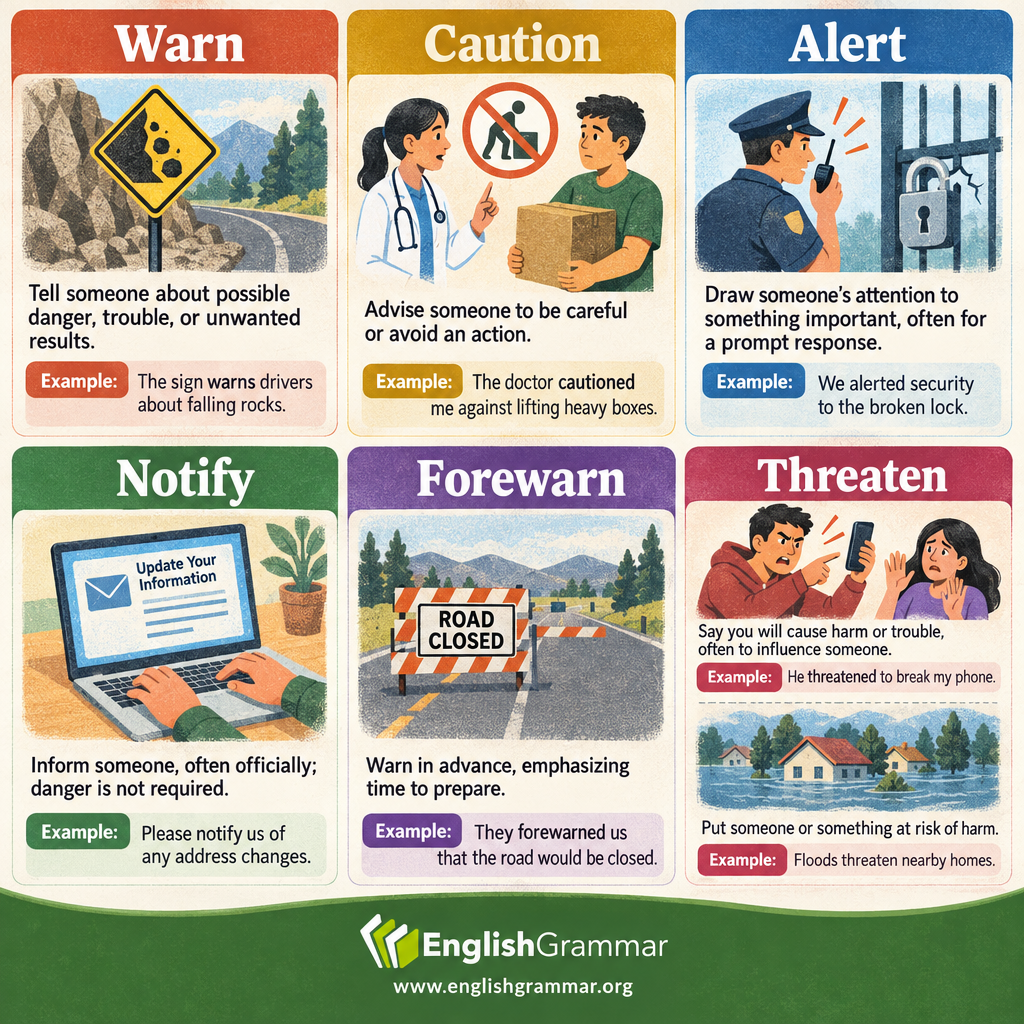
These six verbs all involve information or danger, but they are not interchangeable. Choose according to what the speaker is doing.

  • Warn means telling someone about possible danger, trouble, or unwanted results. The mechanic warned us that the brakes might fail. It is a broad choice when someone needs to know about a risk.
  • Caution emphasizes advising care or advising against an action. Our guide cautioned us against walking on the ice. It often sounds more formal than everyday advice, but it does not necessarily describe a smaller danger.
  • Alert emphasizes drawing attention to something important, often so someone can respond promptly. A neighbour alerted firefighters to the smoke. The information need not always concern danger.
  • Notify means informing someone, often officially. The school notified parents of the new timetable. Unlike a warning, a notification can concern an ordinary administrative change.
  • Forewarn explicitly emphasizes giving a warning in advance, allowing preparation. She forewarned me that the interview would be demanding. Ordinary warnings also commonly come before trouble; this word makes the timing especially clear.
  • Threaten can mean saying that you will cause harm or trouble: The caller threatened to damage our car. It can also mean putting something at risk: The drought threatens local crops. This second use does not require an intentional action.

Useful patterns include warn someone about a risk, caution someone against an action, alert someone to a problem, and notify someone of a change. Context matters: a statement presented as a warning can also function as a threat.

Improve your English grammar, vocabulary and writing

We take you step by step from beginner to advanced, even if you struggled with English at school or have always had trouble remembering the rules.

  • 11 modules, 124 lessons and 819 questions
  • Just log in and learn anytime and anywhere
  • Your progress is saved in your account
  • Download the 2027 Grammar Guide (PDF)
Join free

Already have an account? Sign in

See what’s in the course

Primary sidebar

2.4M760.9K165.9K

Free 2027 Grammar Guide

  • Download Grammar Guide (PDF)
  • Online grammar course, A1 to C2
  • Weekly exercises and vocabulary
  • Join over 3 million English learners

We respect your privacy. Unsubscribe anytime.

Already have an account? Sign in

Grammar Checker - Try Now

Rankings

Home of English Grammar

Free exercises, a step-by-step grammar course, rules and vocabulary lists, with new exercises every week. Join the leading English grammar site with over 3 million followers.

Join free

Learn

  • Exercises
  • Grammar course
  • Level test
  • Matches
  • Grammar rules
  • Vocabulary lists
  • Writing guides
  • Online tools

More

  • Top social media posts
  • Various posts
  • For teachers
  • Contact

Account

  • Join free
  • My word lists
  • Free grammar guide (PDF)

Copyright © 2026 EnglishGrammar.org

  • Disclaimer
  • Privacy policy
  • Terms
  • Sitemap