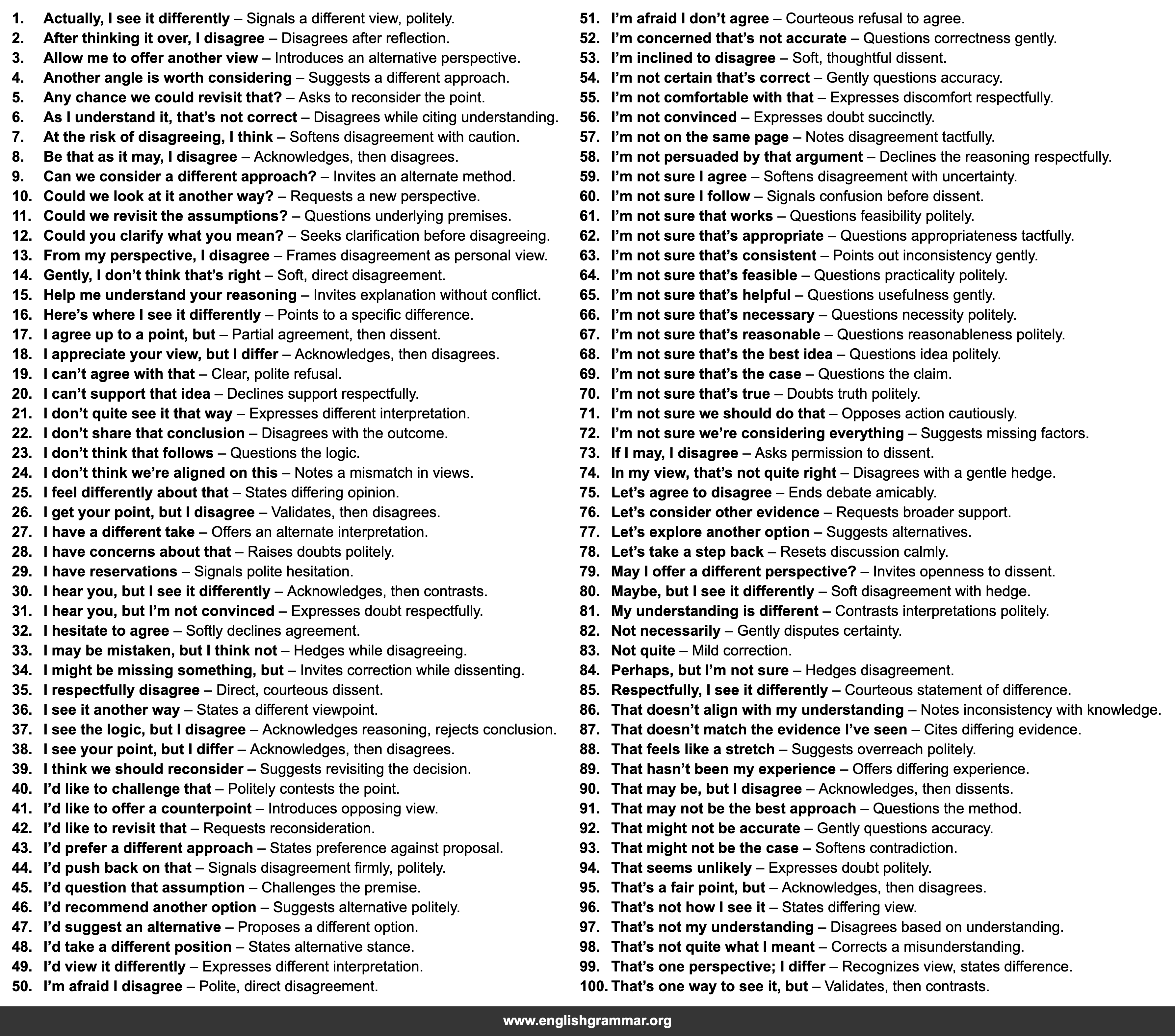
| No. | Term | Definition |
|---|---|---|
| 1. | Actually, I see it differently | Signals a different view, politely. |
| 2. | After thinking it over, I disagree | Disagrees after reflection. |
| 3. | Allow me to offer another view | Introduces an alternative perspective. |
| 4. | Another angle is worth considering | Suggests a different approach. |
| 5. | Any chance we could revisit that? | Asks to reconsider the point. |
| 6. | As I understand it, that’s not correct | Disagrees while citing understanding. |
| 7. | At the risk of disagreeing, I think | Softens disagreement with caution. |
| 8. | Be that as it may, I disagree | Acknowledges, then disagrees. |
| 9. | Can we consider a different approach? | Invites an alternate method. |
| 10. | Could we look at it another way? | Requests a new perspective. |
| 11. | Could we revisit the assumptions? | Questions underlying premises. |
| 12. | Could you clarify what you mean? | Seeks clarification before disagreeing. |
| 13. | From my perspective, I disagree | Frames disagreement as personal view. |
| 14. | Gently, I don’t think that’s right | Soft, direct disagreement. |
| 15. | Help me understand your reasoning | Invites explanation without conflict. |
| 16. | Here’s where I see it differently | Points to a specific difference. |
| 17. | I agree up to a point, but | Partial agreement, then dissent. |
| 18. | I appreciate your view, but I differ | Acknowledges, then disagrees. |
| 19. | I can’t agree with that | Clear, polite refusal. |
| 20. | I can’t support that idea | Declines support respectfully. |
| 21. | I don’t quite see it that way | Expresses different interpretation. |
| 22. | I don’t share that conclusion | Disagrees with the outcome. |
| 23. | I don’t think that follows | Questions the logic. |
| 24. | I don’t think we’re aligned on this | Notes a mismatch in views. |
| 25. | I feel differently about that | States differing opinion. |
| 26. | I get your point, but I disagree | Validates, then disagrees. |
| 27. | I have a different take | Offers an alternate interpretation. |
| 28. | I have concerns about that | Raises doubts politely. |
| 29. | I have reservations | Signals polite hesitation. |
| 30. | I hear you, but I see it differently | Acknowledges, then contrasts. |
| 31. | I hear you, but I’m not convinced | Expresses doubt respectfully. |
| 32. | I hesitate to agree | Softly declines agreement. |
| 33. | I may be mistaken, but I think not | Hedges while disagreeing. |
| 34. | I might be missing something, but | Invites correction while dissenting. |
| 35. | I respectfully disagree | Direct, courteous dissent. |
| 36. | I see it another way | States a different viewpoint. |
| 37. | I see the logic, but I disagree | Acknowledges reasoning, rejects conclusion. |
| 38. | I see your point, but I differ | Acknowledges, then disagrees. |
| 39. | I think we should reconsider | Suggests revisiting the decision. |
| 40. | I’d like to challenge that | Politely contests the point. |
| 41. | I’d like to offer a counterpoint | Introduces opposing view. |
| 42. | I’d like to revisit that | Requests reconsideration. |
| 43. | I’d prefer a different approach | States preference against proposal. |
| 44. | I’d push back on that | Signals disagreement firmly, politely. |
| 45. | I’d question that assumption | Challenges the premise. |
| 46. | I’d recommend another option | Suggests alternative politely. |
| 47. | I’d suggest an alternative | Proposes a different option. |
| 48. | I’d take a different position | States alternative stance. |
| 49. | I’d view it differently | Expresses different interpretation. |
| 50. | I’m afraid I disagree | Polite, direct disagreement. |
| 51. | I’m afraid I don’t agree | Courteous refusal to agree. |
| 52. | I’m concerned that’s not accurate | Questions correctness gently. |
| 53. | I’m inclined to disagree | Soft, thoughtful dissent. |
| 54. | I’m not certain that’s correct | Gently questions accuracy. |
| 55. | I’m not comfortable with that | Expresses discomfort respectfully. |
| 56. | I’m not convinced | Expresses doubt succinctly. |
| 57. | I’m not on the same page | Notes disagreement tactfully. |
| 58. | I’m not persuaded by that argument | Declines the reasoning respectfully. |
| 59. | I’m not sure I agree | Softens disagreement with uncertainty. |
| 60. | I’m not sure I follow | Signals confusion before dissent. |
| 61. | I’m not sure that works | Questions feasibility politely. |
| 62. | I’m not sure that’s appropriate | Questions appropriateness tactfully. |
| 63. | I’m not sure that’s consistent | Points out inconsistency gently. |
| 64. | I’m not sure that’s feasible | Questions practicality politely. |
| 65. | I’m not sure that’s helpful | Questions usefulness gently. |
| 66. | I’m not sure that’s necessary | Questions necessity politely. |
| 67. | I’m not sure that’s reasonable | Questions reasonableness politely. |
| 68. | I’m not sure that’s the best idea | Questions idea politely. |
| 69. | I’m not sure that’s the case | Questions the claim. |
| 70. | I’m not sure that’s true | Doubts truth politely. |
| 71. | I’m not sure we should do that | Opposes action cautiously. |
| 72. | I’m not sure we’re considering everything | Suggests missing factors. |
| 73. | If I may, I disagree | Asks permission to dissent. |
| 74. | In my view, that’s not quite right | Disagrees with a gentle hedge. |
| 75. | Let’s agree to disagree | Ends debate amicably. |
| 76. | Let’s consider other evidence | Requests broader support. |
| 77. | Let’s explore another option | Suggests alternatives. |
| 78. | Let’s take a step back | Resets discussion calmly. |
| 79. | May I offer a different perspective? | Invites openness to dissent. |
| 80. | Maybe, but I see it differently | Soft disagreement with hedge. |
| 81. | My understanding is different | Contrasts interpretations politely. |
| 82. | Not necessarily | Gently disputes certainty. |
| 83. | Not quite | Mild correction. |
| 84. | Perhaps, but I’m not sure | Hedges disagreement. |
| 85. | Respectfully, I see it differently | Courteous statement of difference. |
| 86. | That doesn’t align with my understanding | Notes inconsistency with knowledge. |
| 87. | That doesn’t match the evidence I’ve seen | Cites differing evidence. |
| 88. | That feels like a stretch | Suggests overreach politely. |
| 89. | That hasn’t been my experience | Offers differing experience. |
| 90. | That may be, but I disagree | Acknowledges, then dissents. |
| 91. | That may not be the best approach | Questions the method. |
| 92. | That might not be accurate | Gently questions accuracy. |
| 93. | That might not be the case | Softens contradiction. |
| 94. | That seems unlikely | Expresses doubt politely. |
| 95. | That’s a fair point, but | Acknowledges, then disagrees. |
| 96. | That’s not how I see it | States differing view. |
| 97. | That’s not my understanding | Disagrees based on understanding. |
| 98. | That’s not quite what I meant | Corrects a misunderstanding. |
| 99. | That’s one perspective; I differ | Recognizes view, states difference. |
| 100. | That’s one way to see it, but | Validates, then contrasts. |
