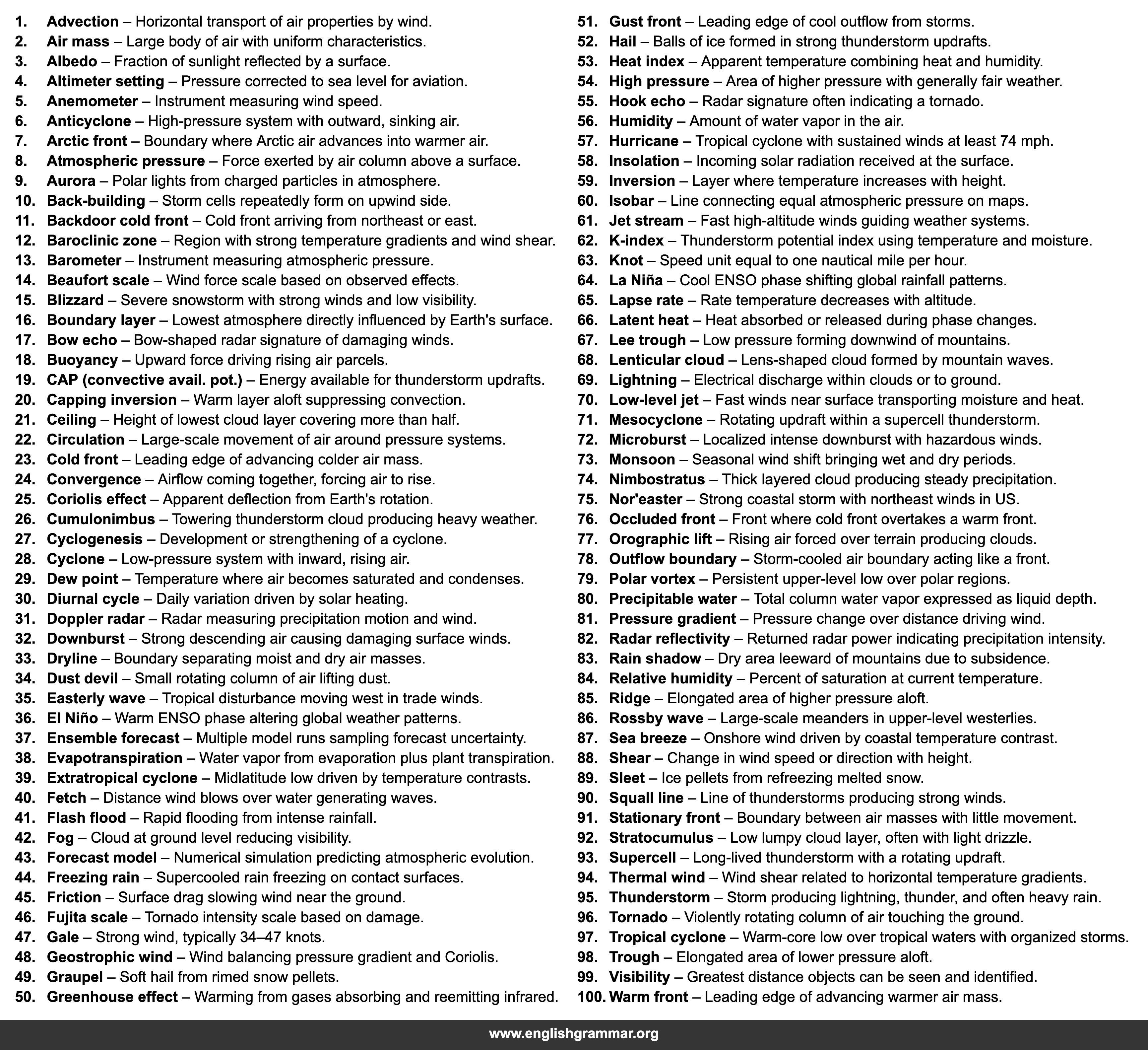
| No. | Term | Definition |
|---|---|---|
| 1. | Advection | Horizontal transport of air properties by wind. |
| 2. | Air mass | Large body of air with uniform characteristics. |
| 3. | Albedo | Fraction of sunlight reflected by a surface. |
| 4. | Altimeter setting | Pressure corrected to sea level for aviation. |
| 5. | Anemometer | Instrument measuring wind speed. |
| 6. | Anticyclone | High-pressure system with outward, sinking air. |
| 7. | Arctic front | Boundary where Arctic air advances into warmer air. |
| 8. | Atmospheric pressure | Force exerted by air column above a surface. |
| 9. | Aurora | Polar lights from charged particles in atmosphere. |
| 10. | Back-building | Storm cells repeatedly form on upwind side. |
| 11. | Backdoor cold front | Cold front arriving from northeast or east. |
| 12. | Baroclinic zone | Region with strong temperature gradients and wind shear. |
| 13. | Barometer | Instrument measuring atmospheric pressure. |
| 14. | Beaufort scale | Wind force scale based on observed effects. |
| 15. | Blizzard | Severe snowstorm with strong winds and low visibility. |
| 16. | Boundary layer | Lowest atmosphere directly influenced by Earth’s surface. |
| 17. | Bow echo | Bow-shaped radar signature of damaging winds. |
| 18. | Buoyancy | Upward force driving rising air parcels. |
| 19. | CAP (convective avail. pot.) | Energy available for thunderstorm updrafts. |
| 20. | Capping inversion | Warm layer aloft suppressing convection. |
| 21. | Ceiling | Height of lowest cloud layer covering more than half. |
| 22. | Circulation | Large-scale movement of air around pressure systems. |
| 23. | Cold front | Leading edge of advancing colder air mass. |
| 24. | Convergence | Airflow coming together, forcing air to rise. |
| 25. | Coriolis effect | Apparent deflection from Earth’s rotation. |
| 26. | Cumulonimbus | Towering thunderstorm cloud producing heavy weather. |
| 27. | Cyclogenesis | Development or strengthening of a cyclone. |
| 28. | Cyclone | Low-pressure system with inward, rising air. |
| 29. | Dew point | Temperature where air becomes saturated and condenses. |
| 30. | Diurnal cycle | Daily variation driven by solar heating. |
| 31. | Doppler radar | Radar measuring precipitation motion and wind. |
| 32. | Downburst | Strong descending air causing damaging surface winds. |
| 33. | Dryline | Boundary separating moist and dry air masses. |
| 34. | Dust devil | Small rotating column of air lifting dust. |
| 35. | Easterly wave | Tropical disturbance moving west in trade winds. |
| 36. | El Niño | Warm ENSO phase altering global weather patterns. |
| 37. | Ensemble forecast | Multiple model runs sampling forecast uncertainty. |
| 38. | Evapotranspiration | Water vapor from evaporation plus plant transpiration. |
| 39. | Extratropical cyclone | Midlatitude low driven by temperature contrasts. |
| 40. | Fetch | Distance wind blows over water generating waves. |
| 41. | Flash flood | Rapid flooding from intense rainfall. |
| 42. | Fog | Cloud at ground level reducing visibility. |
| 43. | Forecast model | Numerical simulation predicting atmospheric evolution. |
| 44. | Freezing rain | Supercooled rain freezing on contact surfaces. |
| 45. | Friction | Surface drag slowing wind near the ground. |
| 46. | Fujita scale | Tornado intensity scale based on damage. |
| 47. | Gale | Strong wind, typically 34–47 knots. |
| 48. | Geostrophic wind | Wind balancing pressure gradient and Coriolis. |
| 49. | Graupel | Soft hail from rimed snow pellets. |
| 50. | Greenhouse effect | Warming from gases absorbing and reemitting infrared. |
| 51. | Gust front | Leading edge of cool outflow from storms. |
| 52. | Hail | Balls of ice formed in strong thunderstorm updrafts. |
| 53. | Heat index | Apparent temperature combining heat and humidity. |
| 54. | High pressure | Area of higher pressure with generally fair weather. |
| 55. | Hook echo | Radar signature often indicating a tornado. |
| 56. | Humidity | Amount of water vapor in the air. |
| 57. | Hurricane | Tropical cyclone with sustained winds at least 74 mph. |
| 58. | Insolation | Incoming solar radiation received at the surface. |
| 59. | Inversion | Layer where temperature increases with height. |
| 60. | Isobar | Line connecting equal atmospheric pressure on maps. |
| 61. | Jet stream | Fast high-altitude winds guiding weather systems. |
| 62. | K-index | Thunderstorm potential index using temperature and moisture. |
| 63. | Knot | Speed unit equal to one nautical mile per hour. |
| 64. | La Niña | Cool ENSO phase shifting global rainfall patterns. |
| 65. | Lapse rate | Rate temperature decreases with altitude. |
| 66. | Latent heat | Heat absorbed or released during phase changes. |
| 67. | Lee trough | Low pressure forming downwind of mountains. |
| 68. | Lenticular cloud | Lens-shaped cloud formed by mountain waves. |
| 69. | Lightning | Electrical discharge within clouds or to ground. |
| 70. | Low-level jet | Fast winds near surface transporting moisture and heat. |
| 71. | Mesocyclone | Rotating updraft within a supercell thunderstorm. |
| 72. | Microburst | Localized intense downburst with hazardous winds. |
| 73. | Monsoon | Seasonal wind shift bringing wet and dry periods. |
| 74. | Nimbostratus | Thick layered cloud producing steady precipitation. |
| 75. | Nor’easter | Strong coastal storm with northeast winds in US. |
| 76. | Occluded front | Front where cold front overtakes a warm front. |
| 77. | Orographic lift | Rising air forced over terrain producing clouds. |
| 78. | Outflow boundary | Storm-cooled air boundary acting like a front. |
| 79. | Polar vortex | Persistent upper-level low over polar regions. |
| 80. | Precipitable water | Total column water vapor expressed as liquid depth. |
| 81. | Pressure gradient | Pressure change over distance driving wind. |
| 82. | Radar reflectivity | Returned radar power indicating precipitation intensity. |
| 83. | Rain shadow | Dry area leeward of mountains due to subsidence. |
| 84. | Relative humidity | Percent of saturation at current temperature. |
| 85. | Ridge | Elongated area of higher pressure aloft. |
| 86. | Rossby wave | Large-scale meanders in upper-level westerlies. |
| 87. | Sea breeze | Onshore wind driven by coastal temperature contrast. |
| 88. | Shear | Change in wind speed or direction with height. |
| 89. | Sleet | Ice pellets from refreezing melted snow. |
| 90. | Squall line | Line of thunderstorms producing strong winds. |
| 91. | Stationary front | Boundary between air masses with little movement. |
| 92. | Stratocumulus | Low lumpy cloud layer, often with light drizzle. |
| 93. | Supercell | Long-lived thunderstorm with a rotating updraft. |
| 94. | Thermal wind | Wind shear related to horizontal temperature gradients. |
| 95. | Thunderstorm | Storm producing lightning, thunder, and often heavy rain. |
| 96. | Tornado | Violently rotating column of air touching the ground. |
| 97. | Tropical cyclone | Warm-core low over tropical waters with organized storms. |
| 98. | Trough | Elongated area of lower pressure aloft. |
| 99. | Visibility | Greatest distance objects can be seen and identified. |
| 100. | Warm front | Leading edge of advancing warmer air mass. |
