
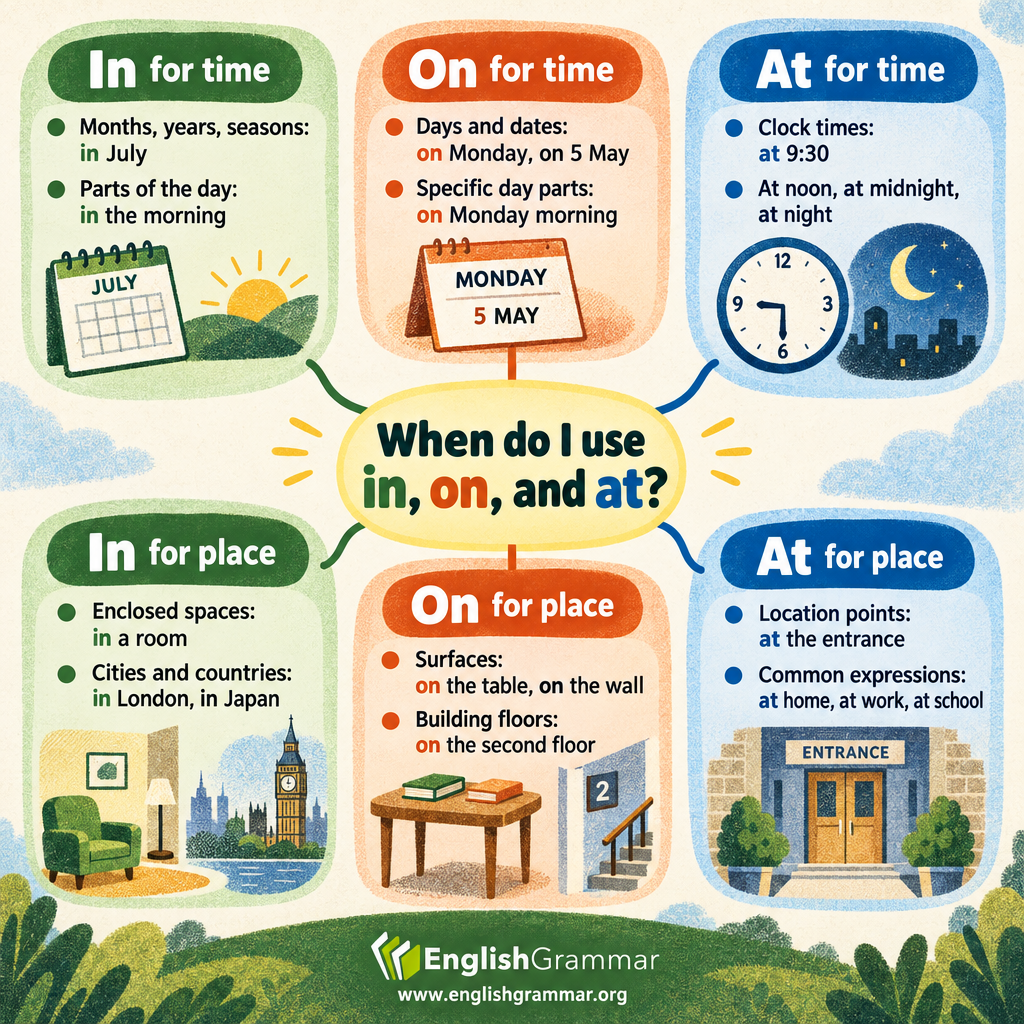
In, on, and at are prepositions commonly used to describe time and place. The best choice depends on how we describe the time or location, not simply on its size. These common patterns provide a useful starting point.
In for time
- Use in with months, years, and seasons: in July, in 2026, in summer.
- Use it with parts of the day: in the morning, in the afternoon, in the evening. Notice the exception at night.
On for time
- Use on with days and dates: on Monday, on 5 May.
- Use it when a part of the day belongs to a particular day: on Monday morning. Compare I study in the morning with I have a test on Monday morning.
At for time
- Use at with clock times: The lesson starts at 9:30.
- Use it in expressions such as at noon, at midnight, and at night.
In for place
- Use in for being inside an enclosed space: in a room, in a box.
- Use it for locations within larger areas, including cities and countries: in London, in Japan.
On for place
- Use on for something touching or attached to a surface: on the table, on the wall.
- Use it for floors of a building: Our office is on the second floor.
At for place
- Use at when treating somewhere as a point or meeting location: at the entrance, at the bus stop.
- Common expressions include at home, at work, and at school. These often describe someone’s general location or activity rather than their exact position inside a building.
Sometimes more than one preposition is possible, with a change in emphasis. At the school identifies a location; in the school emphasizes being inside the building.