
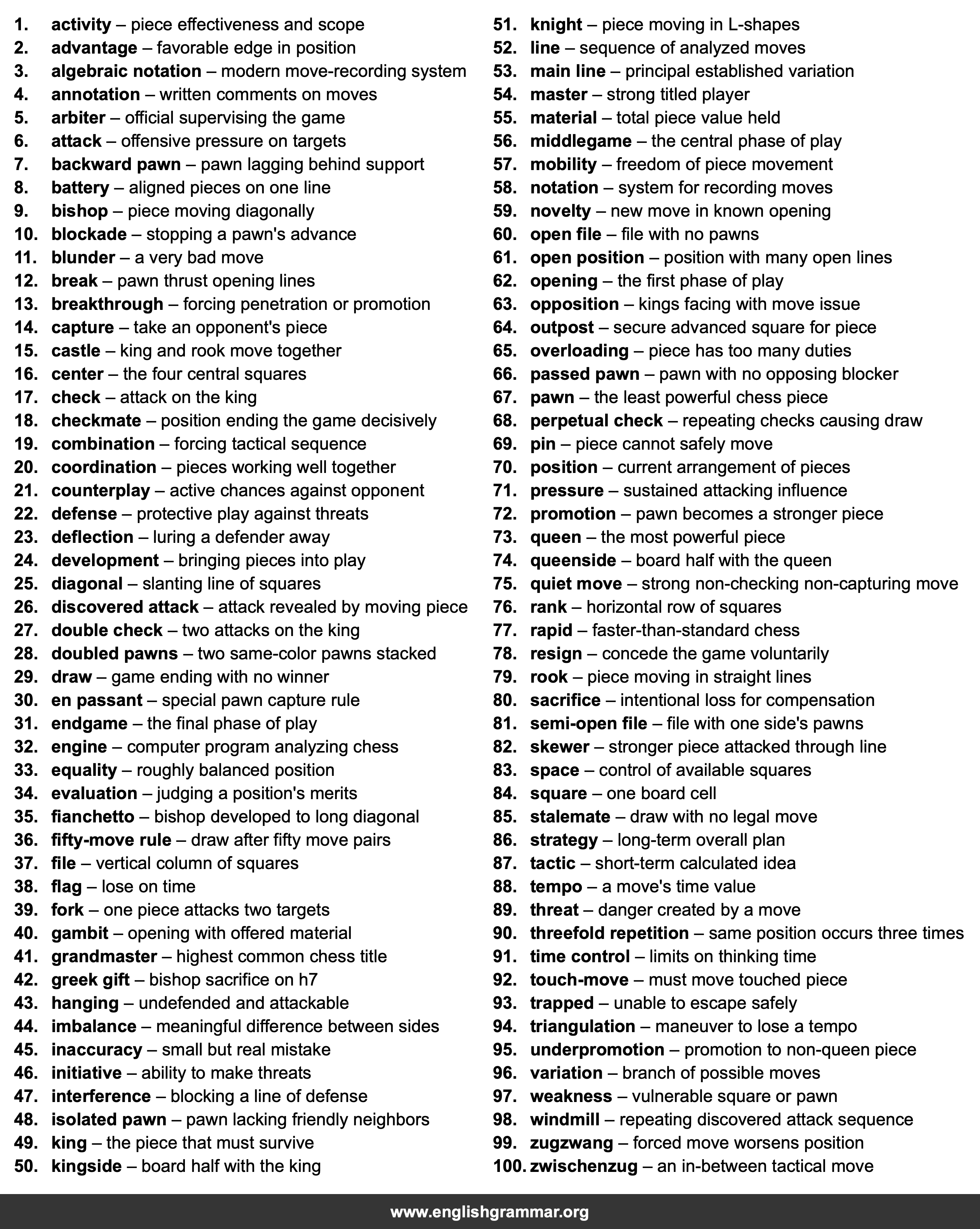
| No. | Item | Definition |
|---|---|---|
| 1. | activity | piece effectiveness and scope |
| 2. | advantage | favorable edge in position |
| 3. | algebraic notation | modern move-recording system |
| 4. | annotation | written comments on moves |
| 5. | arbiter | official supervising the game |
| 6. | attack | offensive pressure on targets |
| 7. | backward pawn | pawn lagging behind support |
| 8. | battery | aligned pieces on one line |
| 9. | bishop | piece moving diagonally |
| 10. | blockade | stopping a pawn’s advance |
| 11. | blunder | a very bad move |
| 12. | break | pawn thrust opening lines |
| 13. | breakthrough | forcing penetration or promotion |
| 14. | capture | take an opponent’s piece |
| 15. | castle | king and rook move together |
| 16. | center | the four central squares |
| 17. | check | attack on the king |
| 18. | checkmate | position ending the game decisively |
| 19. | combination | forcing tactical sequence |
| 20. | coordination | pieces working well together |
| 21. | counterplay | active chances against opponent |
| 22. | defense | protective play against threats |
| 23. | deflection | luring a defender away |
| 24. | development | bringing pieces into play |
| 25. | diagonal | slanting line of squares |
| 26. | discovered attack | attack revealed by moving piece |
| 27. | double check | two attacks on the king |
| 28. | doubled pawns | two same-color pawns stacked |
| 29. | draw | game ending with no winner |
| 30. | en passant | special pawn capture rule |
| 31. | endgame | the final phase of play |
| 32. | engine | computer program analyzing chess |
| 33. | equality | roughly balanced position |
| 34. | evaluation | judging a position’s merits |
| 35. | fianchetto | bishop developed to long diagonal |
| 36. | fifty-move rule | draw after fifty move pairs |
| 37. | file | vertical column of squares |
| 38. | flag | lose on time |
| 39. | fork | one piece attacks two targets |
| 40. | gambit | opening with offered material |
| 41. | grandmaster | highest common chess title |
| 42. | greek gift | bishop sacrifice on h7 |
| 43. | hanging | undefended and attackable |
| 44. | imbalance | meaningful difference between sides |
| 45. | inaccuracy | small but real mistake |
| 46. | initiative | ability to make threats |
| 47. | interference | blocking a line of defense |
| 48. | isolated pawn | pawn lacking friendly neighbors |
| 49. | king | the piece that must survive |
| 50. | kingside | board half with the king |
| 51. | knight | piece moving in L-shapes |
| 52. | line | sequence of analyzed moves |
| 53. | main line | principal established variation |
| 54. | master | strong titled player |
| 55. | material | total piece value held |
| 56. | middlegame | the central phase of play |
| 57. | mobility | freedom of piece movement |
| 58. | notation | system for recording moves |
| 59. | novelty | new move in known opening |
| 60. | open file | file with no pawns |
| 61. | open position | position with many open lines |
| 62. | opening | the first phase of play |
| 63. | opposition | kings facing with move issue |
| 64. | outpost | secure advanced square for piece |
| 65. | overloading | piece has too many duties |
| 66. | passed pawn | pawn with no opposing blocker |
| 67. | pawn | the least powerful chess piece |
| 68. | perpetual check | repeating checks causing draw |
| 69. | pin | piece cannot safely move |
| 70. | position | current arrangement of pieces |
| 71. | pressure | sustained attacking influence |
| 72. | promotion | pawn becomes a stronger piece |
| 73. | queen | the most powerful piece |
| 74. | queenside | board half with the queen |
| 75. | quiet move | strong non-checking non-capturing move |
| 76. | rank | horizontal row of squares |
| 77. | rapid | faster-than-standard chess |
| 78. | resign | concede the game voluntarily |
| 79. | rook | piece moving in straight lines |
| 80. | sacrifice | intentional loss for compensation |
| 81. | semi-open file | file with one side’s pawns |
| 82. | skewer | stronger piece attacked through line |
| 83. | space | control of available squares |
| 84. | square | one board cell |
| 85. | stalemate | draw with no legal move |
| 86. | strategy | long-term overall plan |
| 87. | tactic | short-term calculated idea |
| 88. | tempo | a move’s time value |
| 89. | threat | danger created by a move |
| 90. | threefold repetition | same position occurs three times |
| 91. | time control | limits on thinking time |
| 92. | touch-move | must move touched piece |
| 93. | trapped | unable to escape safely |
| 94. | triangulation | maneuver to lose a tempo |
| 95. | underpromotion | promotion to non-queen piece |
| 96. | variation | branch of possible moves |
| 97. | weakness | vulnerable square or pawn |
| 98. | windmill | repeating discovered attack sequence |
| 99. | zugzwang | forced move worsens position |
| 100. | zwischenzug | an in-between tactical move |