
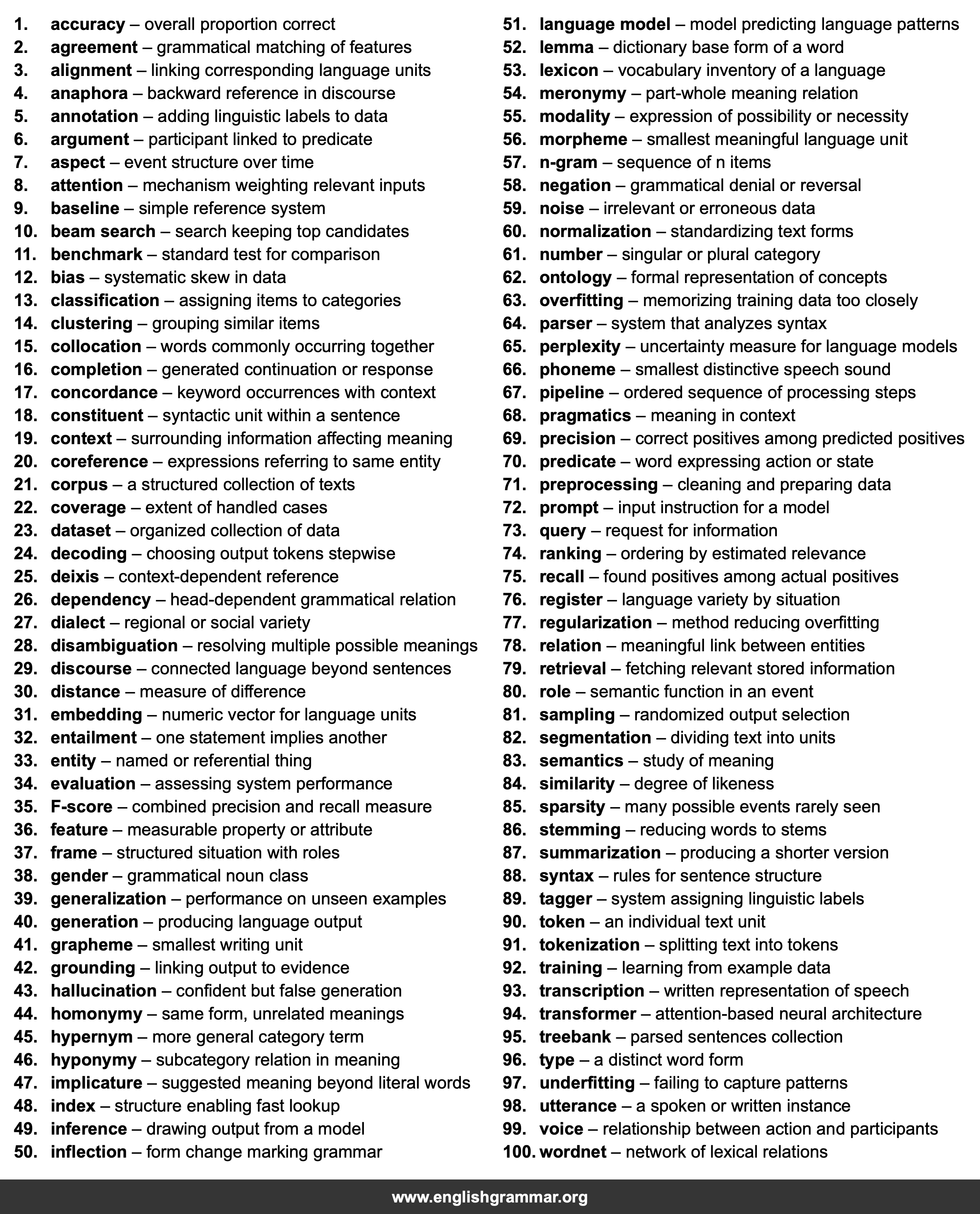
| No. | Item | Definition |
|---|---|---|
| 1. | accuracy | overall proportion correct |
| 2. | agreement | grammatical matching of features |
| 3. | alignment | linking corresponding language units |
| 4. | anaphora | backward reference in discourse |
| 5. | annotation | adding linguistic labels to data |
| 6. | argument | participant linked to predicate |
| 7. | aspect | event structure over time |
| 8. | attention | mechanism weighting relevant inputs |
| 9. | baseline | simple reference system |
| 10. | beam search | search keeping top candidates |
| 11. | benchmark | standard test for comparison |
| 12. | bias | systematic skew in data |
| 13. | classification | assigning items to categories |
| 14. | clustering | grouping similar items |
| 15. | collocation | words commonly occurring together |
| 16. | completion | generated continuation or response |
| 17. | concordance | keyword occurrences with context |
| 18. | constituent | syntactic unit within a sentence |
| 19. | context | surrounding information affecting meaning |
| 20. | coreference | expressions referring to same entity |
| 21. | corpus | a structured collection of texts |
| 22. | coverage | extent of handled cases |
| 23. | dataset | organized collection of data |
| 24. | decoding | choosing output tokens stepwise |
| 25. | deixis | context-dependent reference |
| 26. | dependency | head-dependent grammatical relation |
| 27. | dialect | regional or social variety |
| 28. | disambiguation | resolving multiple possible meanings |
| 29. | discourse | connected language beyond sentences |
| 30. | distance | measure of difference |
| 31. | embedding | numeric vector for language units |
| 32. | entailment | one statement implies another |
| 33. | entity | named or referential thing |
| 34. | evaluation | assessing system performance |
| 35. | F-score | combined precision and recall measure |
| 36. | feature | measurable property or attribute |
| 37. | frame | structured situation with roles |
| 38. | gender | grammatical noun class |
| 39. | generalization | performance on unseen examples |
| 40. | generation | producing language output |
| 41. | grapheme | smallest writing unit |
| 42. | grounding | linking output to evidence |
| 43. | hallucination | confident but false generation |
| 44. | homonymy | same form, unrelated meanings |
| 45. | hypernym | more general category term |
| 46. | hyponymy | subcategory relation in meaning |
| 47. | implicature | suggested meaning beyond literal words |
| 48. | index | structure enabling fast lookup |
| 49. | inference | drawing output from a model |
| 50. | inflection | form change marking grammar |
| 51. | language model | model predicting language patterns |
| 52. | lemma | dictionary base form of a word |
| 53. | lexicon | vocabulary inventory of a language |
| 54. | meronymy | part-whole meaning relation |
| 55. | modality | expression of possibility or necessity |
| 56. | morpheme | smallest meaningful language unit |
| 57. | n-gram | sequence of n items |
| 58. | negation | grammatical denial or reversal |
| 59. | noise | irrelevant or erroneous data |
| 60. | normalization | standardizing text forms |
| 61. | number | singular or plural category |
| 62. | ontology | formal representation of concepts |
| 63. | overfitting | memorizing training data too closely |
| 64. | parser | system that analyzes syntax |
| 65. | perplexity | uncertainty measure for language models |
| 66. | phoneme | smallest distinctive speech sound |
| 67. | pipeline | ordered sequence of processing steps |
| 68. | pragmatics | meaning in context |
| 69. | precision | correct positives among predicted positives |
| 70. | predicate | word expressing action or state |
| 71. | preprocessing | cleaning and preparing data |
| 72. | prompt | input instruction for a model |
| 73. | query | request for information |
| 74. | ranking | ordering by estimated relevance |
| 75. | recall | found positives among actual positives |
| 76. | register | language variety by situation |
| 77. | regularization | method reducing overfitting |
| 78. | relation | meaningful link between entities |
| 79. | retrieval | fetching relevant stored information |
| 80. | role | semantic function in an event |
| 81. | sampling | randomized output selection |
| 82. | segmentation | dividing text into units |
| 83. | semantics | study of meaning |
| 84. | similarity | degree of likeness |
| 85. | sparsity | many possible events rarely seen |
| 86. | stemming | reducing words to stems |
| 87. | summarization | producing a shorter version |
| 88. | syntax | rules for sentence structure |
| 89. | tagger | system assigning linguistic labels |
| 90. | token | an individual text unit |
| 91. | tokenization | splitting text into tokens |
| 92. | training | learning from example data |
| 93. | transcription | written representation of speech |
| 94. | transformer | attention-based neural architecture |
| 95. | treebank | parsed sentences collection |
| 96. | type | a distinct word form |
| 97. | underfitting | failing to capture patterns |
| 98. | utterance | a spoken or written instance |
| 99. | voice | relationship between action and participants |
| 100. | wordnet | network of lexical relations |