
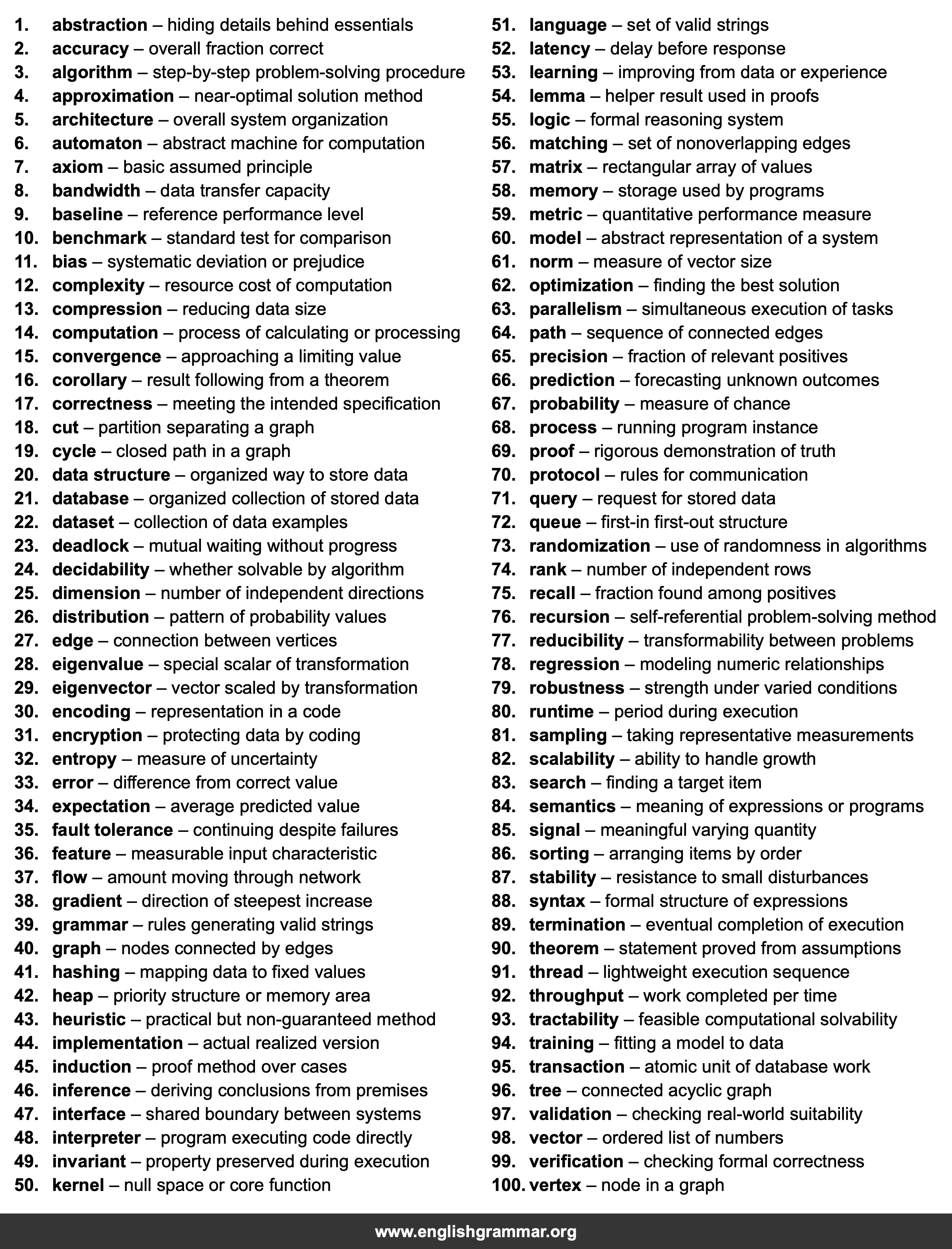
| No. | Item | Definition |
|---|---|---|
| 1. | abstraction | hiding details behind essentials |
| 2. | accuracy | overall fraction correct |
| 3. | algorithm | step-by-step problem-solving procedure |
| 4. | approximation | near-optimal solution method |
| 5. | architecture | overall system organization |
| 6. | automaton | abstract machine for computation |
| 7. | axiom | basic assumed principle |
| 8. | bandwidth | data transfer capacity |
| 9. | baseline | reference performance level |
| 10. | benchmark | standard test for comparison |
| 11. | bias | systematic deviation or prejudice |
| 12. | complexity | resource cost of computation |
| 13. | compression | reducing data size |
| 14. | computation | process of calculating or processing |
| 15. | convergence | approaching a limiting value |
| 16. | corollary | result following from a theorem |
| 17. | correctness | meeting the intended specification |
| 18. | cut | partition separating a graph |
| 19. | cycle | closed path in a graph |
| 20. | data structure | organized way to store data |
| 21. | database | organized collection of stored data |
| 22. | dataset | collection of data examples |
| 23. | deadlock | mutual waiting without progress |
| 24. | decidability | whether solvable by algorithm |
| 25. | dimension | number of independent directions |
| 26. | distribution | pattern of probability values |
| 27. | edge | connection between vertices |
| 28. | eigenvalue | special scalar of transformation |
| 29. | eigenvector | vector scaled by transformation |
| 30. | encoding | representation in a code |
| 31. | encryption | protecting data by coding |
| 32. | entropy | measure of uncertainty |
| 33. | error | difference from correct value |
| 34. | expectation | average predicted value |
| 35. | fault tolerance | continuing despite failures |
| 36. | feature | measurable input characteristic |
| 37. | flow | amount moving through network |
| 38. | gradient | direction of steepest increase |
| 39. | grammar | rules generating valid strings |
| 40. | graph | nodes connected by edges |
| 41. | hashing | mapping data to fixed values |
| 42. | heap | priority structure or memory area |
| 43. | heuristic | practical but non-guaranteed method |
| 44. | implementation | actual realized version |
| 45. | induction | proof method over cases |
| 46. | inference | deriving conclusions from premises |
| 47. | interface | shared boundary between systems |
| 48. | interpreter | program executing code directly |
| 49. | invariant | property preserved during execution |
| 50. | kernel | null space or core function |
| 51. | language | set of valid strings |
| 52. | latency | delay before response |
| 53. | learning | improving from data or experience |
| 54. | lemma | helper result used in proofs |
| 55. | logic | formal reasoning system |
| 56. | matching | set of nonoverlapping edges |
| 57. | matrix | rectangular array of values |
| 58. | memory | storage used by programs |
| 59. | metric | quantitative performance measure |
| 60. | model | abstract representation of a system |
| 61. | norm | measure of vector size |
| 62. | optimization | finding the best solution |
| 63. | parallelism | simultaneous execution of tasks |
| 64. | path | sequence of connected edges |
| 65. | precision | fraction of relevant positives |
| 66. | prediction | forecasting unknown outcomes |
| 67. | probability | measure of chance |
| 68. | process | running program instance |
| 69. | proof | rigorous demonstration of truth |
| 70. | protocol | rules for communication |
| 71. | query | request for stored data |
| 72. | queue | first-in first-out structure |
| 73. | randomization | use of randomness in algorithms |
| 74. | rank | number of independent rows |
| 75. | recall | fraction found among positives |
| 76. | recursion | self-referential problem-solving method |
| 77. | reducibility | transformability between problems |
| 78. | regression | modeling numeric relationships |
| 79. | robustness | strength under varied conditions |
| 80. | runtime | period during execution |
| 81. | sampling | taking representative measurements |
| 82. | scalability | ability to handle growth |
| 83. | search | finding a target item |
| 84. | semantics | meaning of expressions or programs |
| 85. | signal | meaningful varying quantity |
| 86. | sorting | arranging items by order |
| 87. | stability | resistance to small disturbances |
| 88. | syntax | formal structure of expressions |
| 89. | termination | eventual completion of execution |
| 90. | theorem | statement proved from assumptions |
| 91. | thread | lightweight execution sequence |
| 92. | throughput | work completed per time |
| 93. | tractability | feasible computational solvability |
| 94. | training | fitting a model to data |
| 95. | transaction | atomic unit of database work |
| 96. | tree | connected acyclic graph |
| 97. | validation | checking real-world suitability |
| 98. | vector | ordered list of numbers |
| 99. | verification | checking formal correctness |
| 100. | vertex | node in a graph |