
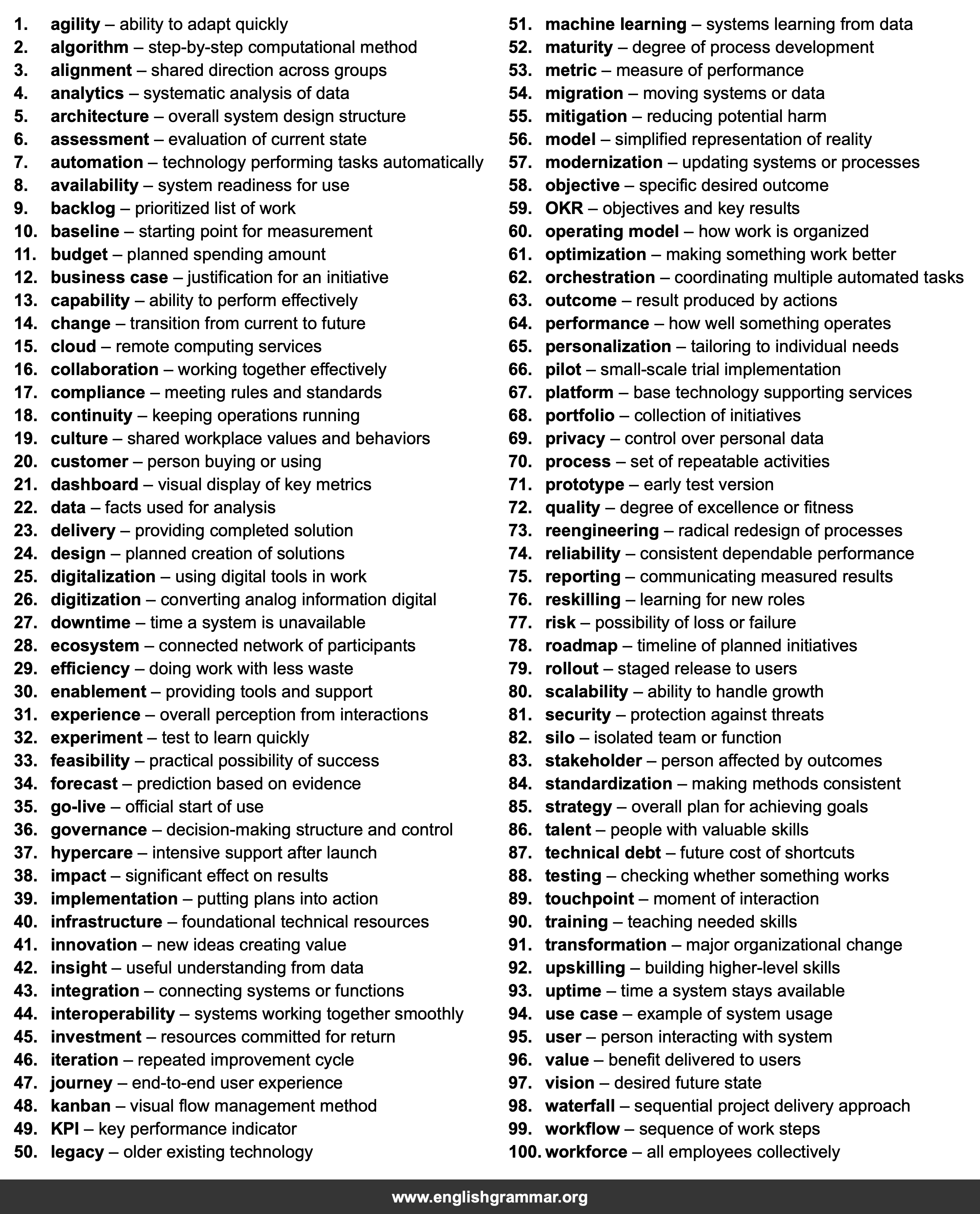
| No. | Item | Definition |
|---|---|---|
| 1. | agility | ability to adapt quickly |
| 2. | algorithm | step-by-step computational method |
| 3. | alignment | shared direction across groups |
| 4. | analytics | systematic analysis of data |
| 5. | architecture | overall system design structure |
| 6. | assessment | evaluation of current state |
| 7. | automation | technology performing tasks automatically |
| 8. | availability | system readiness for use |
| 9. | backlog | prioritized list of work |
| 10. | baseline | starting point for measurement |
| 11. | budget | planned spending amount |
| 12. | business case | justification for an initiative |
| 13. | capability | ability to perform effectively |
| 14. | change | transition from current to future |
| 15. | cloud | remote computing services |
| 16. | collaboration | working together effectively |
| 17. | compliance | meeting rules and standards |
| 18. | continuity | keeping operations running |
| 19. | culture | shared workplace values and behaviors |
| 20. | customer | person buying or using |
| 21. | dashboard | visual display of key metrics |
| 22. | data | facts used for analysis |
| 23. | delivery | providing completed solution |
| 24. | design | planned creation of solutions |
| 25. | digitalization | using digital tools in work |
| 26. | digitization | converting analog information digital |
| 27. | downtime | time a system is unavailable |
| 28. | ecosystem | connected network of participants |
| 29. | efficiency | doing work with less waste |
| 30. | enablement | providing tools and support |
| 31. | experience | overall perception from interactions |
| 32. | experiment | test to learn quickly |
| 33. | feasibility | practical possibility of success |
| 34. | forecast | prediction based on evidence |
| 35. | go-live | official start of use |
| 36. | governance | decision-making structure and control |
| 37. | hypercare | intensive support after launch |
| 38. | impact | significant effect on results |
| 39. | implementation | putting plans into action |
| 40. | infrastructure | foundational technical resources |
| 41. | innovation | new ideas creating value |
| 42. | insight | useful understanding from data |
| 43. | integration | connecting systems or functions |
| 44. | interoperability | systems working together smoothly |
| 45. | investment | resources committed for return |
| 46. | iteration | repeated improvement cycle |
| 47. | journey | end-to-end user experience |
| 48. | kanban | visual flow management method |
| 49. | KPI | key performance indicator |
| 50. | legacy | older existing technology |
| 51. | machine learning | systems learning from data |
| 52. | maturity | degree of process development |
| 53. | metric | measure of performance |
| 54. | migration | moving systems or data |
| 55. | mitigation | reducing potential harm |
| 56. | model | simplified representation of reality |
| 57. | modernization | updating systems or processes |
| 58. | objective | specific desired outcome |
| 59. | OKR | objectives and key results |
| 60. | operating model | how work is organized |
| 61. | optimization | making something work better |
| 62. | orchestration | coordinating multiple automated tasks |
| 63. | outcome | result produced by actions |
| 64. | performance | how well something operates |
| 65. | personalization | tailoring to individual needs |
| 66. | pilot | small-scale trial implementation |
| 67. | platform | base technology supporting services |
| 68. | portfolio | collection of initiatives |
| 69. | privacy | control over personal data |
| 70. | process | set of repeatable activities |
| 71. | prototype | early test version |
| 72. | quality | degree of excellence or fitness |
| 73. | reengineering | radical redesign of processes |
| 74. | reliability | consistent dependable performance |
| 75. | reporting | communicating measured results |
| 76. | reskilling | learning for new roles |
| 77. | risk | possibility of loss or failure |
| 78. | roadmap | timeline of planned initiatives |
| 79. | rollout | staged release to users |
| 80. | scalability | ability to handle growth |
| 81. | security | protection against threats |
| 82. | silo | isolated team or function |
| 83. | stakeholder | person affected by outcomes |
| 84. | standardization | making methods consistent |
| 85. | strategy | overall plan for achieving goals |
| 86. | talent | people with valuable skills |
| 87. | technical debt | future cost of shortcuts |
| 88. | testing | checking whether something works |
| 89. | touchpoint | moment of interaction |
| 90. | training | teaching needed skills |
| 91. | transformation | major organizational change |
| 92. | upskilling | building higher-level skills |
| 93. | uptime | time a system stays available |
| 94. | use case | example of system usage |
| 95. | user | person interacting with system |
| 96. | value | benefit delivered to users |
| 97. | vision | desired future state |
| 98. | waterfall | sequential project delivery approach |
| 99. | workflow | sequence of work steps |
| 100. | workforce | all employees collectively |