
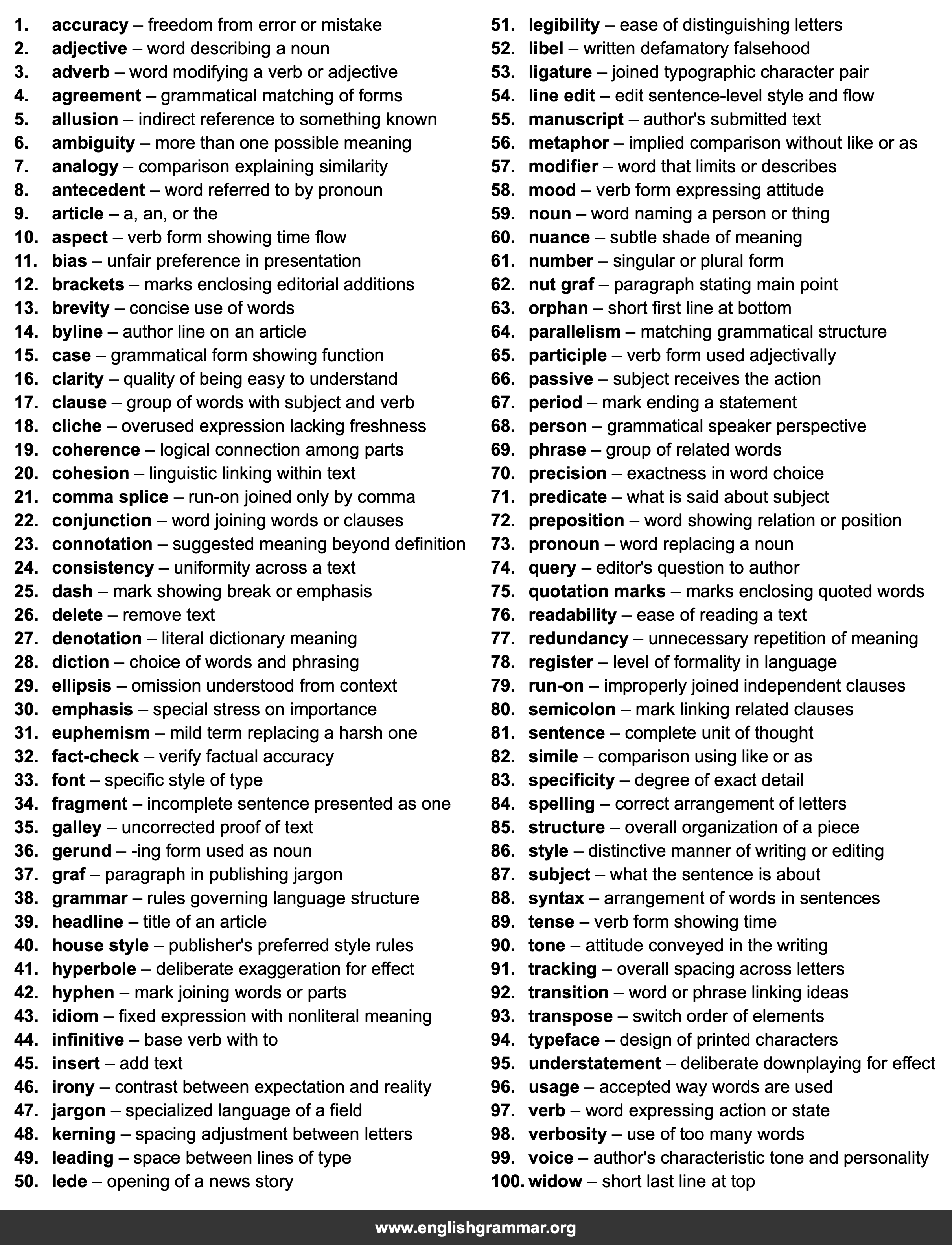
| No. | Item | Definition |
|---|---|---|
| 1. | accuracy | freedom from error or mistake |
| 2. | adjective | word describing a noun |
| 3. | adverb | word modifying a verb or adjective |
| 4. | agreement | grammatical matching of forms |
| 5. | allusion | indirect reference to something known |
| 6. | ambiguity | more than one possible meaning |
| 7. | analogy | comparison explaining similarity |
| 8. | antecedent | word referred to by pronoun |
| 9. | article | a, an, or the |
| 10. | aspect | verb form showing time flow |
| 11. | bias | unfair preference in presentation |
| 12. | brackets | marks enclosing editorial additions |
| 13. | brevity | concise use of words |
| 14. | byline | author line on an article |
| 15. | case | grammatical form showing function |
| 16. | clarity | quality of being easy to understand |
| 17. | clause | group of words with subject and verb |
| 18. | cliche | overused expression lacking freshness |
| 19. | coherence | logical connection among parts |
| 20. | cohesion | linguistic linking within text |
| 21. | comma splice | run-on joined only by comma |
| 22. | conjunction | word joining words or clauses |
| 23. | connotation | suggested meaning beyond definition |
| 24. | consistency | uniformity across a text |
| 25. | dash | mark showing break or emphasis |
| 26. | delete | remove text |
| 27. | denotation | literal dictionary meaning |
| 28. | diction | choice of words and phrasing |
| 29. | ellipsis | omission understood from context |
| 30. | emphasis | special stress on importance |
| 31. | euphemism | mild term replacing a harsh one |
| 32. | fact-check | verify factual accuracy |
| 33. | font | specific style of type |
| 34. | fragment | incomplete sentence presented as one |
| 35. | galley | uncorrected proof of text |
| 36. | gerund | -ing form used as noun |
| 37. | graf | paragraph in publishing jargon |
| 38. | grammar | rules governing language structure |
| 39. | headline | title of an article |
| 40. | house style | publisher’s preferred style rules |
| 41. | hyperbole | deliberate exaggeration for effect |
| 42. | hyphen | mark joining words or parts |
| 43. | idiom | fixed expression with nonliteral meaning |
| 44. | infinitive | base verb with to |
| 45. | insert | add text |
| 46. | irony | contrast between expectation and reality |
| 47. | jargon | specialized language of a field |
| 48. | kerning | spacing adjustment between letters |
| 49. | leading | space between lines of type |
| 50. | lede | opening of a news story |
| 51. | legibility | ease of distinguishing letters |
| 52. | libel | written defamatory falsehood |
| 53. | ligature | joined typographic character pair |
| 54. | line edit | edit sentence-level style and flow |
| 55. | manuscript | author’s submitted text |
| 56. | metaphor | implied comparison without like or as |
| 57. | modifier | word that limits or describes |
| 58. | mood | verb form expressing attitude |
| 59. | noun | word naming a person or thing |
| 60. | nuance | subtle shade of meaning |
| 61. | number | singular or plural form |
| 62. | nut graf | paragraph stating main point |
| 63. | orphan | short first line at bottom |
| 64. | parallelism | matching grammatical structure |
| 65. | participle | verb form used adjectivally |
| 66. | passive | subject receives the action |
| 67. | period | mark ending a statement |
| 68. | person | grammatical speaker perspective |
| 69. | phrase | group of related words |
| 70. | precision | exactness in word choice |
| 71. | predicate | what is said about subject |
| 72. | preposition | word showing relation or position |
| 73. | pronoun | word replacing a noun |
| 74. | query | editor’s question to author |
| 75. | quotation marks | marks enclosing quoted words |
| 76. | readability | ease of reading a text |
| 77. | redundancy | unnecessary repetition of meaning |
| 78. | register | level of formality in language |
| 79. | run-on | improperly joined independent clauses |
| 80. | semicolon | mark linking related clauses |
| 81. | sentence | complete unit of thought |
| 82. | simile | comparison using like or as |
| 83. | specificity | degree of exact detail |
| 84. | spelling | correct arrangement of letters |
| 85. | structure | overall organization of a piece |
| 86. | style | distinctive manner of writing or editing |
| 87. | subject | what the sentence is about |
| 88. | syntax | arrangement of words in sentences |
| 89. | tense | verb form showing time |
| 90. | tone | attitude conveyed in the writing |
| 91. | tracking | overall spacing across letters |
| 92. | transition | word or phrase linking ideas |
| 93. | transpose | switch order of elements |
| 94. | typeface | design of printed characters |
| 95. | understatement | deliberate downplaying for effect |
| 96. | usage | accepted way words are used |
| 97. | verb | word expressing action or state |
| 98. | verbosity | use of too many words |
| 99. | voice | author’s characteristic tone and personality |
| 100. | widow | short last line at top |