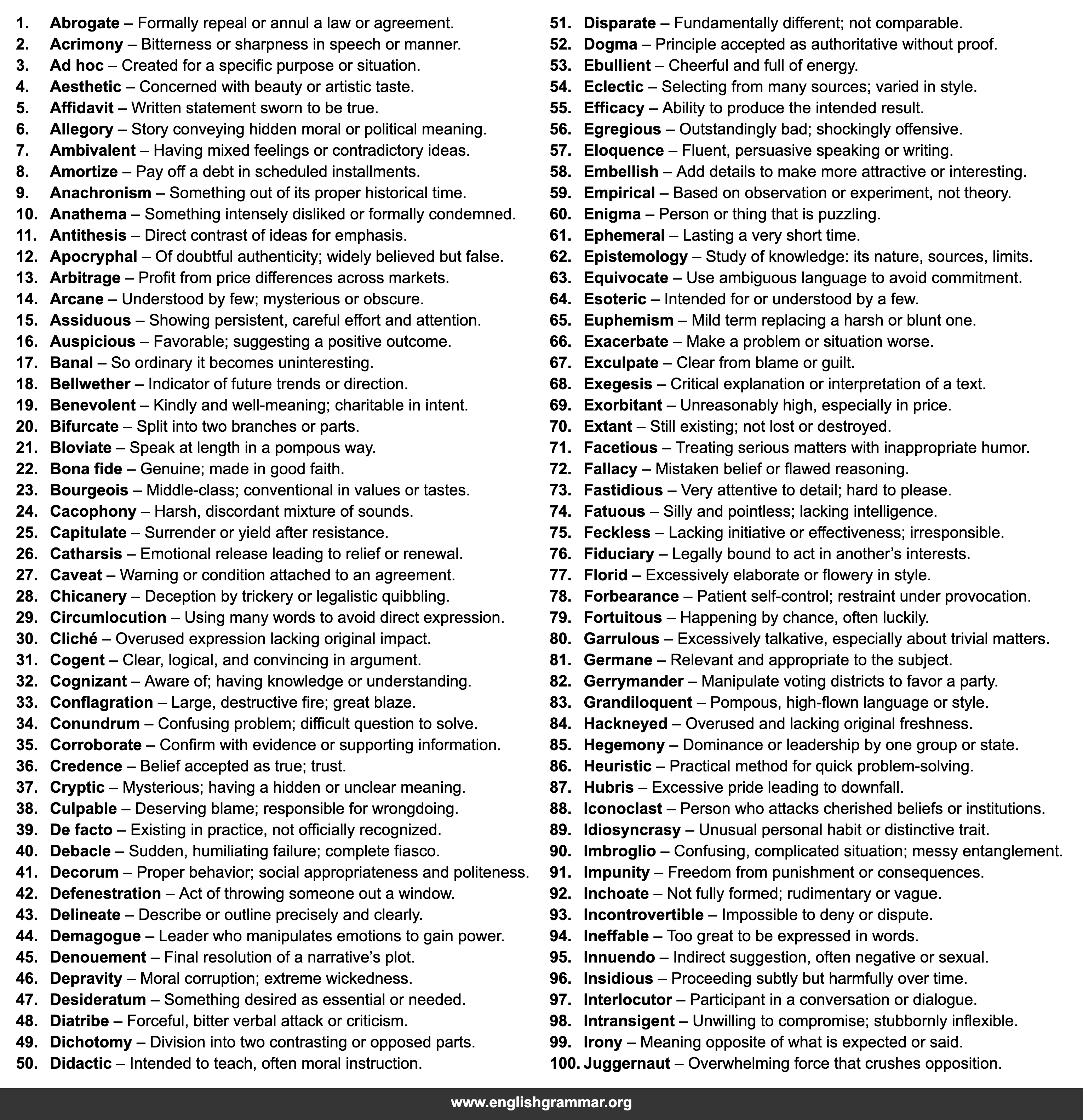
| No. | Term | Definition |
|---|---|---|
| 1. | Abrogate | Formally repeal or annul a law or agreement. |
| 2. | Acrimony | Bitterness or sharpness in speech or manner. |
| 3. | Ad hoc | Created for a specific purpose or situation. |
| 4. | Aesthetic | Concerned with beauty or artistic taste. |
| 5. | Affidavit | Written statement sworn to be true. |
| 6. | Allegory | Story conveying hidden moral or political meaning. |
| 7. | Ambivalent | Having mixed feelings or contradictory ideas. |
| 8. | Amortize | Pay off a debt in scheduled installments. |
| 9. | Anachronism | Something out of its proper historical time. |
| 10. | Anathema | Something intensely disliked or formally condemned. |
| 11. | Antithesis | Direct contrast of ideas for emphasis. |
| 12. | Apocryphal | Of doubtful authenticity; widely believed but false. |
| 13. | Arbitrage | Profit from price differences across markets. |
| 14. | Arcane | Understood by few; mysterious or obscure. |
| 15. | Assiduous | Showing persistent, careful effort and attention. |
| 16. | Auspicious | Favorable; suggesting a positive outcome. |
| 17. | Banal | So ordinary it becomes uninteresting. |
| 18. | Bellwether | Indicator of future trends or direction. |
| 19. | Benevolent | Kindly and well-meaning; charitable in intent. |
| 20. | Bifurcate | Split into two branches or parts. |
| 21. | Bloviate | Speak at length in a pompous way. |
| 22. | Bona fide | Genuine; made in good faith. |
| 23. | Bourgeois | Middle-class; conventional in values or tastes. |
| 24. | Cacophony | Harsh, discordant mixture of sounds. |
| 25. | Capitulate | Surrender or yield after resistance. |
| 26. | Catharsis | Emotional release leading to relief or renewal. |
| 27. | Caveat | Warning or condition attached to an agreement. |
| 28. | Chicanery | Deception by trickery or legalistic quibbling. |
| 29. | Circumlocution | Using many words to avoid direct expression. |
| 30. | Cliché | Overused expression lacking original impact. |
| 31. | Cogent | Clear, logical, and convincing in argument. |
| 32. | Cognizant | Aware of; having knowledge or understanding. |
| 33. | Conflagration | Large, destructive fire; great blaze. |
| 34. | Conundrum | Confusing problem; difficult question to solve. |
| 35. | Corroborate | Confirm with evidence or supporting information. |
| 36. | Credence | Belief accepted as true; trust. |
| 37. | Cryptic | Mysterious; having a hidden or unclear meaning. |
| 38. | Culpable | Deserving blame; responsible for wrongdoing. |
| 39. | De facto | Existing in practice, not officially recognized. |
| 40. | Debacle | Sudden, humiliating failure; complete fiasco. |
| 41. | Decorum | Proper behavior; social appropriateness and politeness. |
| 42. | Defenestration | Act of throwing someone out a window. |
| 43. | Delineate | Describe or outline precisely and clearly. |
| 44. | Demagogue | Leader who manipulates emotions to gain power. |
| 45. | Denouement | Final resolution of a narrative’s plot. |
| 46. | Depravity | Moral corruption; extreme wickedness. |
| 47. | Desideratum | Something desired as essential or needed. |
| 48. | Diatribe | Forceful, bitter verbal attack or criticism. |
| 49. | Dichotomy | Division into two contrasting or opposed parts. |
| 50. | Didactic | Intended to teach, often moral instruction. |
| 51. | Disparate | Fundamentally different; not comparable. |
| 52. | Dogma | Principle accepted as authoritative without proof. |
| 53. | Ebullient | Cheerful and full of energy. |
| 54. | Eclectic | Selecting from many sources; varied in style. |
| 55. | Efficacy | Ability to produce the intended result. |
| 56. | Egregious | Outstandingly bad; shockingly offensive. |
| 57. | Eloquence | Fluent, persuasive speaking or writing. |
| 58. | Embellish | Add details to make more attractive or interesting. |
| 59. | Empirical | Based on observation or experiment, not theory. |
| 60. | Enigma | Person or thing that is puzzling. |
| 61. | Ephemeral | Lasting a very short time. |
| 62. | Epistemology | Study of knowledge: its nature, sources, limits. |
| 63. | Equivocate | Use ambiguous language to avoid commitment. |
| 64. | Esoteric | Intended for or understood by a few. |
| 65. | Euphemism | Mild term replacing a harsh or blunt one. |
| 66. | Exacerbate | Make a problem or situation worse. |
| 67. | Exculpate | Clear from blame or guilt. |
| 68. | Exegesis | Critical explanation or interpretation of a text. |
| 69. | Exorbitant | Unreasonably high, especially in price. |
| 70. | Extant | Still existing; not lost or destroyed. |
| 71. | Facetious | Treating serious matters with inappropriate humor. |
| 72. | Fallacy | Mistaken belief or flawed reasoning. |
| 73. | Fastidious | Very attentive to detail; hard to please. |
| 74. | Fatuous | Silly and pointless; lacking intelligence. |
| 75. | Feckless | Lacking initiative or effectiveness; irresponsible. |
| 76. | Fiduciary | Legally bound to act in another’s interests. |
| 77. | Florid | Excessively elaborate or flowery in style. |
| 78. | Forbearance | Patient self-control; restraint under provocation. |
| 79. | Fortuitous | Happening by chance, often luckily. |
| 80. | Garrulous | Excessively talkative, especially about trivial matters. |
| 81. | Germane | Relevant and appropriate to the subject. |
| 82. | Gerrymander | Manipulate voting districts to favor a party. |
| 83. | Grandiloquent | Pompous, high-flown language or style. |
| 84. | Hackneyed | Overused and lacking original freshness. |
| 85. | Hegemony | Dominance or leadership by one group or state. |
| 86. | Heuristic | Practical method for quick problem-solving. |
| 87. | Hubris | Excessive pride leading to downfall. |
| 88. | Iconoclast | Person who attacks cherished beliefs or institutions. |
| 89. | Idiosyncrasy | Unusual personal habit or distinctive trait. |
| 90. | Imbroglio | Confusing, complicated situation; messy entanglement. |
| 91. | Impunity | Freedom from punishment or consequences. |
| 92. | Inchoate | Not fully formed; rudimentary or vague. |
| 93. | Incontrovertible | Impossible to deny or dispute. |
| 94. | Ineffable | Too great to be expressed in words. |
| 95. | Innuendo | Indirect suggestion, often negative or sexual. |
| 96. | Insidious | Proceeding subtly but harmfully over time. |
| 97. | Interlocutor | Participant in a conversation or dialogue. |
| 98. | Intransigent | Unwilling to compromise; stubbornly inflexible. |
| 99. | Irony | Meaning opposite of what is expected or said. |
| 100. | Juggernaut | Overwhelming force that crushes opposition. |
