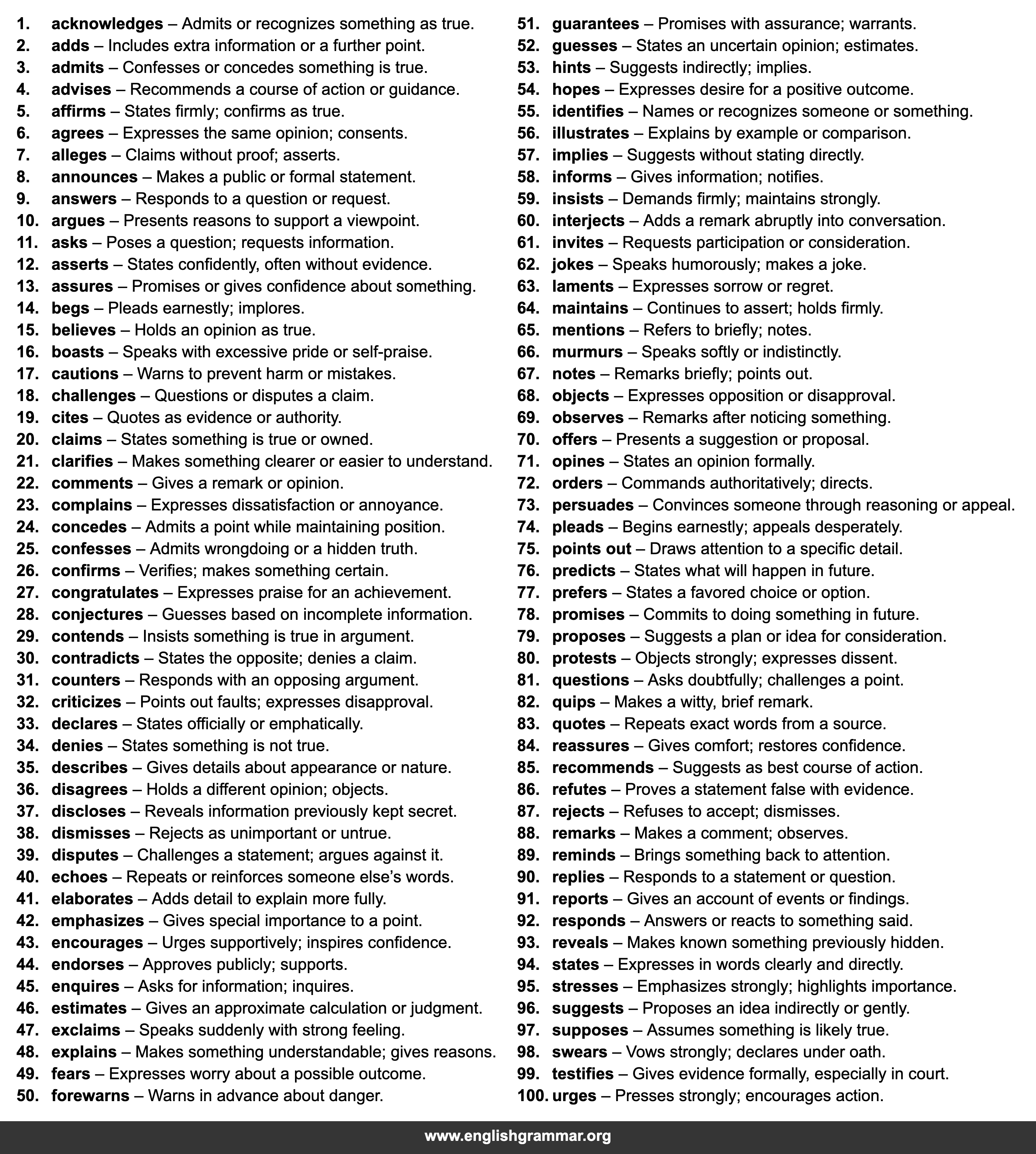
| No. | Term | Definition |
|---|---|---|
| 1. | acknowledges | Admits or recognizes something as true. |
| 2. | adds | Includes extra information or a further point. |
| 3. | admits | Confesses or concedes something is true. |
| 4. | advises | Recommends a course of action or guidance. |
| 5. | affirms | States firmly; confirms as true. |
| 6. | agrees | Expresses the same opinion; consents. |
| 7. | alleges | Claims without proof; asserts. |
| 8. | announces | Makes a public or formal statement. |
| 9. | answers | Responds to a question or request. |
| 10. | argues | Presents reasons to support a viewpoint. |
| 11. | asks | Poses a question; requests information. |
| 12. | asserts | States confidently, often without evidence. |
| 13. | assures | Promises or gives confidence about something. |
| 14. | begs | Pleads earnestly; implores. |
| 15. | believes | Holds an opinion as true. |
| 16. | boasts | Speaks with excessive pride or self-praise. |
| 17. | cautions | Warns to prevent harm or mistakes. |
| 18. | challenges | Questions or disputes a claim. |
| 19. | cites | Quotes as evidence or authority. |
| 20. | claims | States something is true or owned. |
| 21. | clarifies | Makes something clearer or easier to understand. |
| 22. | comments | Gives a remark or opinion. |
| 23. | complains | Expresses dissatisfaction or annoyance. |
| 24. | concedes | Admits a point while maintaining position. |
| 25. | confesses | Admits wrongdoing or a hidden truth. |
| 26. | confirms | Verifies; makes something certain. |
| 27. | congratulates | Expresses praise for an achievement. |
| 28. | conjectures | Guesses based on incomplete information. |
| 29. | contends | Insists something is true in argument. |
| 30. | contradicts | States the opposite; denies a claim. |
| 31. | counters | Responds with an opposing argument. |
| 32. | criticizes | Points out faults; expresses disapproval. |
| 33. | declares | States officially or emphatically. |
| 34. | denies | States something is not true. |
| 35. | describes | Gives details about appearance or nature. |
| 36. | disagrees | Holds a different opinion; objects. |
| 37. | discloses | Reveals information previously kept secret. |
| 38. | dismisses | Rejects as unimportant or untrue. |
| 39. | disputes | Challenges a statement; argues against it. |
| 40. | echoes | Repeats or reinforces someone else’s words. |
| 41. | elaborates | Adds detail to explain more fully. |
| 42. | emphasizes | Gives special importance to a point. |
| 43. | encourages | Urges supportively; inspires confidence. |
| 44. | endorses | Approves publicly; supports. |
| 45. | enquires | Asks for information; inquires. |
| 46. | estimates | Gives an approximate calculation or judgment. |
| 47. | exclaims | Speaks suddenly with strong feeling. |
| 48. | explains | Makes something understandable; gives reasons. |
| 49. | fears | Expresses worry about a possible outcome. |
| 50. | forewarns | Warns in advance about danger. |
| 51. | guarantees | Promises with assurance; warrants. |
| 52. | guesses | States an uncertain opinion; estimates. |
| 53. | hints | Suggests indirectly; implies. |
| 54. | hopes | Expresses desire for a positive outcome. |
| 55. | identifies | Names or recognizes someone or something. |
| 56. | illustrates | Explains by example or comparison. |
| 57. | implies | Suggests without stating directly. |
| 58. | informs | Gives information; notifies. |
| 59. | insists | Demands firmly; maintains strongly. |
| 60. | interjects | Adds a remark abruptly into conversation. |
| 61. | invites | Requests participation or consideration. |
| 62. | jokes | Speaks humorously; makes a joke. |
| 63. | laments | Expresses sorrow or regret. |
| 64. | maintains | Continues to assert; holds firmly. |
| 65. | mentions | Refers to briefly; notes. |
| 66. | murmurs | Speaks softly or indistinctly. |
| 67. | notes | Remarks briefly; points out. |
| 68. | objects | Expresses opposition or disapproval. |
| 69. | observes | Remarks after noticing something. |
| 70. | offers | Presents a suggestion or proposal. |
| 71. | opines | States an opinion formally. |
| 72. | orders | Commands authoritatively; directs. |
| 73. | persuades | Convinces someone through reasoning or appeal. |
| 74. | pleads | Begins earnestly; appeals desperately. |
| 75. | points out | Draws attention to a specific detail. |
| 76. | predicts | States what will happen in future. |
| 77. | prefers | States a favored choice or option. |
| 78. | promises | Commits to doing something in future. |
| 79. | proposes | Suggests a plan or idea for consideration. |
| 80. | protests | Objects strongly; expresses dissent. |
| 81. | questions | Asks doubtfully; challenges a point. |
| 82. | quips | Makes a witty, brief remark. |
| 83. | quotes | Repeats exact words from a source. |
| 84. | reassures | Gives comfort; restores confidence. |
| 85. | recommends | Suggests as best course of action. |
| 86. | refutes | Proves a statement false with evidence. |
| 87. | rejects | Refuses to accept; dismisses. |
| 88. | remarks | Makes a comment; observes. |
| 89. | reminds | Brings something back to attention. |
| 90. | replies | Responds to a statement or question. |
| 91. | reports | Gives an account of events or findings. |
| 92. | responds | Answers or reacts to something said. |
| 93. | reveals | Makes known something previously hidden. |
| 94. | states | Expresses in words clearly and directly. |
| 95. | stresses | Emphasizes strongly; highlights importance. |
| 96. | suggests | Proposes an idea indirectly or gently. |
| 97. | supposes | Assumes something is likely true. |
| 98. | swears | Vows strongly; declares under oath. |
| 99. | testifies | Gives evidence formally, especially in court. |
| 100. | urges | Presses strongly; encourages action. |
