
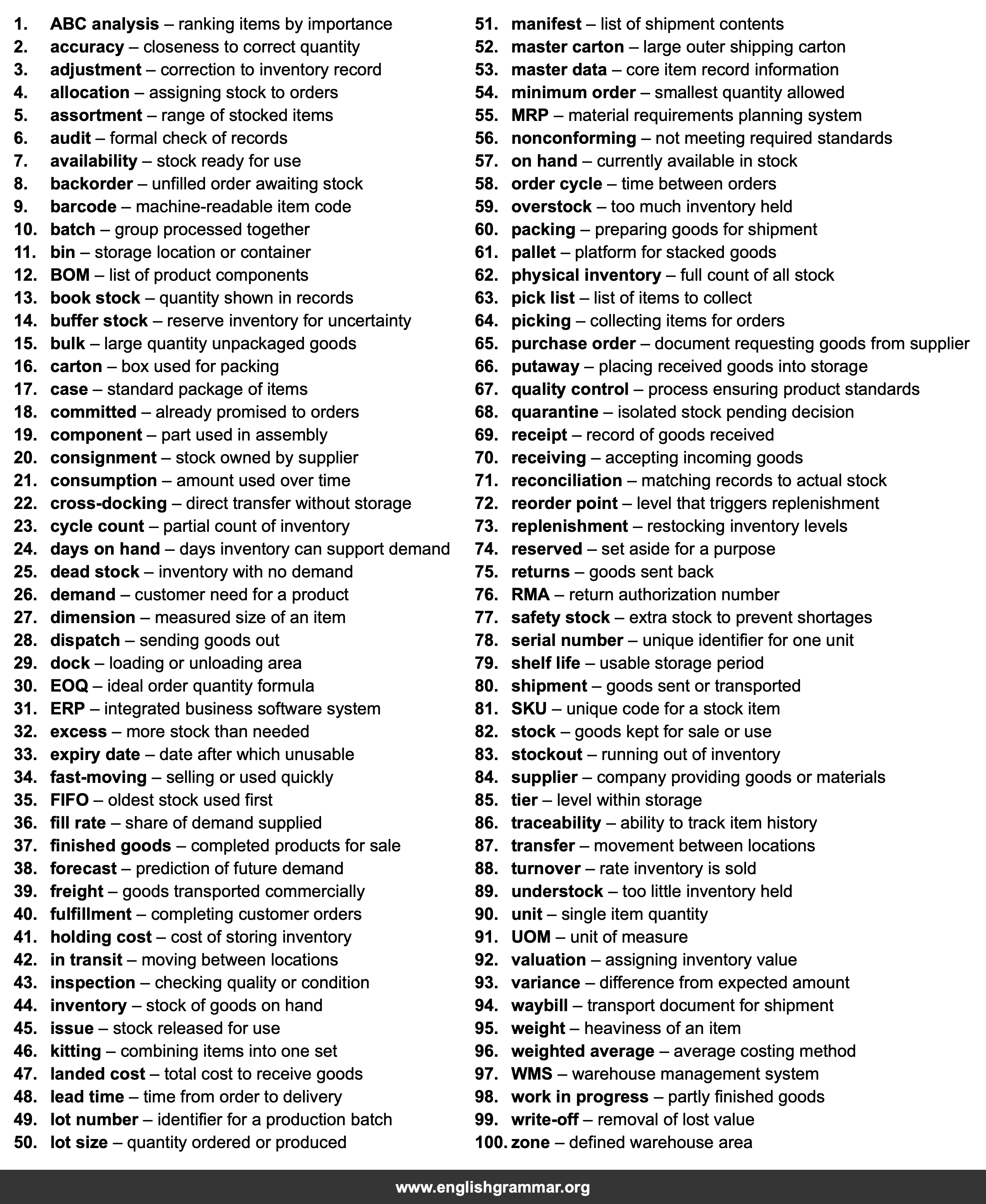
| No. | Item | Definition |
|---|---|---|
| 1. | ABC analysis | ranking items by importance |
| 2. | accuracy | closeness to correct quantity |
| 3. | adjustment | correction to inventory record |
| 4. | allocation | assigning stock to orders |
| 5. | assortment | range of stocked items |
| 6. | audit | formal check of records |
| 7. | availability | stock ready for use |
| 8. | backorder | unfilled order awaiting stock |
| 9. | barcode | machine-readable item code |
| 10. | batch | group processed together |
| 11. | bin | storage location or container |
| 12. | BOM | list of product components |
| 13. | book stock | quantity shown in records |
| 14. | buffer stock | reserve inventory for uncertainty |
| 15. | bulk | large quantity unpackaged goods |
| 16. | carton | box used for packing |
| 17. | case | standard package of items |
| 18. | committed | already promised to orders |
| 19. | component | part used in assembly |
| 20. | consignment | stock owned by supplier |
| 21. | consumption | amount used over time |
| 22. | cross-docking | direct transfer without storage |
| 23. | cycle count | partial count of inventory |
| 24. | days on hand | days inventory can support demand |
| 25. | dead stock | inventory with no demand |
| 26. | demand | customer need for a product |
| 27. | dimension | measured size of an item |
| 28. | dispatch | sending goods out |
| 29. | dock | loading or unloading area |
| 30. | EOQ | ideal order quantity formula |
| 31. | ERP | integrated business software system |
| 32. | excess | more stock than needed |
| 33. | expiry date | date after which unusable |
| 34. | fast-moving | selling or used quickly |
| 35. | FIFO | oldest stock used first |
| 36. | fill rate | share of demand supplied |
| 37. | finished goods | completed products for sale |
| 38. | forecast | prediction of future demand |
| 39. | freight | goods transported commercially |
| 40. | fulfillment | completing customer orders |
| 41. | holding cost | cost of storing inventory |
| 42. | in transit | moving between locations |
| 43. | inspection | checking quality or condition |
| 44. | inventory | stock of goods on hand |
| 45. | issue | stock released for use |
| 46. | kitting | combining items into one set |
| 47. | landed cost | total cost to receive goods |
| 48. | lead time | time from order to delivery |
| 49. | lot number | identifier for a production batch |
| 50. | lot size | quantity ordered or produced |
| 51. | manifest | list of shipment contents |
| 52. | master carton | large outer shipping carton |
| 53. | master data | core item record information |
| 54. | minimum order | smallest quantity allowed |
| 55. | MRP | material requirements planning system |
| 56. | nonconforming | not meeting required standards |
| 57. | on hand | currently available in stock |
| 58. | order cycle | time between orders |
| 59. | overstock | too much inventory held |
| 60. | packing | preparing goods for shipment |
| 61. | pallet | platform for stacked goods |
| 62. | physical inventory | full count of all stock |
| 63. | pick list | list of items to collect |
| 64. | picking | collecting items for orders |
| 65. | purchase order | document requesting goods from supplier |
| 66. | putaway | placing received goods into storage |
| 67. | quality control | process ensuring product standards |
| 68. | quarantine | isolated stock pending decision |
| 69. | receipt | record of goods received |
| 70. | receiving | accepting incoming goods |
| 71. | reconciliation | matching records to actual stock |
| 72. | reorder point | level that triggers replenishment |
| 73. | replenishment | restocking inventory levels |
| 74. | reserved | set aside for a purpose |
| 75. | returns | goods sent back |
| 76. | RMA | return authorization number |
| 77. | safety stock | extra stock to prevent shortages |
| 78. | serial number | unique identifier for one unit |
| 79. | shelf life | usable storage period |
| 80. | shipment | goods sent or transported |
| 81. | SKU | unique code for a stock item |
| 82. | stock | goods kept for sale or use |
| 83. | stockout | running out of inventory |
| 84. | supplier | company providing goods or materials |
| 85. | tier | level within storage |
| 86. | traceability | ability to track item history |
| 87. | transfer | movement between locations |
| 88. | turnover | rate inventory is sold |
| 89. | understock | too little inventory held |
| 90. | unit | single item quantity |
| 91. | UOM | unit of measure |
| 92. | valuation | assigning inventory value |
| 93. | variance | difference from expected amount |
| 94. | waybill | transport document for shipment |
| 95. | weight | heaviness of an item |
| 96. | weighted average | average costing method |
| 97. | WMS | warehouse management system |
| 98. | work in progress | partly finished goods |
| 99. | write-off | removal of lost value |
| 100. | zone | defined warehouse area |