
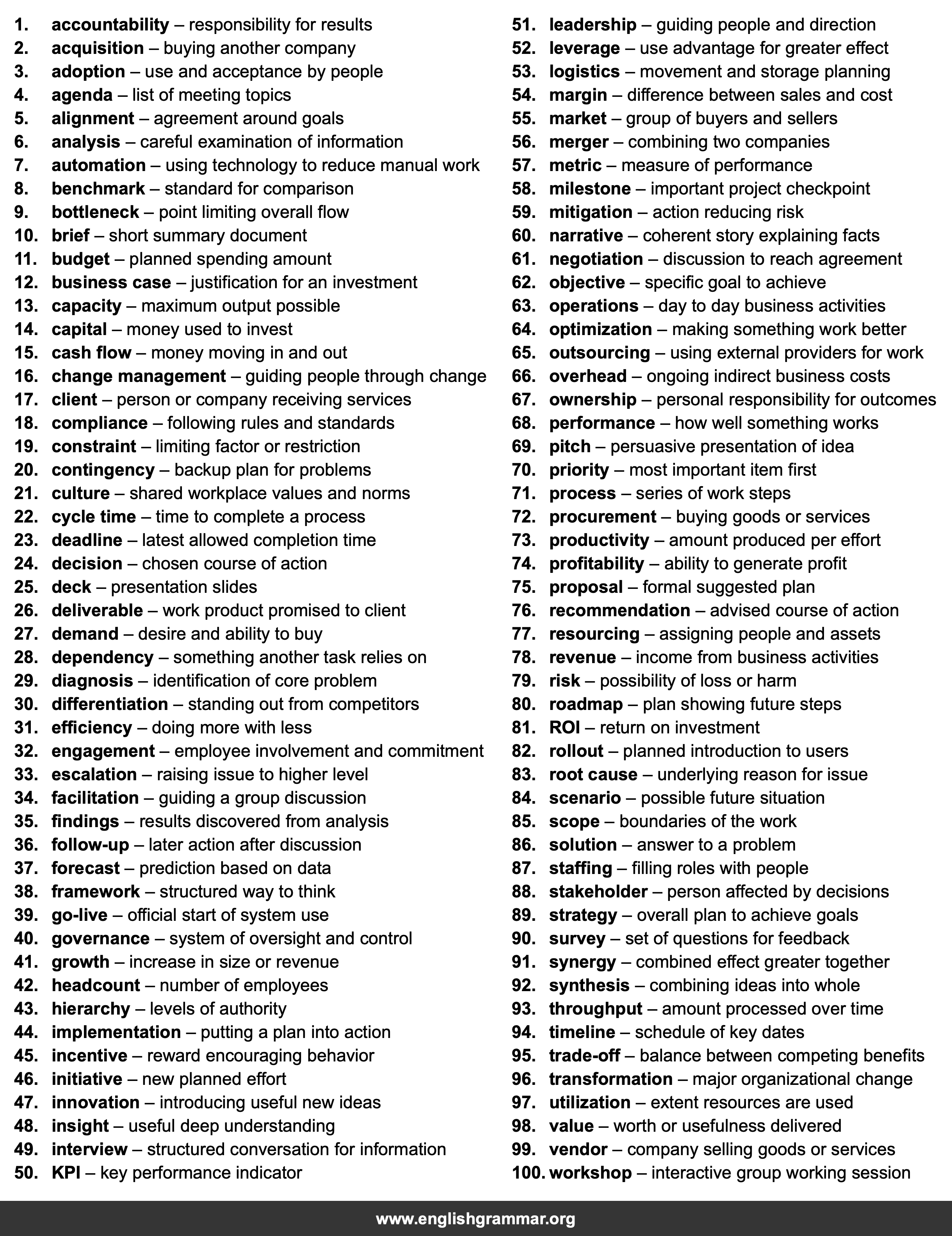
| No. | Item | Definition |
|---|---|---|
| 1. | accountability | responsibility for results |
| 2. | acquisition | buying another company |
| 3. | adoption | use and acceptance by people |
| 4. | agenda | list of meeting topics |
| 5. | alignment | agreement around goals |
| 6. | analysis | careful examination of information |
| 7. | automation | using technology to reduce manual work |
| 8. | benchmark | standard for comparison |
| 9. | bottleneck | point limiting overall flow |
| 10. | brief | short summary document |
| 11. | budget | planned spending amount |
| 12. | business case | justification for an investment |
| 13. | capacity | maximum output possible |
| 14. | capital | money used to invest |
| 15. | cash flow | money moving in and out |
| 16. | change management | guiding people through change |
| 17. | client | person or company receiving services |
| 18. | compliance | following rules and standards |
| 19. | constraint | limiting factor or restriction |
| 20. | contingency | backup plan for problems |
| 21. | culture | shared workplace values and norms |
| 22. | cycle time | time to complete a process |
| 23. | deadline | latest allowed completion time |
| 24. | decision | chosen course of action |
| 25. | deck | presentation slides |
| 26. | deliverable | work product promised to client |
| 27. | demand | desire and ability to buy |
| 28. | dependency | something another task relies on |
| 29. | diagnosis | identification of core problem |
| 30. | differentiation | standing out from competitors |
| 31. | efficiency | doing more with less |
| 32. | engagement | employee involvement and commitment |
| 33. | escalation | raising issue to higher level |
| 34. | facilitation | guiding a group discussion |
| 35. | findings | results discovered from analysis |
| 36. | follow-up | later action after discussion |
| 37. | forecast | prediction based on data |
| 38. | framework | structured way to think |
| 39. | go-live | official start of system use |
| 40. | governance | system of oversight and control |
| 41. | growth | increase in size or revenue |
| 42. | headcount | number of employees |
| 43. | hierarchy | levels of authority |
| 44. | implementation | putting a plan into action |
| 45. | incentive | reward encouraging behavior |
| 46. | initiative | new planned effort |
| 47. | innovation | introducing useful new ideas |
| 48. | insight | useful deep understanding |
| 49. | interview | structured conversation for information |
| 50. | KPI | key performance indicator |
| 51. | leadership | guiding people and direction |
| 52. | leverage | use advantage for greater effect |
| 53. | logistics | movement and storage planning |
| 54. | margin | difference between sales and cost |
| 55. | market | group of buyers and sellers |
| 56. | merger | combining two companies |
| 57. | metric | measure of performance |
| 58. | milestone | important project checkpoint |
| 59. | mitigation | action reducing risk |
| 60. | narrative | coherent story explaining facts |
| 61. | negotiation | discussion to reach agreement |
| 62. | objective | specific goal to achieve |
| 63. | operations | day to day business activities |
| 64. | optimization | making something work better |
| 65. | outsourcing | using external providers for work |
| 66. | overhead | ongoing indirect business costs |
| 67. | ownership | personal responsibility for outcomes |
| 68. | performance | how well something works |
| 69. | pitch | persuasive presentation of idea |
| 70. | priority | most important item first |
| 71. | process | series of work steps |
| 72. | procurement | buying goods or services |
| 73. | productivity | amount produced per effort |
| 74. | profitability | ability to generate profit |
| 75. | proposal | formal suggested plan |
| 76. | recommendation | advised course of action |
| 77. | resourcing | assigning people and assets |
| 78. | revenue | income from business activities |
| 79. | risk | possibility of loss or harm |
| 80. | roadmap | plan showing future steps |
| 81. | ROI | return on investment |
| 82. | rollout | planned introduction to users |
| 83. | root cause | underlying reason for issue |
| 84. | scenario | possible future situation |
| 85. | scope | boundaries of the work |
| 86. | solution | answer to a problem |
| 87. | staffing | filling roles with people |
| 88. | stakeholder | person affected by decisions |
| 89. | strategy | overall plan to achieve goals |
| 90. | survey | set of questions for feedback |
| 91. | synergy | combined effect greater together |
| 92. | synthesis | combining ideas into whole |
| 93. | throughput | amount processed over time |
| 94. | timeline | schedule of key dates |
| 95. | trade-off | balance between competing benefits |
| 96. | transformation | major organizational change |
| 97. | utilization | extent resources are used |
| 98. | value | worth or usefulness delivered |
| 99. | vendor | company selling goods or services |
| 100. | workshop | interactive group working session |