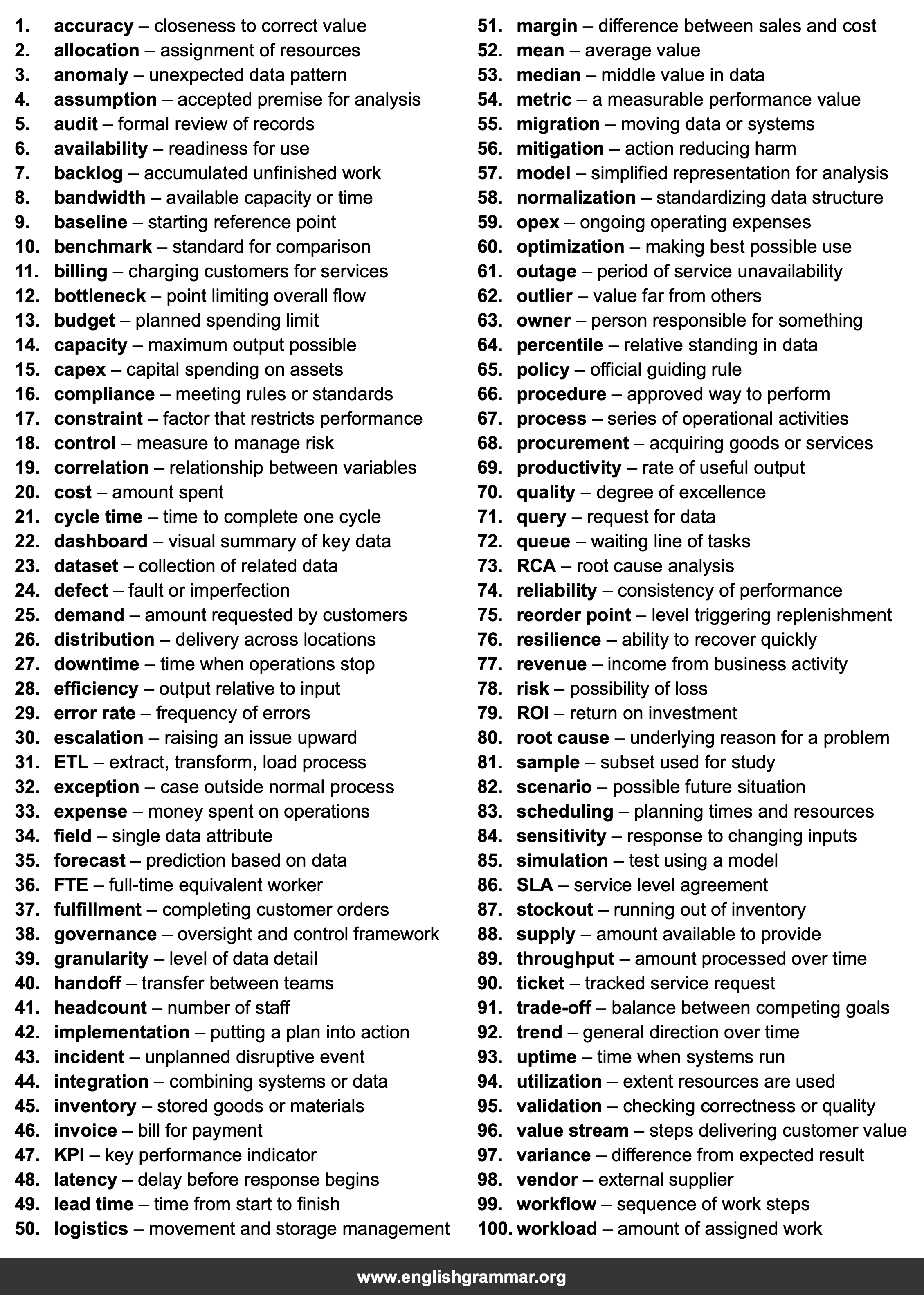
| No. | Item | Definition |
|---|---|---|
| 1. | accuracy | closeness to correct value |
| 2. | allocation | assignment of resources |
| 3. | anomaly | unexpected data pattern |
| 4. | assumption | accepted premise for analysis |
| 5. | audit | formal review of records |
| 6. | availability | readiness for use |
| 7. | backlog | accumulated unfinished work |
| 8. | bandwidth | available capacity or time |
| 9. | baseline | starting reference point |
| 10. | benchmark | standard for comparison |
| 11. | billing | charging customers for services |
| 12. | bottleneck | point limiting overall flow |
| 13. | budget | planned spending limit |
| 14. | capacity | maximum output possible |
| 15. | capex | capital spending on assets |
| 16. | compliance | meeting rules or standards |
| 17. | constraint | factor that restricts performance |
| 18. | control | measure to manage risk |
| 19. | correlation | relationship between variables |
| 20. | cost | amount spent |
| 21. | cycle time | time to complete one cycle |
| 22. | dashboard | visual summary of key data |
| 23. | dataset | collection of related data |
| 24. | defect | fault or imperfection |
| 25. | demand | amount requested by customers |
| 26. | distribution | delivery across locations |
| 27. | downtime | time when operations stop |
| 28. | efficiency | output relative to input |
| 29. | error rate | frequency of errors |
| 30. | escalation | raising an issue upward |
| 31. | ETL | extract, transform, load process |
| 32. | exception | case outside normal process |
| 33. | expense | money spent on operations |
| 34. | field | single data attribute |
| 35. | forecast | prediction based on data |
| 36. | FTE | full-time equivalent worker |
| 37. | fulfillment | completing customer orders |
| 38. | governance | oversight and control framework |
| 39. | granularity | level of data detail |
| 40. | handoff | transfer between teams |
| 41. | headcount | number of staff |
| 42. | implementation | putting a plan into action |
| 43. | incident | unplanned disruptive event |
| 44. | integration | combining systems or data |
| 45. | inventory | stored goods or materials |
| 46. | invoice | bill for payment |
| 47. | KPI | key performance indicator |
| 48. | latency | delay before response begins |
| 49. | lead time | time from start to finish |
| 50. | logistics | movement and storage management |
| 51. | margin | difference between sales and cost |
| 52. | mean | average value |
| 53. | median | middle value in data |
| 54. | metric | a measurable performance value |
| 55. | migration | moving data or systems |
| 56. | mitigation | action reducing harm |
| 57. | model | simplified representation for analysis |
| 58. | normalization | standardizing data structure |
| 59. | opex | ongoing operating expenses |
| 60. | optimization | making best possible use |
| 61. | outage | period of service unavailability |
| 62. | outlier | value far from others |
| 63. | owner | person responsible for something |
| 64. | percentile | relative standing in data |
| 65. | policy | official guiding rule |
| 66. | procedure | approved way to perform |
| 67. | process | series of operational activities |
| 68. | procurement | acquiring goods or services |
| 69. | productivity | rate of useful output |
| 70. | quality | degree of excellence |
| 71. | query | request for data |
| 72. | queue | waiting line of tasks |
| 73. | RCA | root cause analysis |
| 74. | reliability | consistency of performance |
| 75. | reorder point | level triggering replenishment |
| 76. | resilience | ability to recover quickly |
| 77. | revenue | income from business activity |
| 78. | risk | possibility of loss |
| 79. | ROI | return on investment |
| 80. | root cause | underlying reason for a problem |
| 81. | sample | subset used for study |
| 82. | scenario | possible future situation |
| 83. | scheduling | planning times and resources |
| 84. | sensitivity | response to changing inputs |
| 85. | simulation | test using a model |
| 86. | SLA | service level agreement |
| 87. | stockout | running out of inventory |
| 88. | supply | amount available to provide |
| 89. | throughput | amount processed over time |
| 90. | ticket | tracked service request |
| 91. | trade-off | balance between competing goals |
| 92. | trend | general direction over time |
| 93. | uptime | time when systems run |
| 94. | utilization | extent resources are used |
| 95. | validation | checking correctness or quality |
| 96. | value stream | steps delivering customer value |
| 97. | variance | difference from expected result |
| 98. | vendor | external supplier |
| 99. | workflow | sequence of work steps |
| 100. | workload | amount of assigned work |
