
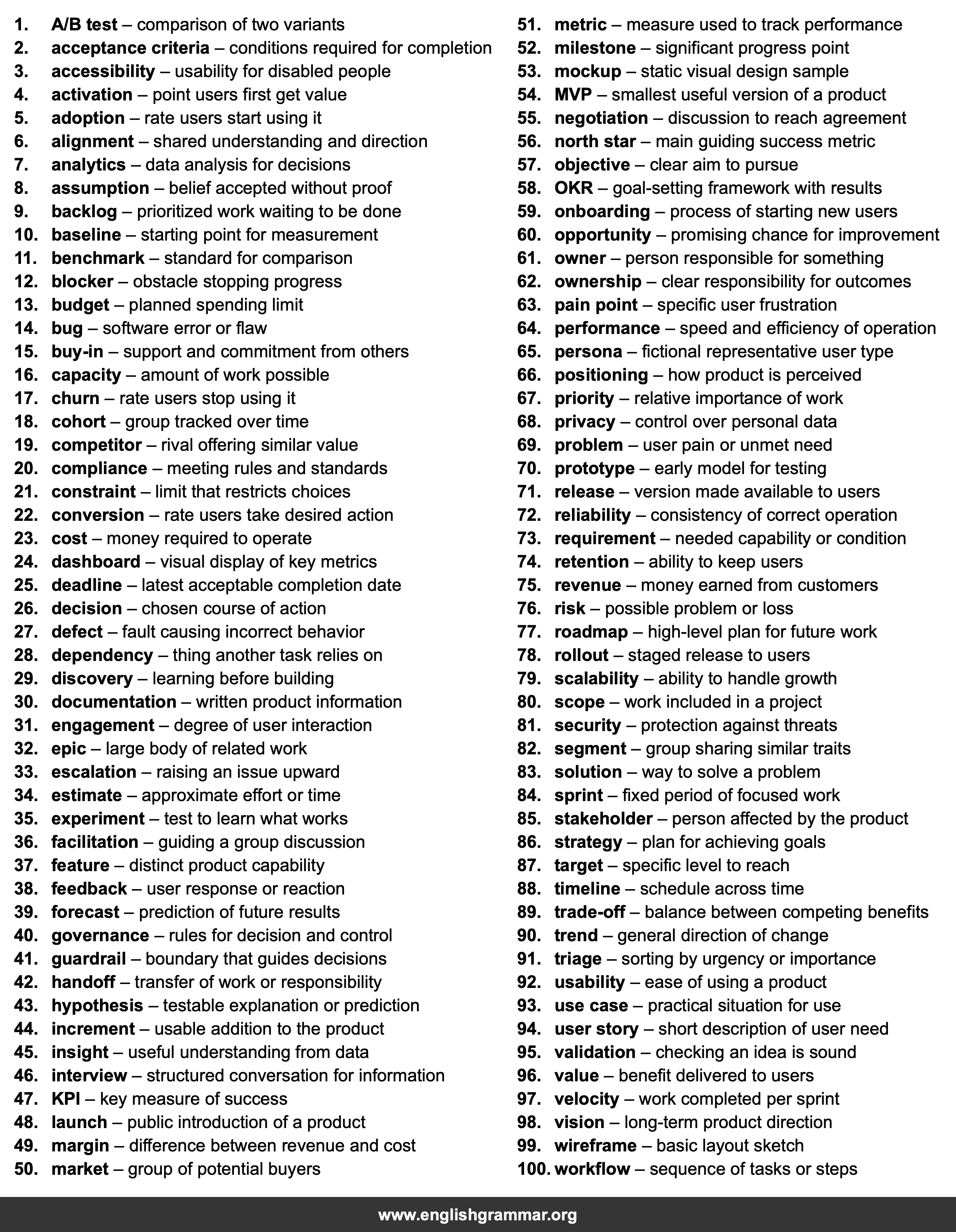
| No. | Item | Definition |
|---|---|---|
| 1. | A/B test | comparison of two variants |
| 2. | acceptance criteria | conditions required for completion |
| 3. | accessibility | usability for disabled people |
| 4. | activation | point users first get value |
| 5. | adoption | rate users start using it |
| 6. | alignment | shared understanding and direction |
| 7. | analytics | data analysis for decisions |
| 8. | assumption | belief accepted without proof |
| 9. | backlog | prioritized work waiting to be done |
| 10. | baseline | starting point for measurement |
| 11. | benchmark | standard for comparison |
| 12. | blocker | obstacle stopping progress |
| 13. | budget | planned spending limit |
| 14. | bug | software error or flaw |
| 15. | buy-in | support and commitment from others |
| 16. | capacity | amount of work possible |
| 17. | churn | rate users stop using it |
| 18. | cohort | group tracked over time |
| 19. | competitor | rival offering similar value |
| 20. | compliance | meeting rules and standards |
| 21. | constraint | limit that restricts choices |
| 22. | conversion | rate users take desired action |
| 23. | cost | money required to operate |
| 24. | dashboard | visual display of key metrics |
| 25. | deadline | latest acceptable completion date |
| 26. | decision | chosen course of action |
| 27. | defect | fault causing incorrect behavior |
| 28. | dependency | thing another task relies on |
| 29. | discovery | learning before building |
| 30. | documentation | written product information |
| 31. | engagement | degree of user interaction |
| 32. | epic | large body of related work |
| 33. | escalation | raising an issue upward |
| 34. | estimate | approximate effort or time |
| 35. | experiment | test to learn what works |
| 36. | facilitation | guiding a group discussion |
| 37. | feature | distinct product capability |
| 38. | feedback | user response or reaction |
| 39. | forecast | prediction of future results |
| 40. | governance | rules for decision and control |
| 41. | guardrail | boundary that guides decisions |
| 42. | handoff | transfer of work or responsibility |
| 43. | hypothesis | testable explanation or prediction |
| 44. | increment | usable addition to the product |
| 45. | insight | useful understanding from data |
| 46. | interview | structured conversation for information |
| 47. | KPI | key measure of success |
| 48. | launch | public introduction of a product |
| 49. | margin | difference between revenue and cost |
| 50. | market | group of potential buyers |
| 51. | metric | measure used to track performance |
| 52. | milestone | significant progress point |
| 53. | mockup | static visual design sample |
| 54. | MVP | smallest useful version of a product |
| 55. | negotiation | discussion to reach agreement |
| 56. | north star | main guiding success metric |
| 57. | objective | clear aim to pursue |
| 58. | OKR | goal-setting framework with results |
| 59. | onboarding | process of starting new users |
| 60. | opportunity | promising chance for improvement |
| 61. | owner | person responsible for something |
| 62. | ownership | clear responsibility for outcomes |
| 63. | pain point | specific user frustration |
| 64. | performance | speed and efficiency of operation |
| 65. | persona | fictional representative user type |
| 66. | positioning | how product is perceived |
| 67. | priority | relative importance of work |
| 68. | privacy | control over personal data |
| 69. | problem | user pain or unmet need |
| 70. | prototype | early model for testing |
| 71. | release | version made available to users |
| 72. | reliability | consistency of correct operation |
| 73. | requirement | needed capability or condition |
| 74. | retention | ability to keep users |
| 75. | revenue | money earned from customers |
| 76. | risk | possible problem or loss |
| 77. | roadmap | high-level plan for future work |
| 78. | rollout | staged release to users |
| 79. | scalability | ability to handle growth |
| 80. | scope | work included in a project |
| 81. | security | protection against threats |
| 82. | segment | group sharing similar traits |
| 83. | solution | way to solve a problem |
| 84. | sprint | fixed period of focused work |
| 85. | stakeholder | person affected by the product |
| 86. | strategy | plan for achieving goals |
| 87. | target | specific level to reach |
| 88. | timeline | schedule across time |
| 89. | trade-off | balance between competing benefits |
| 90. | trend | general direction of change |
| 91. | triage | sorting by urgency or importance |
| 92. | usability | ease of using a product |
| 93. | use case | practical situation for use |
| 94. | user story | short description of user need |
| 95. | validation | checking an idea is sound |
| 96. | value | benefit delivered to users |
| 97. | velocity | work completed per sprint |
| 98. | vision | long-term product direction |
| 99. | wireframe | basic layout sketch |
| 100. | workflow | sequence of tasks or steps |