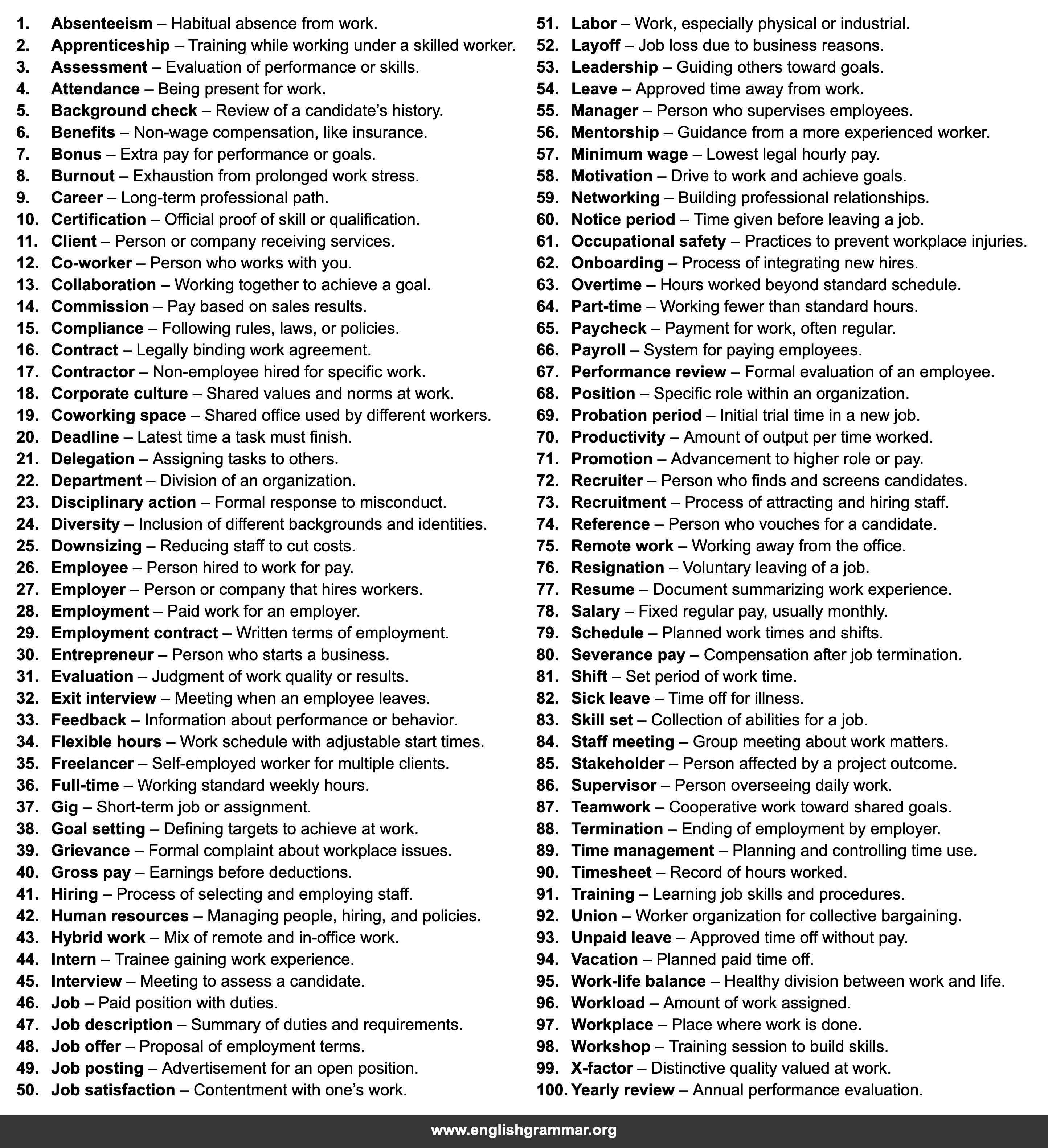
| No. | Term | Definition |
|---|---|---|
| 1. | Absenteeism | Habitual absence from work. |
| 2. | Apprenticeship | Training while working under a skilled worker. |
| 3. | Assessment | Evaluation of performance or skills. |
| 4. | Attendance | Being present for work. |
| 5. | Background check | Review of a candidate’s history. |
| 6. | Benefits | Non-wage compensation, like insurance. |
| 7. | Bonus | Extra pay for performance or goals. |
| 8. | Burnout | Exhaustion from prolonged work stress. |
| 9. | Career | Long-term professional path. |
| 10. | Certification | Official proof of skill or qualification. |
| 11. | Client | Person or company receiving services. |
| 12. | Co-worker | Person who works with you. |
| 13. | Collaboration | Working together to achieve a goal. |
| 14. | Commission | Pay based on sales results. |
| 15. | Compliance | Following rules, laws, or policies. |
| 16. | Contract | Legally binding work agreement. |
| 17. | Contractor | Non-employee hired for specific work. |
| 18. | Corporate culture | Shared values and norms at work. |
| 19. | Coworking space | Shared office used by different workers. |
| 20. | Deadline | Latest time a task must finish. |
| 21. | Delegation | Assigning tasks to others. |
| 22. | Department | Division of an organization. |
| 23. | Disciplinary action | Formal response to misconduct. |
| 24. | Diversity | Inclusion of different backgrounds and identities. |
| 25. | Downsizing | Reducing staff to cut costs. |
| 26. | Employee | Person hired to work for pay. |
| 27. | Employer | Person or company that hires workers. |
| 28. | Employment | Paid work for an employer. |
| 29. | Employment contract | Written terms of employment. |
| 30. | Entrepreneur | Person who starts a business. |
| 31. | Evaluation | Judgment of work quality or results. |
| 32. | Exit interview | Meeting when an employee leaves. |
| 33. | Feedback | Information about performance or behavior. |
| 34. | Flexible hours | Work schedule with adjustable start times. |
| 35. | Freelancer | Self-employed worker for multiple clients. |
| 36. | Full-time | Working standard weekly hours. |
| 37. | Gig | Short-term job or assignment. |
| 38. | Goal setting | Defining targets to achieve at work. |
| 39. | Grievance | Formal complaint about workplace issues. |
| 40. | Gross pay | Earnings before deductions. |
| 41. | Hiring | Process of selecting and employing staff. |
| 42. | Human resources | Managing people, hiring, and policies. |
| 43. | Hybrid work | Mix of remote and in-office work. |
| 44. | Intern | Trainee gaining work experience. |
| 45. | Interview | Meeting to assess a candidate. |
| 46. | Job | Paid position with duties. |
| 47. | Job description | Summary of duties and requirements. |
| 48. | Job offer | Proposal of employment terms. |
| 49. | Job posting | Advertisement for an open position. |
| 50. | Job satisfaction | Contentment with one’s work. |
| 51. | Labor | Work, especially physical or industrial. |
| 52. | Layoff | Job loss due to business reasons. |
| 53. | Leadership | Guiding others toward goals. |
| 54. | Leave | Approved time away from work. |
| 55. | Manager | Person who supervises employees. |
| 56. | Mentorship | Guidance from a more experienced worker. |
| 57. | Minimum wage | Lowest legal hourly pay. |
| 58. | Motivation | Drive to work and achieve goals. |
| 59. | Networking | Building professional relationships. |
| 60. | Notice period | Time given before leaving a job. |
| 61. | Occupational safety | Practices to prevent workplace injuries. |
| 62. | Onboarding | Process of integrating new hires. |
| 63. | Overtime | Hours worked beyond standard schedule. |
| 64. | Part-time | Working fewer than standard hours. |
| 65. | Paycheck | Payment for work, often regular. |
| 66. | Payroll | System for paying employees. |
| 67. | Performance review | Formal evaluation of an employee. |
| 68. | Position | Specific role within an organization. |
| 69. | Probation period | Initial trial time in a new job. |
| 70. | Productivity | Amount of output per time worked. |
| 71. | Promotion | Advancement to higher role or pay. |
| 72. | Recruiter | Person who finds and screens candidates. |
| 73. | Recruitment | Process of attracting and hiring staff. |
| 74. | Reference | Person who vouches for a candidate. |
| 75. | Remote work | Working away from the office. |
| 76. | Resignation | Voluntary leaving of a job. |
| 77. | Resume | Document summarizing work experience. |
| 78. | Salary | Fixed regular pay, usually monthly. |
| 79. | Schedule | Planned work times and shifts. |
| 80. | Severance pay | Compensation after job termination. |
| 81. | Shift | Set period of work time. |
| 82. | Sick leave | Time off for illness. |
| 83. | Skill set | Collection of abilities for a job. |
| 84. | Staff meeting | Group meeting about work matters. |
| 85. | Stakeholder | Person affected by a project outcome. |
| 86. | Supervisor | Person overseeing daily work. |
| 87. | Teamwork | Cooperative work toward shared goals. |
| 88. | Termination | Ending of employment by employer. |
| 89. | Time management | Planning and controlling time use. |
| 90. | Timesheet | Record of hours worked. |
| 91. | Training | Learning job skills and procedures. |
| 92. | Union | Worker organization for collective bargaining. |
| 93. | Unpaid leave | Approved time off without pay. |
| 94. | Vacation | Planned paid time off. |
| 95. | Work-life balance | Healthy division between work and life. |
| 96. | Workload | Amount of work assigned. |
| 97. | Workplace | Place where work is done. |
| 98. | Workshop | Training session to build skills. |
| 99. | X-factor | Distinctive quality valued at work. |
| 100. | Yearly review | Annual performance evaluation. |
