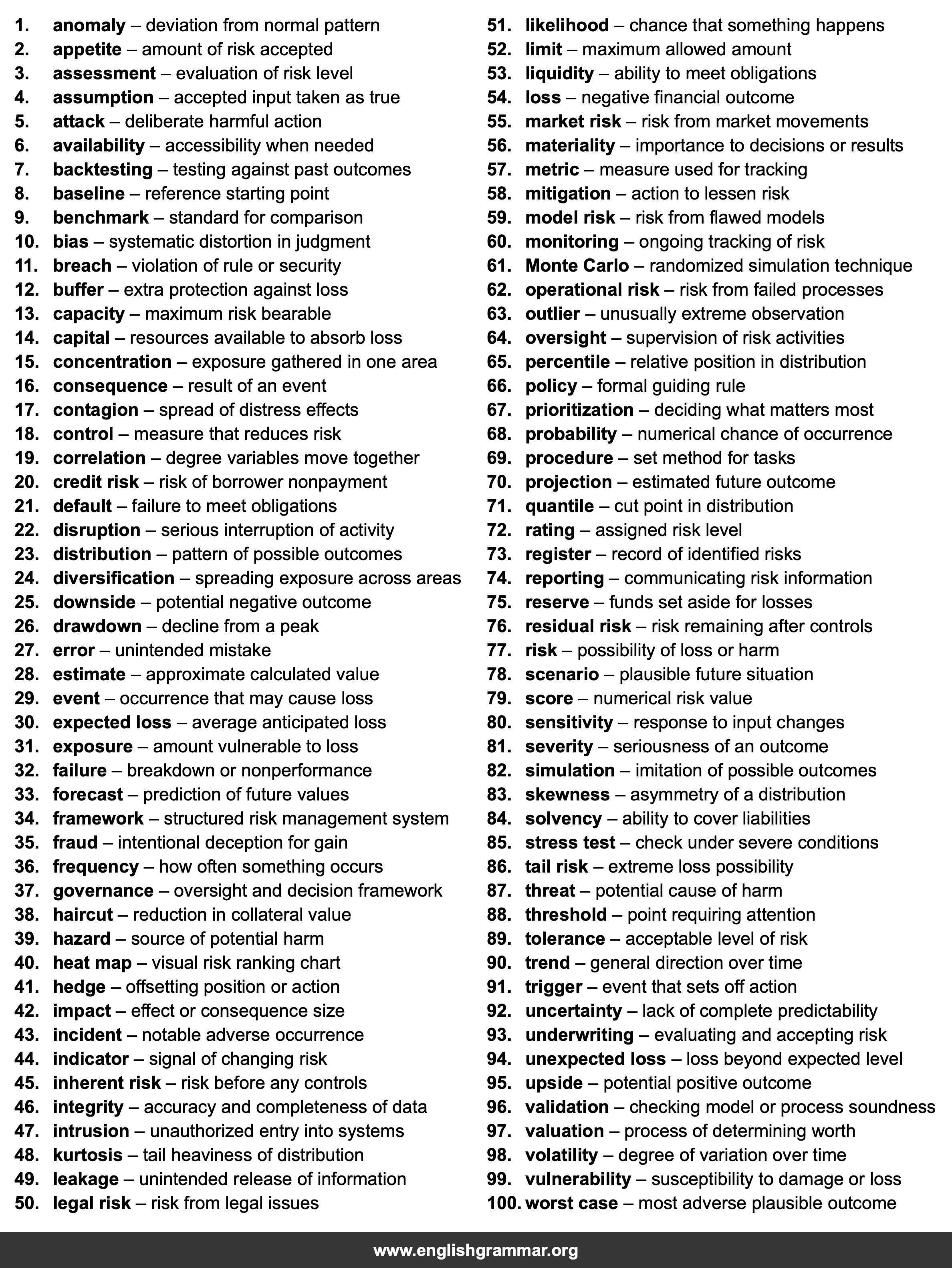
| No. | Item | Definition |
|---|---|---|
| 1. | anomaly | deviation from normal pattern |
| 2. | appetite | amount of risk accepted |
| 3. | assessment | evaluation of risk level |
| 4. | assumption | accepted input taken as true |
| 5. | attack | deliberate harmful action |
| 6. | availability | accessibility when needed |
| 7. | backtesting | testing against past outcomes |
| 8. | baseline | reference starting point |
| 9. | benchmark | standard for comparison |
| 10. | bias | systematic distortion in judgment |
| 11. | breach | violation of rule or security |
| 12. | buffer | extra protection against loss |
| 13. | capacity | maximum risk bearable |
| 14. | capital | resources available to absorb loss |
| 15. | concentration | exposure gathered in one area |
| 16. | consequence | result of an event |
| 17. | contagion | spread of distress effects |
| 18. | control | measure that reduces risk |
| 19. | correlation | degree variables move together |
| 20. | credit risk | risk of borrower nonpayment |
| 21. | default | failure to meet obligations |
| 22. | disruption | serious interruption of activity |
| 23. | distribution | pattern of possible outcomes |
| 24. | diversification | spreading exposure across areas |
| 25. | downside | potential negative outcome |
| 26. | drawdown | decline from a peak |
| 27. | error | unintended mistake |
| 28. | estimate | approximate calculated value |
| 29. | event | occurrence that may cause loss |
| 30. | expected loss | average anticipated loss |
| 31. | exposure | amount vulnerable to loss |
| 32. | failure | breakdown or nonperformance |
| 33. | forecast | prediction of future values |
| 34. | framework | structured risk management system |
| 35. | fraud | intentional deception for gain |
| 36. | frequency | how often something occurs |
| 37. | governance | oversight and decision framework |
| 38. | haircut | reduction in collateral value |
| 39. | hazard | source of potential harm |
| 40. | heat map | visual risk ranking chart |
| 41. | hedge | offsetting position or action |
| 42. | impact | effect or consequence size |
| 43. | incident | notable adverse occurrence |
| 44. | indicator | signal of changing risk |
| 45. | inherent risk | risk before any controls |
| 46. | integrity | accuracy and completeness of data |
| 47. | intrusion | unauthorized entry into systems |
| 48. | kurtosis | tail heaviness of distribution |
| 49. | leakage | unintended release of information |
| 50. | legal risk | risk from legal issues |
| 51. | likelihood | chance that something happens |
| 52. | limit | maximum allowed amount |
| 53. | liquidity | ability to meet obligations |
| 54. | loss | negative financial outcome |
| 55. | market risk | risk from market movements |
| 56. | materiality | importance to decisions or results |
| 57. | metric | measure used for tracking |
| 58. | mitigation | action to lessen risk |
| 59. | model risk | risk from flawed models |
| 60. | monitoring | ongoing tracking of risk |
| 61. | Monte Carlo | randomized simulation technique |
| 62. | operational risk | risk from failed processes |
| 63. | outlier | unusually extreme observation |
| 64. | oversight | supervision of risk activities |
| 65. | percentile | relative position in distribution |
| 66. | policy | formal guiding rule |
| 67. | prioritization | deciding what matters most |
| 68. | probability | numerical chance of occurrence |
| 69. | procedure | set method for tasks |
| 70. | projection | estimated future outcome |
| 71. | quantile | cut point in distribution |
| 72. | rating | assigned risk level |
| 73. | register | record of identified risks |
| 74. | reporting | communicating risk information |
| 75. | reserve | funds set aside for losses |
| 76. | residual risk | risk remaining after controls |
| 77. | risk | possibility of loss or harm |
| 78. | scenario | plausible future situation |
| 79. | score | numerical risk value |
| 80. | sensitivity | response to input changes |
| 81. | severity | seriousness of an outcome |
| 82. | simulation | imitation of possible outcomes |
| 83. | skewness | asymmetry of a distribution |
| 84. | solvency | ability to cover liabilities |
| 85. | stress test | check under severe conditions |
| 86. | tail risk | extreme loss possibility |
| 87. | threat | potential cause of harm |
| 88. | threshold | point requiring attention |
| 89. | tolerance | acceptable level of risk |
| 90. | trend | general direction over time |
| 91. | trigger | event that sets off action |
| 92. | uncertainty | lack of complete predictability |
| 93. | underwriting | evaluating and accepting risk |
| 94. | unexpected loss | loss beyond expected level |
| 95. | upside | potential positive outcome |
| 96. | validation | checking model or process soundness |
| 97. | valuation | process of determining worth |
| 98. | volatility | degree of variation over time |
| 99. | vulnerability | susceptibility to damage or loss |
| 100. | worst case | most adverse plausible outcome |
