
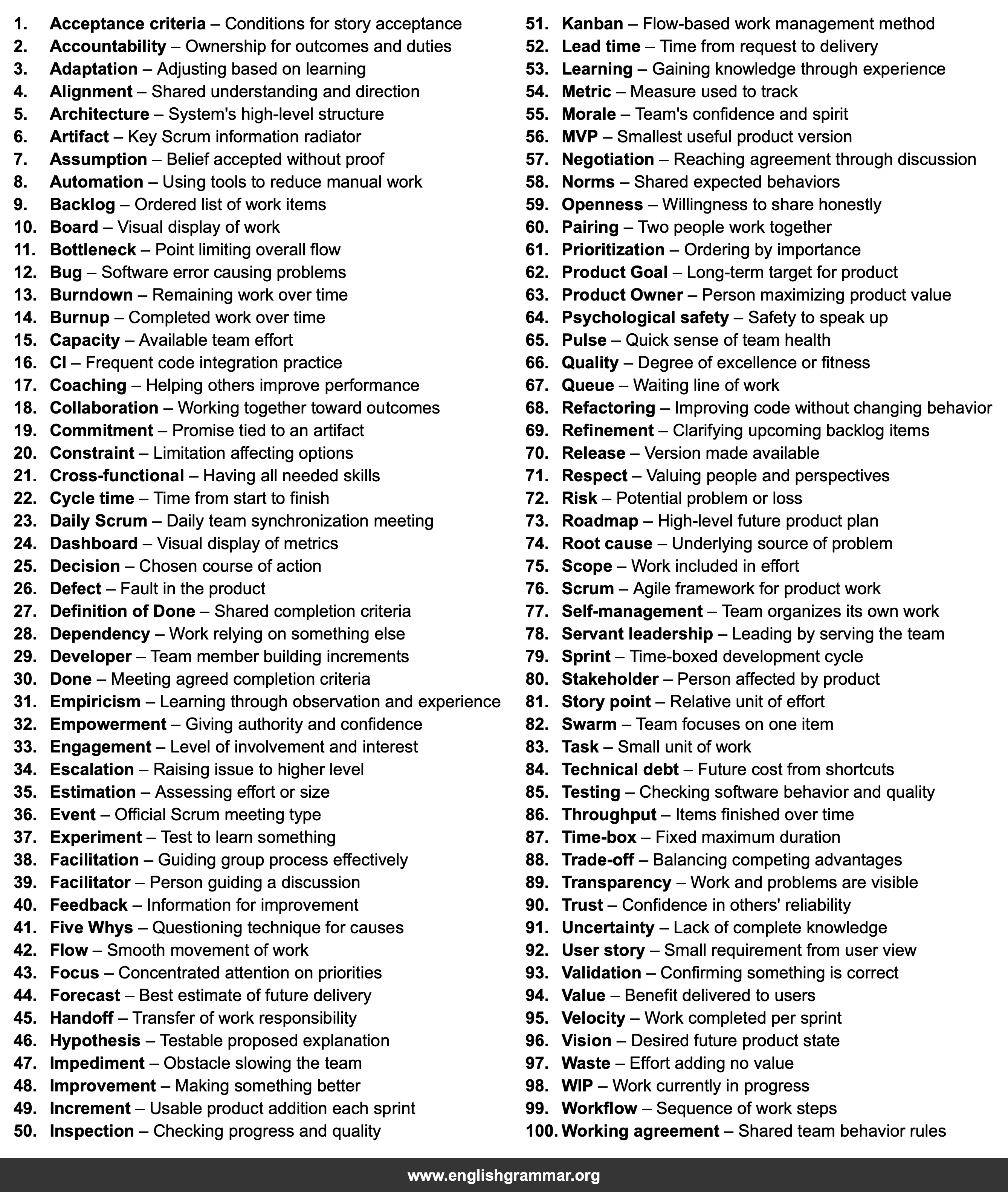
| No. | Item | Definition |
|---|---|---|
| 1. | Acceptance criteria | Conditions for story acceptance |
| 2. | Accountability | Ownership for outcomes and duties |
| 3. | Adaptation | Adjusting based on learning |
| 4. | Alignment | Shared understanding and direction |
| 5. | Architecture | System’s high-level structure |
| 6. | Artifact | Key Scrum information radiator |
| 7. | Assumption | Belief accepted without proof |
| 8. | Automation | Using tools to reduce manual work |
| 9. | Backlog | Ordered list of work items |
| 10. | Board | Visual display of work |
| 11. | Bottleneck | Point limiting overall flow |
| 12. | Bug | Software error causing problems |
| 13. | Burndown | Remaining work over time |
| 14. | Burnup | Completed work over time |
| 15. | Capacity | Available team effort |
| 16. | CI | Frequent code integration practice |
| 17. | Coaching | Helping others improve performance |
| 18. | Collaboration | Working together toward outcomes |
| 19. | Commitment | Promise tied to an artifact |
| 20. | Constraint | Limitation affecting options |
| 21. | Cross-functional | Having all needed skills |
| 22. | Cycle time | Time from start to finish |
| 23. | Daily Scrum | Daily team synchronization meeting |
| 24. | Dashboard | Visual display of metrics |
| 25. | Decision | Chosen course of action |
| 26. | Defect | Fault in the product |
| 27. | Definition of Done | Shared completion criteria |
| 28. | Dependency | Work relying on something else |
| 29. | Developer | Team member building increments |
| 30. | Done | Meeting agreed completion criteria |
| 31. | Empiricism | Learning through observation and experience |
| 32. | Empowerment | Giving authority and confidence |
| 33. | Engagement | Level of involvement and interest |
| 34. | Escalation | Raising issue to higher level |
| 35. | Estimation | Assessing effort or size |
| 36. | Event | Official Scrum meeting type |
| 37. | Experiment | Test to learn something |
| 38. | Facilitation | Guiding group process effectively |
| 39. | Facilitator | Person guiding a discussion |
| 40. | Feedback | Information for improvement |
| 41. | Five Whys | Questioning technique for causes |
| 42. | Flow | Smooth movement of work |
| 43. | Focus | Concentrated attention on priorities |
| 44. | Forecast | Best estimate of future delivery |
| 45. | Handoff | Transfer of work responsibility |
| 46. | Hypothesis | Testable proposed explanation |
| 47. | Impediment | Obstacle slowing the team |
| 48. | Improvement | Making something better |
| 49. | Increment | Usable product addition each sprint |
| 50. | Inspection | Checking progress and quality |
| 51. | Kanban | Flow-based work management method |
| 52. | Lead time | Time from request to delivery |
| 53. | Learning | Gaining knowledge through experience |
| 54. | Metric | Measure used to track |
| 55. | Morale | Team’s confidence and spirit |
| 56. | MVP | Smallest useful product version |
| 57. | Negotiation | Reaching agreement through discussion |
| 58. | Norms | Shared expected behaviors |
| 59. | Openness | Willingness to share honestly |
| 60. | Pairing | Two people work together |
| 61. | Prioritization | Ordering by importance |
| 62. | Product Goal | Long-term target for product |
| 63. | Product Owner | Person maximizing product value |
| 64. | Psychological safety | Safety to speak up |
| 65. | Pulse | Quick sense of team health |
| 66. | Quality | Degree of excellence or fitness |
| 67. | Queue | Waiting line of work |
| 68. | Refactoring | Improving code without changing behavior |
| 69. | Refinement | Clarifying upcoming backlog items |
| 70. | Release | Version made available |
| 71. | Respect | Valuing people and perspectives |
| 72. | Risk | Potential problem or loss |
| 73. | Roadmap | High-level future product plan |
| 74. | Root cause | Underlying source of problem |
| 75. | Scope | Work included in effort |
| 76. | Scrum | Agile framework for product work |
| 77. | Self-management | Team organizes its own work |
| 78. | Servant leadership | Leading by serving the team |
| 79. | Sprint | Time-boxed development cycle |
| 80. | Stakeholder | Person affected by product |
| 81. | Story point | Relative unit of effort |
| 82. | Swarm | Team focuses on one item |
| 83. | Task | Small unit of work |
| 84. | Technical debt | Future cost from shortcuts |
| 85. | Testing | Checking software behavior and quality |
| 86. | Throughput | Items finished over time |
| 87. | Time-box | Fixed maximum duration |
| 88. | Trade-off | Balancing competing advantages |
| 89. | Transparency | Work and problems are visible |
| 90. | Trust | Confidence in others’ reliability |
| 91. | Uncertainty | Lack of complete knowledge |
| 92. | User story | Small requirement from user view |
| 93. | Validation | Confirming something is correct |
| 94. | Value | Benefit delivered to users |
| 95. | Velocity | Work completed per sprint |
| 96. | Vision | Desired future product state |
| 97. | Waste | Effort adding no value |
| 98. | WIP | Work currently in progress |
| 99. | Workflow | Sequence of work steps |
| 100. | Working agreement | Shared team behavior rules |