
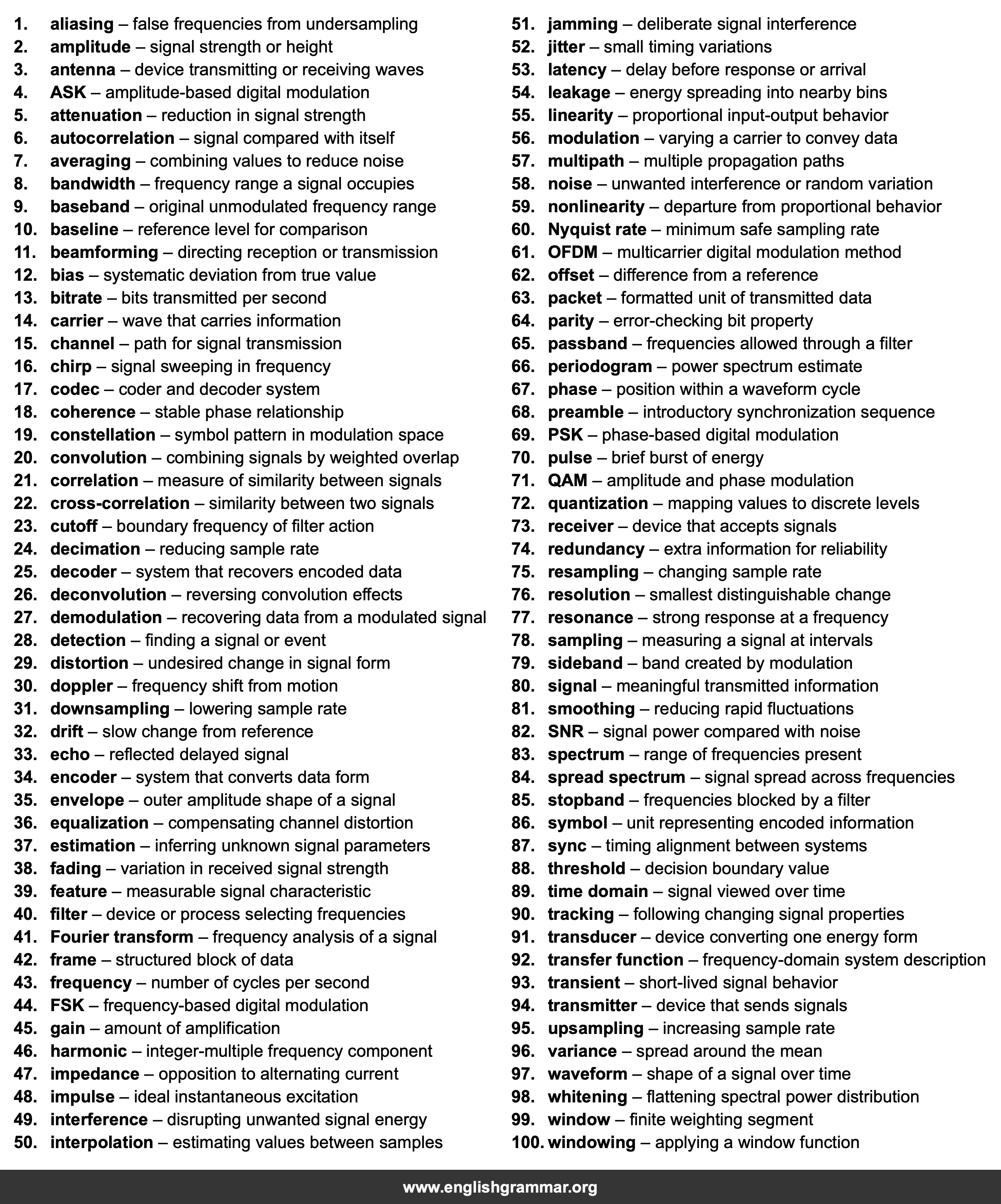
| No. | Item | Definition |
|---|---|---|
| 1. | aliasing | false frequencies from undersampling |
| 2. | amplitude | signal strength or height |
| 3. | antenna | device transmitting or receiving waves |
| 4. | ASK | amplitude-based digital modulation |
| 5. | attenuation | reduction in signal strength |
| 6. | autocorrelation | signal compared with itself |
| 7. | averaging | combining values to reduce noise |
| 8. | bandwidth | frequency range a signal occupies |
| 9. | baseband | original unmodulated frequency range |
| 10. | baseline | reference level for comparison |
| 11. | beamforming | directing reception or transmission |
| 12. | bias | systematic deviation from true value |
| 13. | bitrate | bits transmitted per second |
| 14. | carrier | wave that carries information |
| 15. | channel | path for signal transmission |
| 16. | chirp | signal sweeping in frequency |
| 17. | codec | coder and decoder system |
| 18. | coherence | stable phase relationship |
| 19. | constellation | symbol pattern in modulation space |
| 20. | convolution | combining signals by weighted overlap |
| 21. | correlation | measure of similarity between signals |
| 22. | cross-correlation | similarity between two signals |
| 23. | cutoff | boundary frequency of filter action |
| 24. | decimation | reducing sample rate |
| 25. | decoder | system that recovers encoded data |
| 26. | deconvolution | reversing convolution effects |
| 27. | demodulation | recovering data from a modulated signal |
| 28. | detection | finding a signal or event |
| 29. | distortion | undesired change in signal form |
| 30. | doppler | frequency shift from motion |
| 31. | downsampling | lowering sample rate |
| 32. | drift | slow change from reference |
| 33. | echo | reflected delayed signal |
| 34. | encoder | system that converts data form |
| 35. | envelope | outer amplitude shape of a signal |
| 36. | equalization | compensating channel distortion |
| 37. | estimation | inferring unknown signal parameters |
| 38. | fading | variation in received signal strength |
| 39. | feature | measurable signal characteristic |
| 40. | filter | device or process selecting frequencies |
| 41. | Fourier transform | frequency analysis of a signal |
| 42. | frame | structured block of data |
| 43. | frequency | number of cycles per second |
| 44. | FSK | frequency-based digital modulation |
| 45. | gain | amount of amplification |
| 46. | harmonic | integer-multiple frequency component |
| 47. | impedance | opposition to alternating current |
| 48. | impulse | ideal instantaneous excitation |
| 49. | interference | disrupting unwanted signal energy |
| 50. | interpolation | estimating values between samples |
| 51. | jamming | deliberate signal interference |
| 52. | jitter | small timing variations |
| 53. | latency | delay before response or arrival |
| 54. | leakage | energy spreading into nearby bins |
| 55. | linearity | proportional input-output behavior |
| 56. | modulation | varying a carrier to convey data |
| 57. | multipath | multiple propagation paths |
| 58. | noise | unwanted interference or random variation |
| 59. | nonlinearity | departure from proportional behavior |
| 60. | Nyquist rate | minimum safe sampling rate |
| 61. | OFDM | multicarrier digital modulation method |
| 62. | offset | difference from a reference |
| 63. | packet | formatted unit of transmitted data |
| 64. | parity | error-checking bit property |
| 65. | passband | frequencies allowed through a filter |
| 66. | periodogram | power spectrum estimate |
| 67. | phase | position within a waveform cycle |
| 68. | preamble | introductory synchronization sequence |
| 69. | PSK | phase-based digital modulation |
| 70. | pulse | brief burst of energy |
| 71. | QAM | amplitude and phase modulation |
| 72. | quantization | mapping values to discrete levels |
| 73. | receiver | device that accepts signals |
| 74. | redundancy | extra information for reliability |
| 75. | resampling | changing sample rate |
| 76. | resolution | smallest distinguishable change |
| 77. | resonance | strong response at a frequency |
| 78. | sampling | measuring a signal at intervals |
| 79. | sideband | band created by modulation |
| 80. | signal | meaningful transmitted information |
| 81. | smoothing | reducing rapid fluctuations |
| 82. | SNR | signal power compared with noise |
| 83. | spectrum | range of frequencies present |
| 84. | spread spectrum | signal spread across frequencies |
| 85. | stopband | frequencies blocked by a filter |
| 86. | symbol | unit representing encoded information |
| 87. | sync | timing alignment between systems |
| 88. | threshold | decision boundary value |
| 89. | time domain | signal viewed over time |
| 90. | tracking | following changing signal properties |
| 91. | transducer | device converting one energy form |
| 92. | transfer function | frequency-domain system description |
| 93. | transient | short-lived signal behavior |
| 94. | transmitter | device that sends signals |
| 95. | upsampling | increasing sample rate |
| 96. | variance | spread around the mean |
| 97. | waveform | shape of a signal over time |
| 98. | whitening | flattening spectral power distribution |
| 99. | window | finite weighting segment |
| 100. | windowing | applying a window function |