
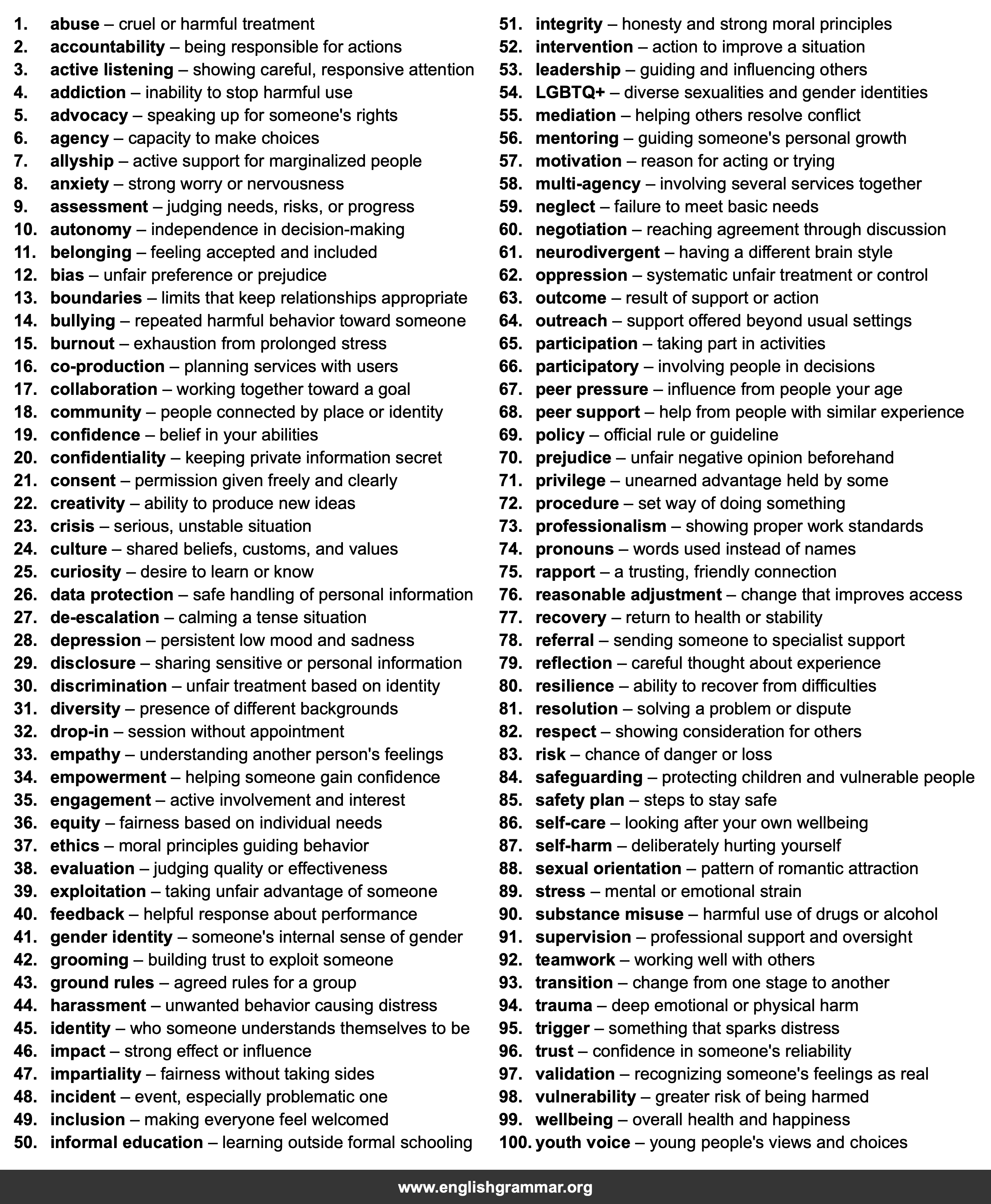
| No. | Item | Definition |
|---|---|---|
| 1. | abuse | cruel or harmful treatment |
| 2. | accountability | being responsible for actions |
| 3. | active listening | showing careful, responsive attention |
| 4. | addiction | inability to stop harmful use |
| 5. | advocacy | speaking up for someone’s rights |
| 6. | agency | capacity to make choices |
| 7. | allyship | active support for marginalized people |
| 8. | anxiety | strong worry or nervousness |
| 9. | assessment | judging needs, risks, or progress |
| 10. | autonomy | independence in decision-making |
| 11. | belonging | feeling accepted and included |
| 12. | bias | unfair preference or prejudice |
| 13. | boundaries | limits that keep relationships appropriate |
| 14. | bullying | repeated harmful behavior toward someone |
| 15. | burnout | exhaustion from prolonged stress |
| 16. | co-production | planning services with users |
| 17. | collaboration | working together toward a goal |
| 18. | community | people connected by place or identity |
| 19. | confidence | belief in your abilities |
| 20. | confidentiality | keeping private information secret |
| 21. | consent | permission given freely and clearly |
| 22. | creativity | ability to produce new ideas |
| 23. | crisis | serious, unstable situation |
| 24. | culture | shared beliefs, customs, and values |
| 25. | curiosity | desire to learn or know |
| 26. | data protection | safe handling of personal information |
| 27. | de-escalation | calming a tense situation |
| 28. | depression | persistent low mood and sadness |
| 29. | disclosure | sharing sensitive or personal information |
| 30. | discrimination | unfair treatment based on identity |
| 31. | diversity | presence of different backgrounds |
| 32. | drop-in | session without appointment |
| 33. | empathy | understanding another person’s feelings |
| 34. | empowerment | helping someone gain confidence |
| 35. | engagement | active involvement and interest |
| 36. | equity | fairness based on individual needs |
| 37. | ethics | moral principles guiding behavior |
| 38. | evaluation | judging quality or effectiveness |
| 39. | exploitation | taking unfair advantage of someone |
| 40. | feedback | helpful response about performance |
| 41. | gender identity | someone’s internal sense of gender |
| 42. | grooming | building trust to exploit someone |
| 43. | ground rules | agreed rules for a group |
| 44. | harassment | unwanted behavior causing distress |
| 45. | identity | who someone understands themselves to be |
| 46. | impact | strong effect or influence |
| 47. | impartiality | fairness without taking sides |
| 48. | incident | event, especially problematic one |
| 49. | inclusion | making everyone feel welcomed |
| 50. | informal education | learning outside formal schooling |
| 51. | integrity | honesty and strong moral principles |
| 52. | intervention | action to improve a situation |
| 53. | leadership | guiding and influencing others |
| 54. | LGBTQ+ | diverse sexualities and gender identities |
| 55. | mediation | helping others resolve conflict |
| 56. | mentoring | guiding someone’s personal growth |
| 57. | motivation | reason for acting or trying |
| 58. | multi-agency | involving several services together |
| 59. | neglect | failure to meet basic needs |
| 60. | negotiation | reaching agreement through discussion |
| 61. | neurodivergent | having a different brain style |
| 62. | oppression | systematic unfair treatment or control |
| 63. | outcome | result of support or action |
| 64. | outreach | support offered beyond usual settings |
| 65. | participation | taking part in activities |
| 66. | participatory | involving people in decisions |
| 67. | peer pressure | influence from people your age |
| 68. | peer support | help from people with similar experience |
| 69. | policy | official rule or guideline |
| 70. | prejudice | unfair negative opinion beforehand |
| 71. | privilege | unearned advantage held by some |
| 72. | procedure | set way of doing something |
| 73. | professionalism | showing proper work standards |
| 74. | pronouns | words used instead of names |
| 75. | rapport | a trusting, friendly connection |
| 76. | reasonable adjustment | change that improves access |
| 77. | recovery | return to health or stability |
| 78. | referral | sending someone to specialist support |
| 79. | reflection | careful thought about experience |
| 80. | resilience | ability to recover from difficulties |
| 81. | resolution | solving a problem or dispute |
| 82. | respect | showing consideration for others |
| 83. | risk | chance of danger or loss |
| 84. | safeguarding | protecting children and vulnerable people |
| 85. | safety plan | steps to stay safe |
| 86. | self-care | looking after your own wellbeing |
| 87. | self-harm | deliberately hurting yourself |
| 88. | sexual orientation | pattern of romantic attraction |
| 89. | stress | mental or emotional strain |
| 90. | substance misuse | harmful use of drugs or alcohol |
| 91. | supervision | professional support and oversight |
| 92. | teamwork | working well with others |
| 93. | transition | change from one stage to another |
| 94. | trauma | deep emotional or physical harm |
| 95. | trigger | something that sparks distress |
| 96. | trust | confidence in someone’s reliability |
| 97. | validation | recognizing someone’s feelings as real |
| 98. | vulnerability | greater risk of being harmed |
| 99. | wellbeing | overall health and happiness |
| 100. | youth voice | young people’s views and choices |