
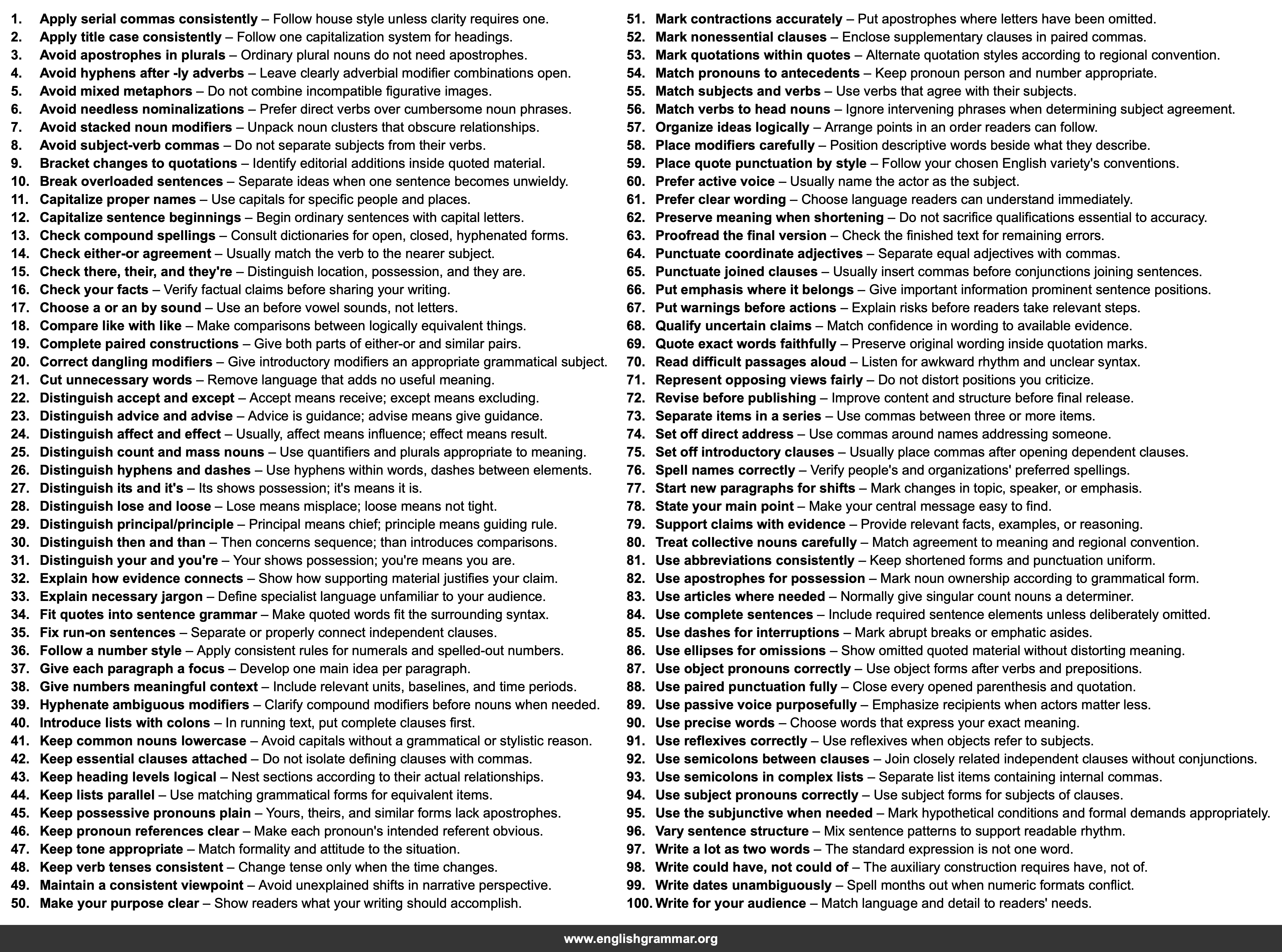
| No. | Item | Definition |
|---|---|---|
| 1. | Apply serial commas consistently | Follow house style unless clarity requires one. |
| 2. | Apply title case consistently | Follow one capitalization system for headings. |
| 3. | Avoid apostrophes in plurals | Ordinary plural nouns do not need apostrophes. |
| 4. | Avoid hyphens after -ly adverbs | Leave clearly adverbial modifier combinations open. |
| 5. | Avoid mixed metaphors | Do not combine incompatible figurative images. |
| 6. | Avoid needless nominalizations | Prefer direct verbs over cumbersome noun phrases. |
| 7. | Avoid stacked noun modifiers | Unpack noun clusters that obscure relationships. |
| 8. | Avoid subject-verb commas | Do not separate subjects from their verbs. |
| 9. | Bracket changes to quotations | Identify editorial additions inside quoted material. |
| 10. | Break overloaded sentences | Separate ideas when one sentence becomes unwieldy. |
| 11. | Capitalize proper names | Use capitals for specific people and places. |
| 12. | Capitalize sentence beginnings | Begin ordinary sentences with capital letters. |
| 13. | Check compound spellings | Consult dictionaries for open, closed, hyphenated forms. |
| 14. | Check either-or agreement | Usually match the verb to the nearer subject. |
| 15. | Check there, their, and they’re | Distinguish location, possession, and they are. |
| 16. | Check your facts | Verify factual claims before sharing your writing. |
| 17. | Choose a or an by sound | Use an before vowel sounds, not letters. |
| 18. | Compare like with like | Make comparisons between logically equivalent things. |
| 19. | Complete paired constructions | Give both parts of either-or and similar pairs. |
| 20. | Correct dangling modifiers | Give introductory modifiers an appropriate grammatical subject. |
| 21. | Cut unnecessary words | Remove language that adds no useful meaning. |
| 22. | Distinguish accept and except | Accept means receive; except means excluding. |
| 23. | Distinguish advice and advise | Advice is guidance; advise means give guidance. |
| 24. | Distinguish affect and effect | Usually, affect means influence; effect means result. |
| 25. | Distinguish count and mass nouns | Use quantifiers and plurals appropriate to meaning. |
| 26. | Distinguish hyphens and dashes | Use hyphens within words, dashes between elements. |
| 27. | Distinguish its and it’s | Its shows possession; it’s means it is. |
| 28. | Distinguish lose and loose | Lose means misplace; loose means not tight. |
| 29. | Distinguish principal/principle | Principal means chief; principle means guiding rule. |
| 30. | Distinguish then and than | Then concerns sequence; than introduces comparisons. |
| 31. | Distinguish your and you’re | Your shows possession; you’re means you are. |
| 32. | Explain how evidence connects | Show how supporting material justifies your claim. |
| 33. | Explain necessary jargon | Define specialist language unfamiliar to your audience. |
| 34. | Fit quotes into sentence grammar | Make quoted words fit the surrounding syntax. |
| 35. | Fix run-on sentences | Separate or properly connect independent clauses. |
| 36. | Follow a number style | Apply consistent rules for numerals and spelled-out numbers. |
| 37. | Give each paragraph a focus | Develop one main idea per paragraph. |
| 38. | Give numbers meaningful context | Include relevant units, baselines, and time periods. |
| 39. | Hyphenate ambiguous modifiers | Clarify compound modifiers before nouns when needed. |
| 40. | Introduce lists with colons | In running text, put complete clauses first. |
| 41. | Keep common nouns lowercase | Avoid capitals without a grammatical or stylistic reason. |
| 42. | Keep essential clauses attached | Do not isolate defining clauses with commas. |
| 43. | Keep heading levels logical | Nest sections according to their actual relationships. |
| 44. | Keep lists parallel | Use matching grammatical forms for equivalent items. |
| 45. | Keep possessive pronouns plain | Yours, theirs, and similar forms lack apostrophes. |
| 46. | Keep pronoun references clear | Make each pronoun’s intended referent obvious. |
| 47. | Keep tone appropriate | Match formality and attitude to the situation. |
| 48. | Keep verb tenses consistent | Change tense only when the time changes. |
| 49. | Maintain a consistent viewpoint | Avoid unexplained shifts in narrative perspective. |
| 50. | Make your purpose clear | Show readers what your writing should accomplish. |
| 51. | Mark contractions accurately | Put apostrophes where letters have been omitted. |
| 52. | Mark nonessential clauses | Enclose supplementary clauses in paired commas. |
| 53. | Mark quotations within quotes | Alternate quotation styles according to regional convention. |
| 54. | Match pronouns to antecedents | Keep pronoun person and number appropriate. |
| 55. | Match subjects and verbs | Use verbs that agree with their subjects. |
| 56. | Match verbs to head nouns | Ignore intervening phrases when determining subject agreement. |
| 57. | Organize ideas logically | Arrange points in an order readers can follow. |
| 58. | Place modifiers carefully | Position descriptive words beside what they describe. |
| 59. | Place quote punctuation by style | Follow your chosen English variety’s conventions. |
| 60. | Prefer active voice | Usually name the actor as the subject. |
| 61. | Prefer clear wording | Choose language readers can understand immediately. |
| 62. | Preserve meaning when shortening | Do not sacrifice qualifications essential to accuracy. |
| 63. | Proofread the final version | Check the finished text for remaining errors. |
| 64. | Punctuate coordinate adjectives | Separate equal adjectives with commas. |
| 65. | Punctuate joined clauses | Usually insert commas before conjunctions joining sentences. |
| 66. | Put emphasis where it belongs | Give important information prominent sentence positions. |
| 67. | Put warnings before actions | Explain risks before readers take relevant steps. |
| 68. | Qualify uncertain claims | Match confidence in wording to available evidence. |
| 69. | Quote exact words faithfully | Preserve original wording inside quotation marks. |
| 70. | Read difficult passages aloud | Listen for awkward rhythm and unclear syntax. |
| 71. | Represent opposing views fairly | Do not distort positions you criticize. |
| 72. | Revise before publishing | Improve content and structure before final release. |
| 73. | Separate items in a series | Use commas between three or more items. |
| 74. | Set off direct address | Use commas around names addressing someone. |
| 75. | Set off introductory clauses | Usually place commas after opening dependent clauses. |
| 76. | Spell names correctly | Verify people’s and organizations’ preferred spellings. |
| 77. | Start new paragraphs for shifts | Mark changes in topic, speaker, or emphasis. |
| 78. | State your main point | Make your central message easy to find. |
| 79. | Support claims with evidence | Provide relevant facts, examples, or reasoning. |
| 80. | Treat collective nouns carefully | Match agreement to meaning and regional convention. |
| 81. | Use abbreviations consistently | Keep shortened forms and punctuation uniform. |
| 82. | Use apostrophes for possession | Mark noun ownership according to grammatical form. |
| 83. | Use articles where needed | Normally give singular count nouns a determiner. |
| 84. | Use complete sentences | Include required sentence elements unless deliberately omitted. |
| 85. | Use dashes for interruptions | Mark abrupt breaks or emphatic asides. |
| 86. | Use ellipses for omissions | Show omitted quoted material without distorting meaning. |
| 87. | Use object pronouns correctly | Use object forms after verbs and prepositions. |
| 88. | Use paired punctuation fully | Close every opened parenthesis and quotation. |
| 89. | Use passive voice purposefully | Emphasize recipients when actors matter less. |
| 90. | Use precise words | Choose words that express your exact meaning. |
| 91. | Use reflexives correctly | Use reflexives when objects refer to subjects. |
| 92. | Use semicolons between clauses | Join closely related independent clauses without conjunctions. |
| 93. | Use semicolons in complex lists | Separate list items containing internal commas. |
| 94. | Use subject pronouns correctly | Use subject forms for subjects of clauses. |
| 95. | Use the subjunctive when needed | Mark hypothetical conditions and formal demands appropriately. |
| 96. | Vary sentence structure | Mix sentence patterns to support readable rhythm. |
| 97. | Write a lot as two words | The standard expression is not one word. |
| 98. | Write could have, not could of | The auxiliary construction requires have, not of. |
| 99. | Write dates unambiguously | Spell months out when numeric formats conflict. |
| 100. | Write for your audience | Match language and detail to readers’ needs. |